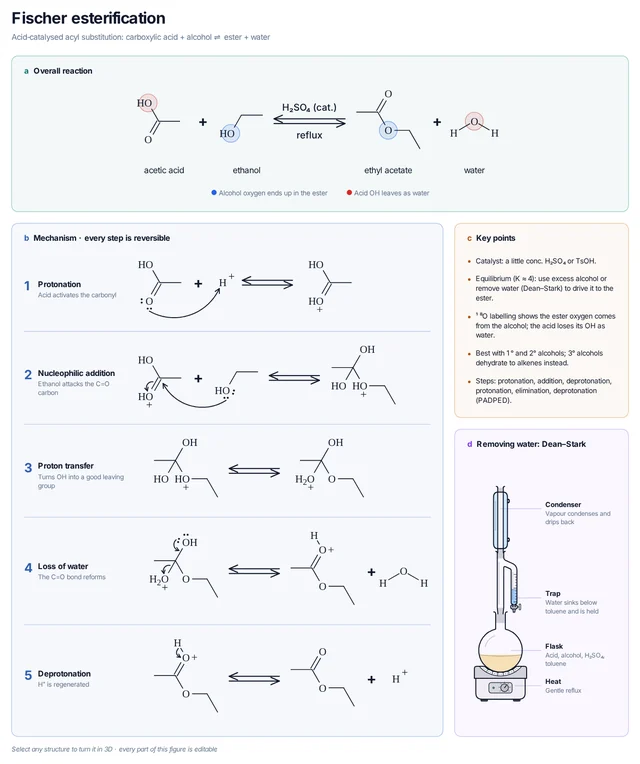
Fischer esterification
carboxylic acid + alcohol → ester
An acid and an alcohol give an ester and water under acid catalysis.
MolDraw › Chemistry tools › Name Reaction Finder
In short: Pick the group you start from and the group you want, or type a reagent. You get the matching named reactions, each with its full curly-arrow mechanism that opens in MolDraw. 47 reactions are included.
Useful for organic synthesis problems, conversion questions in JEE and NEET, and revision: every card shows the reagents, the exam level and links to a step-by-step mechanism.
47 reactions
carboxylic acid + alcohol → ester
An acid and an alcohol give an ester and water under acid catalysis.
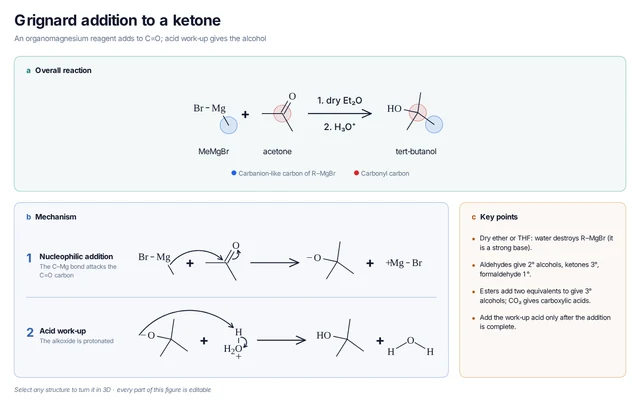
ketone + aldehyde + alkyl halide → alcohol
An organomagnesium reagent adds to C=O; acid work-up gives the alcohol.
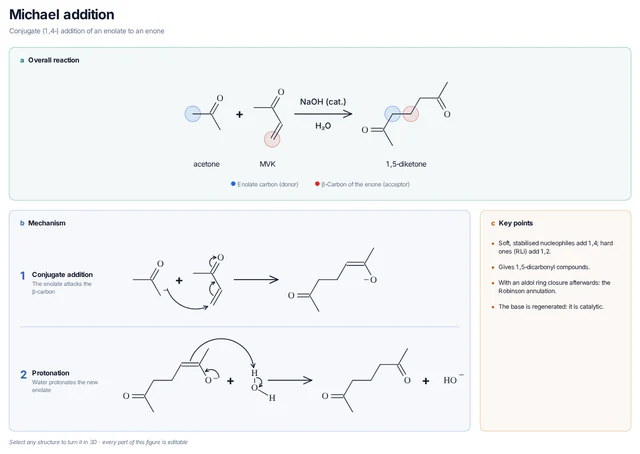
α,β-unsaturated carbonyl + ketone + ester → 1,5-dicarbonyl
Conjugate (1,4-) addition of an enolate to an enone.
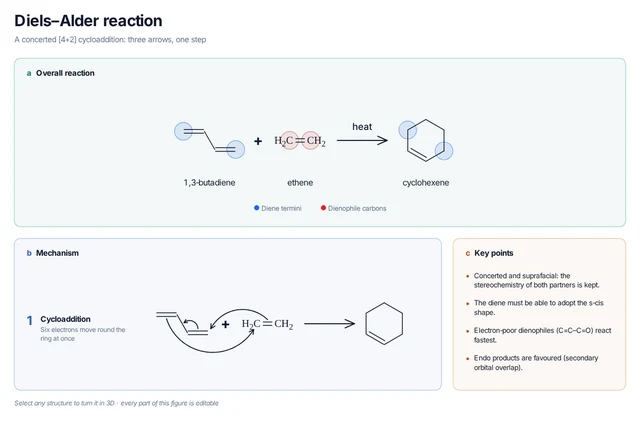
alkene → alkene
A concerted [4+2] cycloaddition: three arrows, one step.
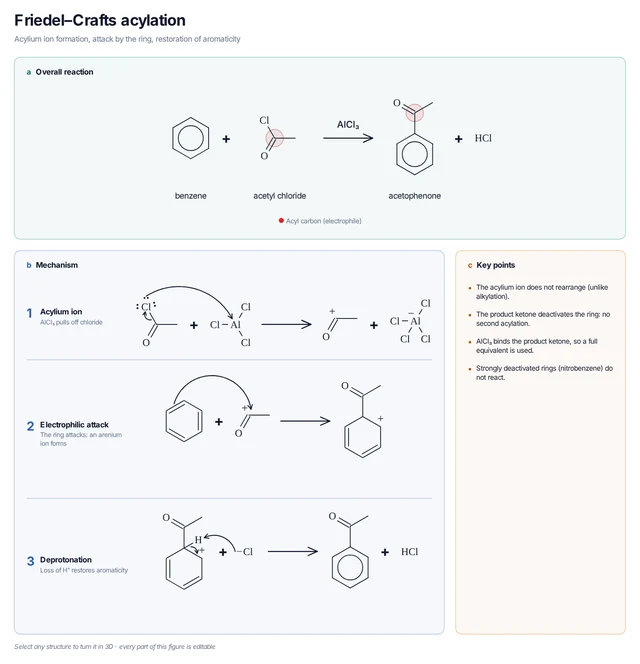
arene + acid chloride → ketone
Acylium ion formation, attack by the ring, restoration of aromaticity.
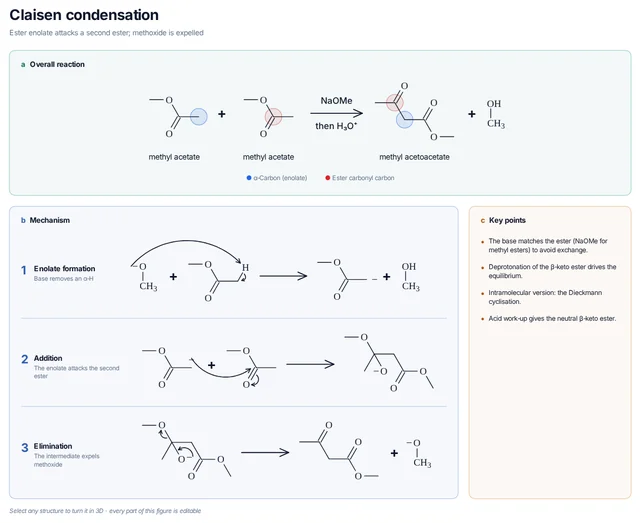
ester → β-keto ester
Ester enolate attacks a second ester; methoxide is expelled.
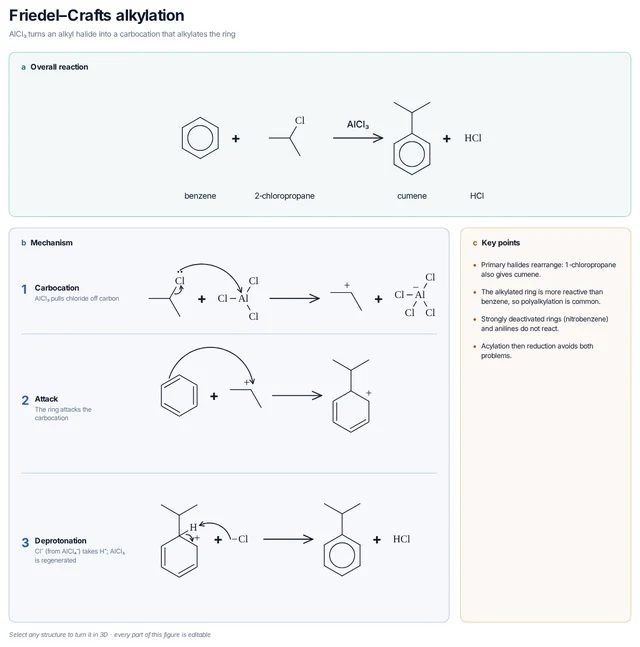
arene + alkyl halide → arene
AlCl₃ turns an alkyl halide into a carbocation that alkylates the ring.
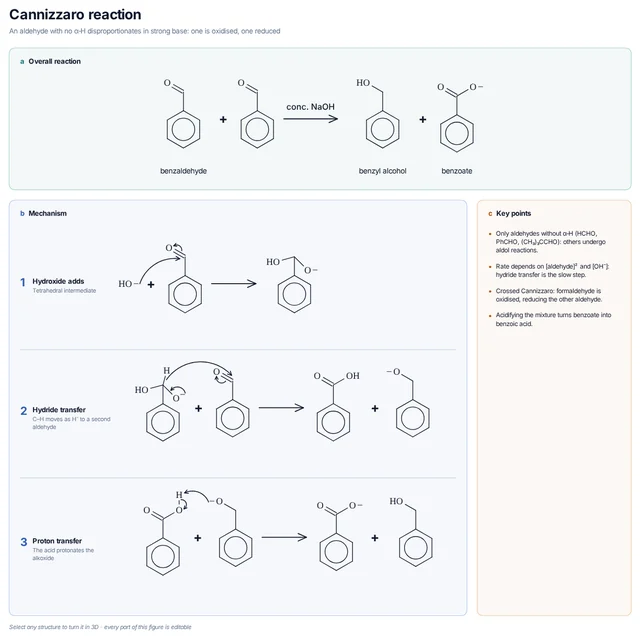
aldehyde → alcohol + carboxylic acid
An aldehyde with no α-H disproportionates in strong base: one is oxidised, one reduced.
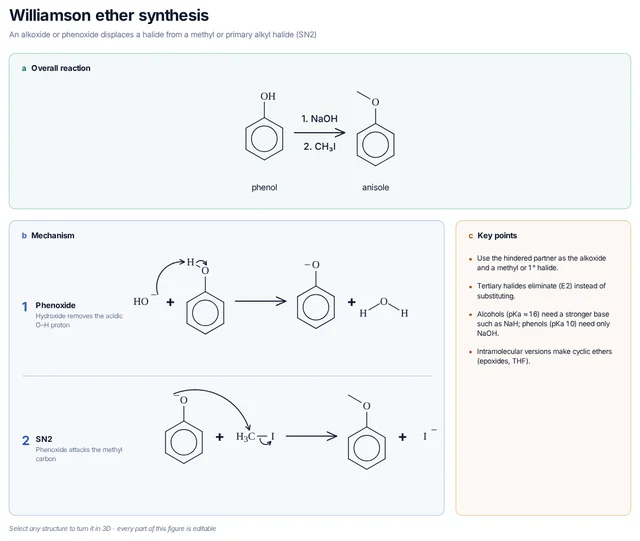
alcohol + phenol + alkyl halide → ether
An alkoxide or phenoxide displaces a halide from a methyl or primary alkyl halide (SN2).
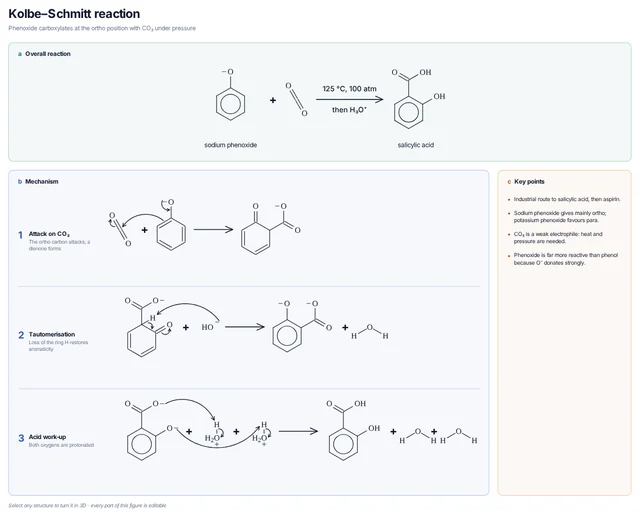
phenol → carboxylic acid
Phenoxide carboxylates at the ortho position with CO₂ under pressure.
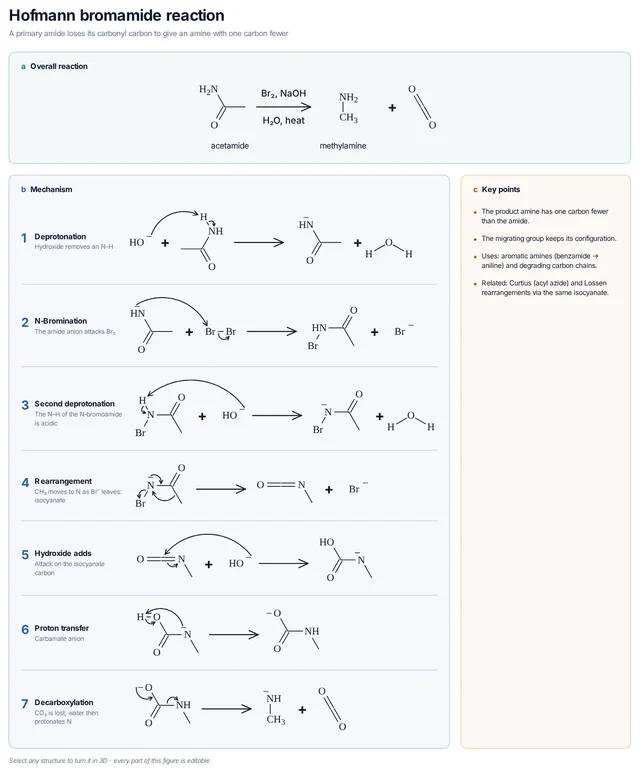
amide → amine
A primary amide loses its carbonyl carbon to give an amine with one carbon fewer.
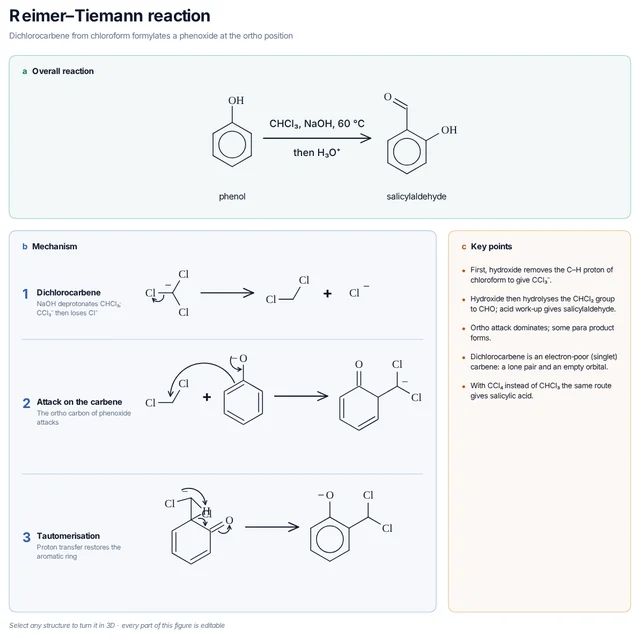
phenol → aldehyde
Dichlorocarbene from chloroform formylates a phenoxide at the ortho position.
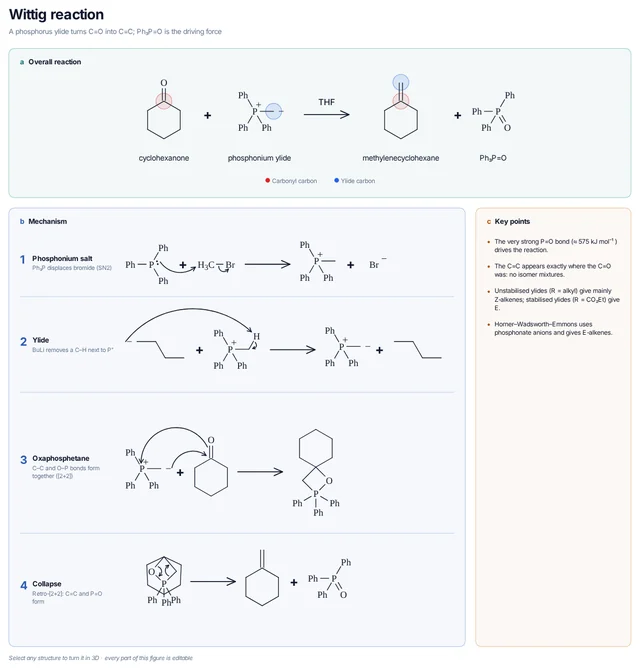
aldehyde + ketone → alkene
A phosphorus ylide turns C=O into C=C; Ph₃P=O is the driving force.
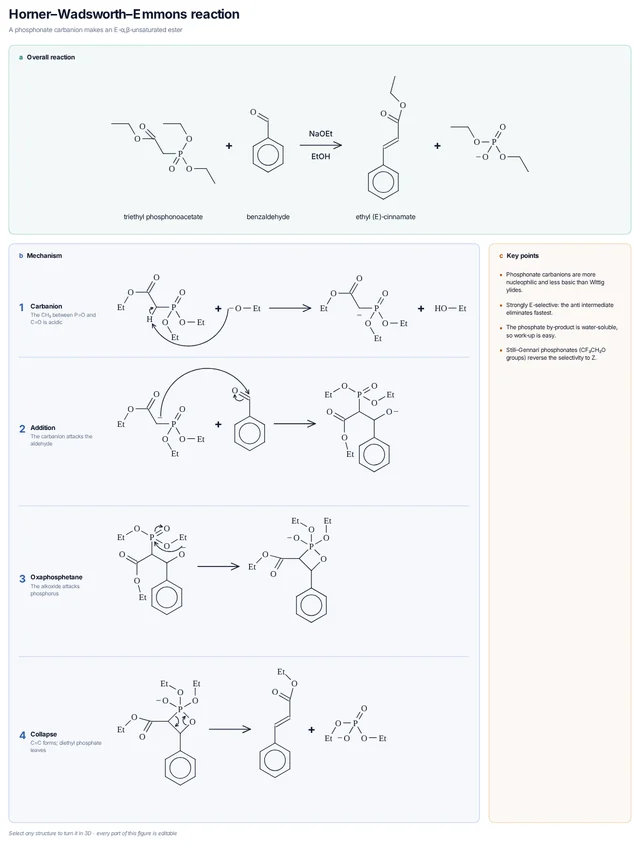
aldehyde → α,β-unsaturated carbonyl
A phosphonate carbanion makes an E-α,β-unsaturated ester.
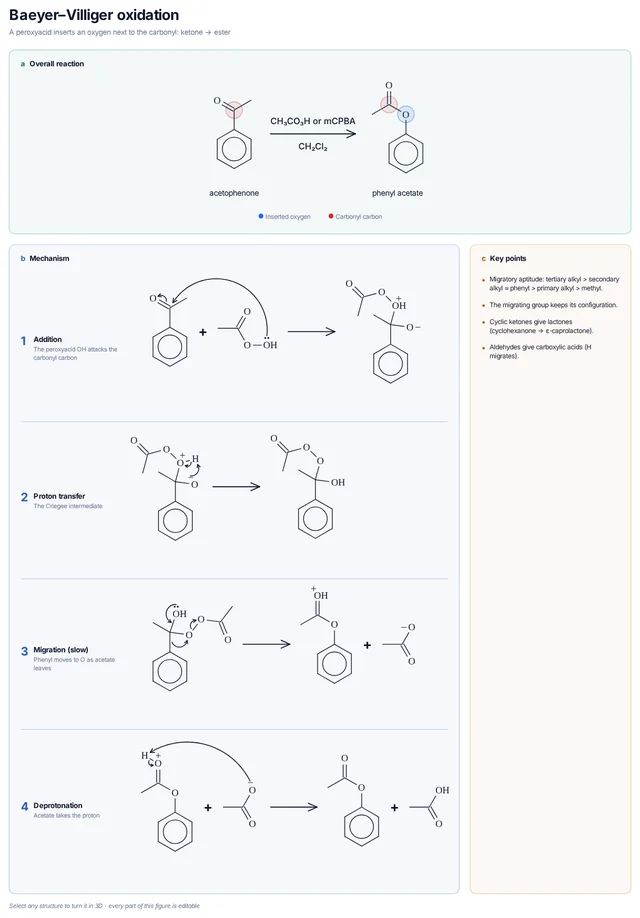
ketone → ester
A peroxyacid inserts an oxygen next to the carbonyl: ketone → ester.
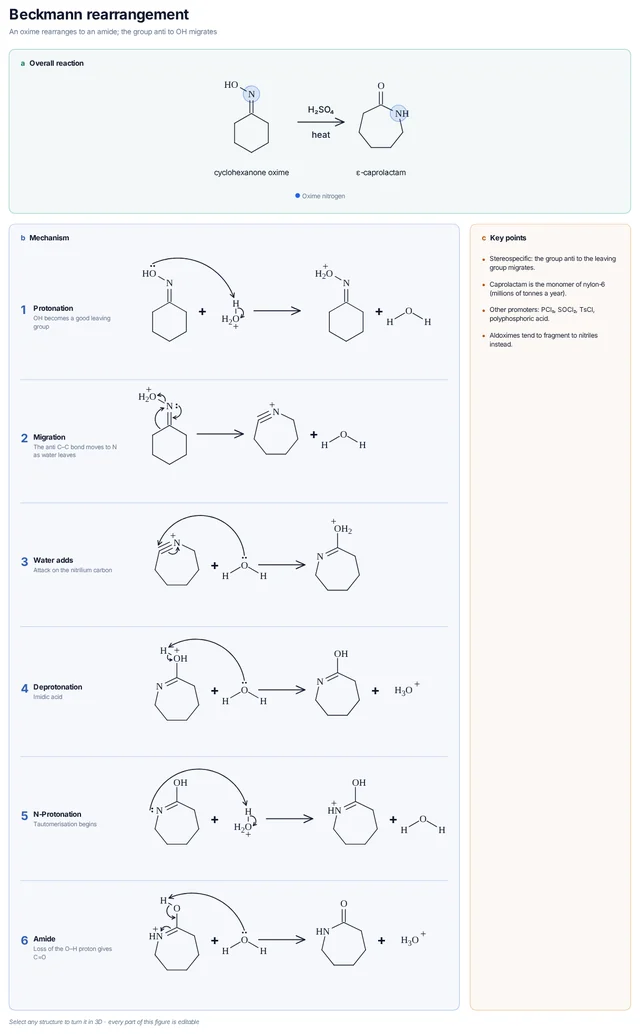
oxime + ketone → amide
An oxime rearranges to an amide; the group anti to OH migrates.
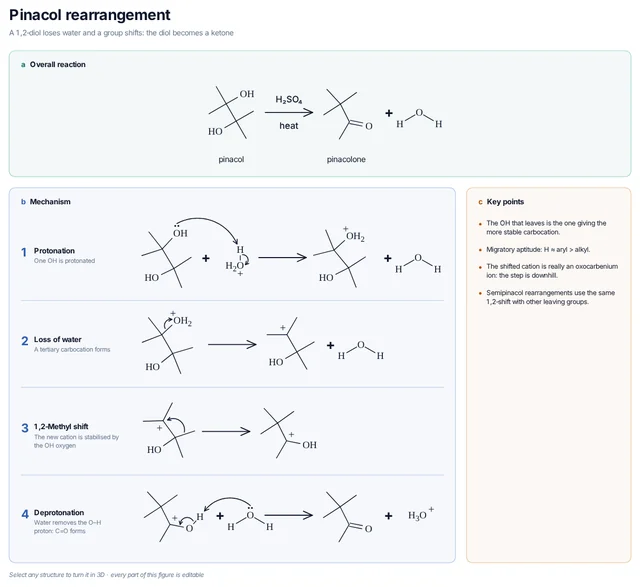
1,2-diol → ketone
A 1,2-diol loses water and a group shifts: the diol becomes a ketone.
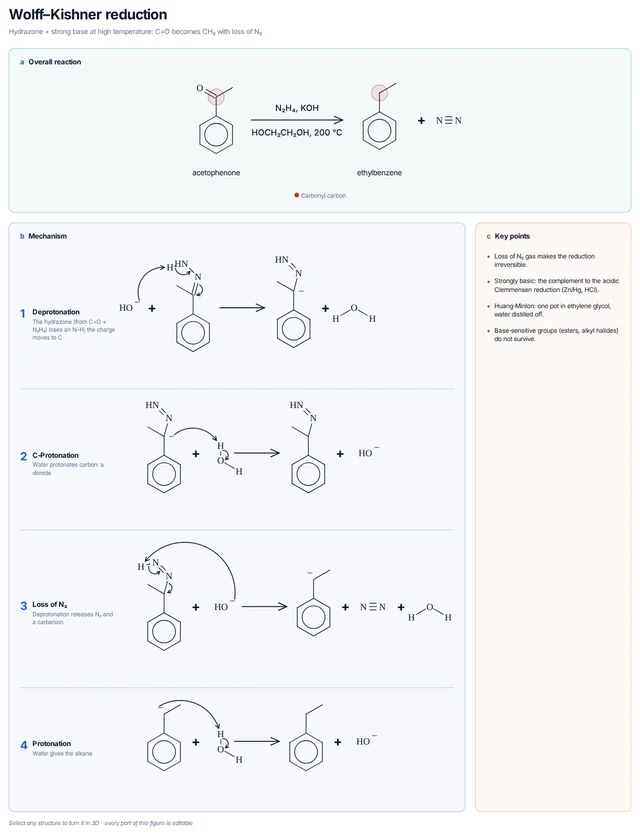
ketone + aldehyde → alkane
Hydrazone + strong base at high temperature: C=O becomes CH₂ with loss of N₂.
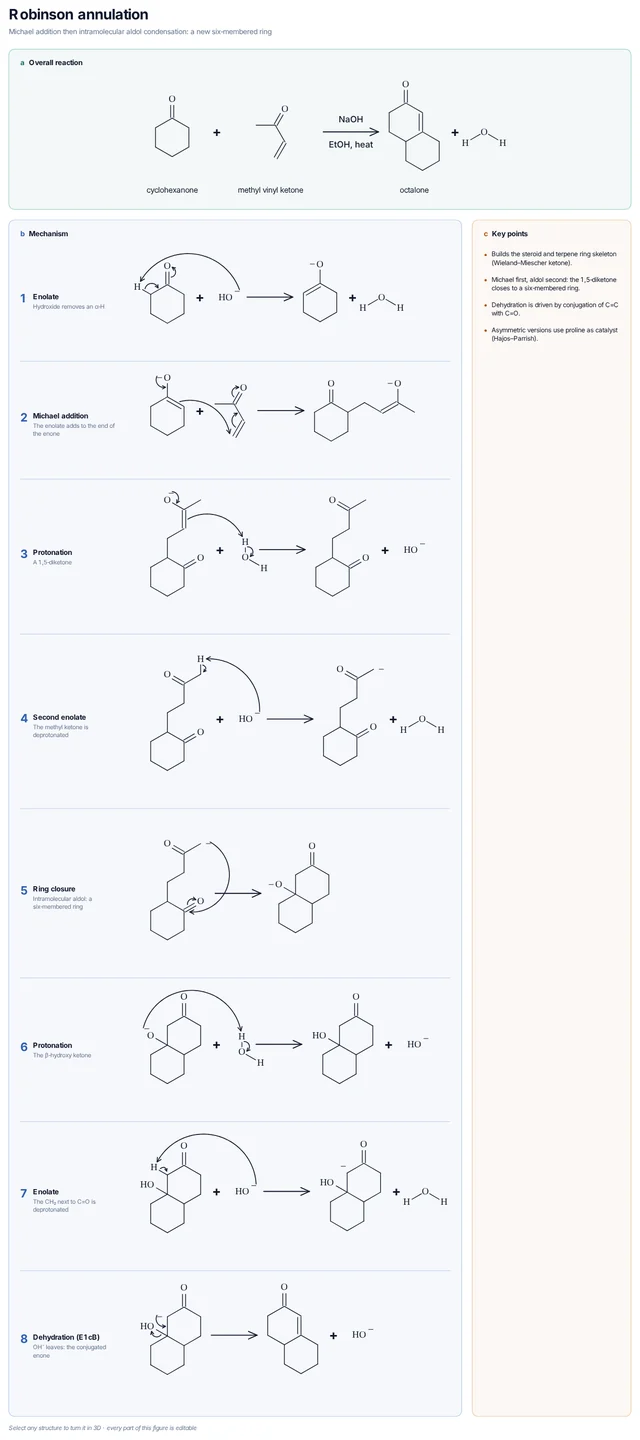
ketone + α,β-unsaturated carbonyl → α,β-unsaturated carbonyl
Michael addition then intramolecular aldol condensation: a new six-membered ring.
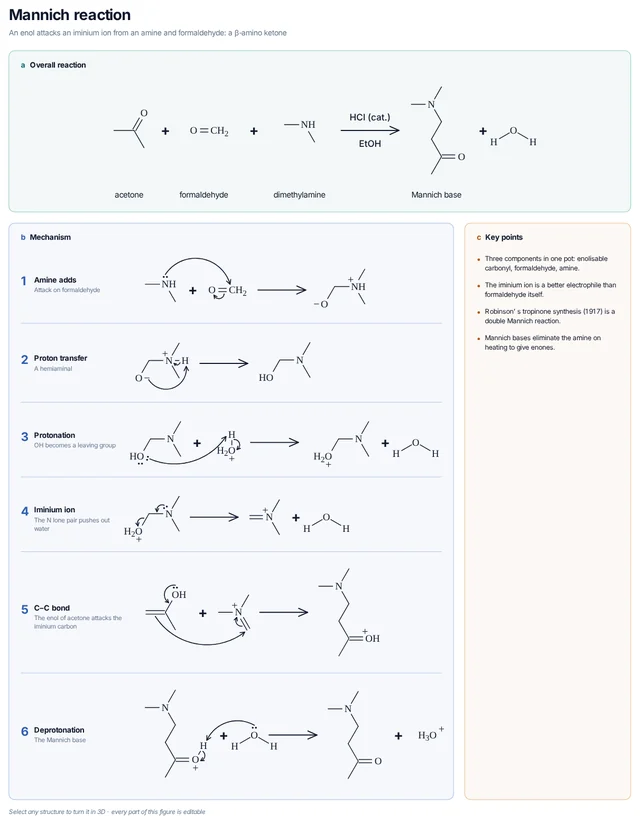
ketone + aldehyde + amine → β-amino ketone
An enol attacks an iminium ion from an amine and formaldehyde: a β-amino ketone.
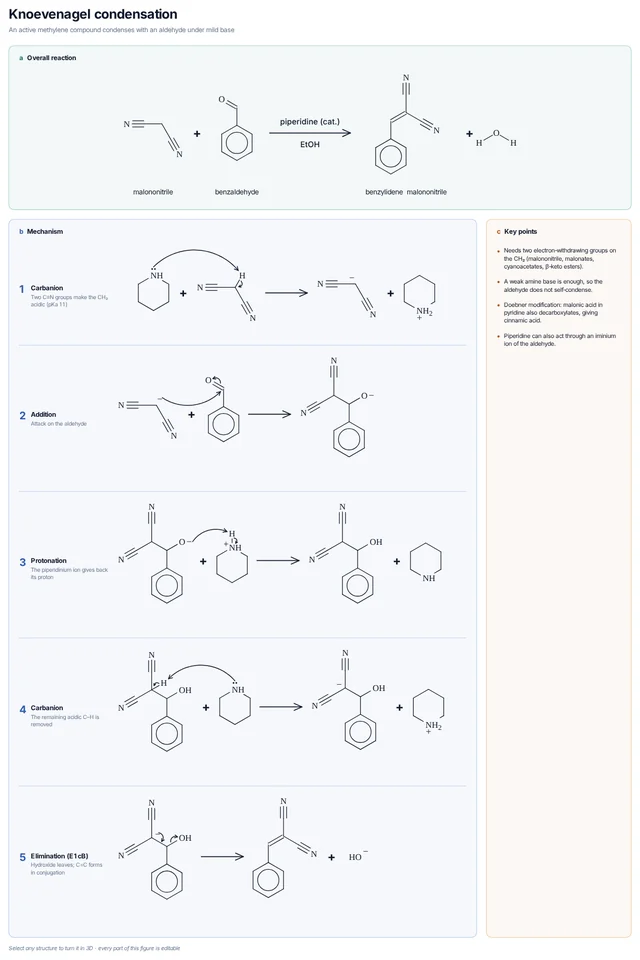
aldehyde + nitrile + ester → alkene + α,β-unsaturated carbonyl
An active methylene compound condenses with an aldehyde under mild base.
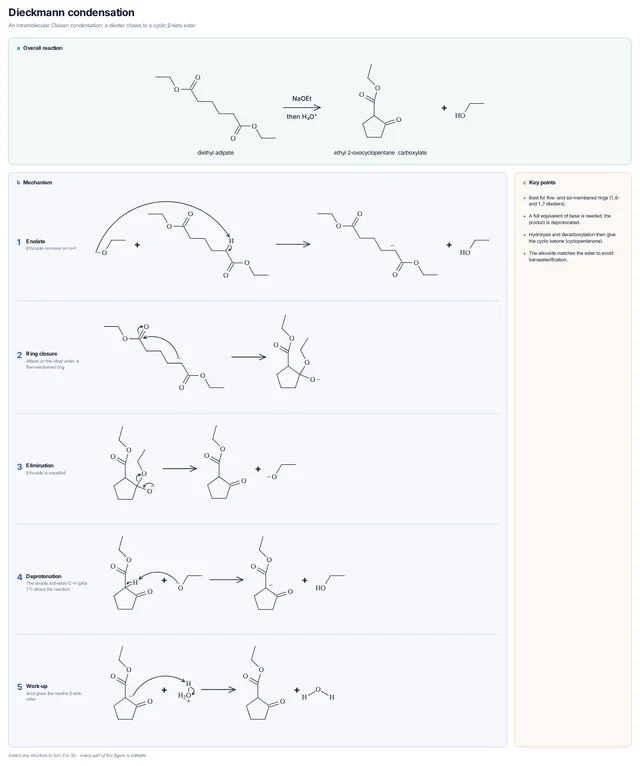
ester → β-keto ester
An intramolecular Claisen condensation: a diester closes to a cyclic β-keto ester.
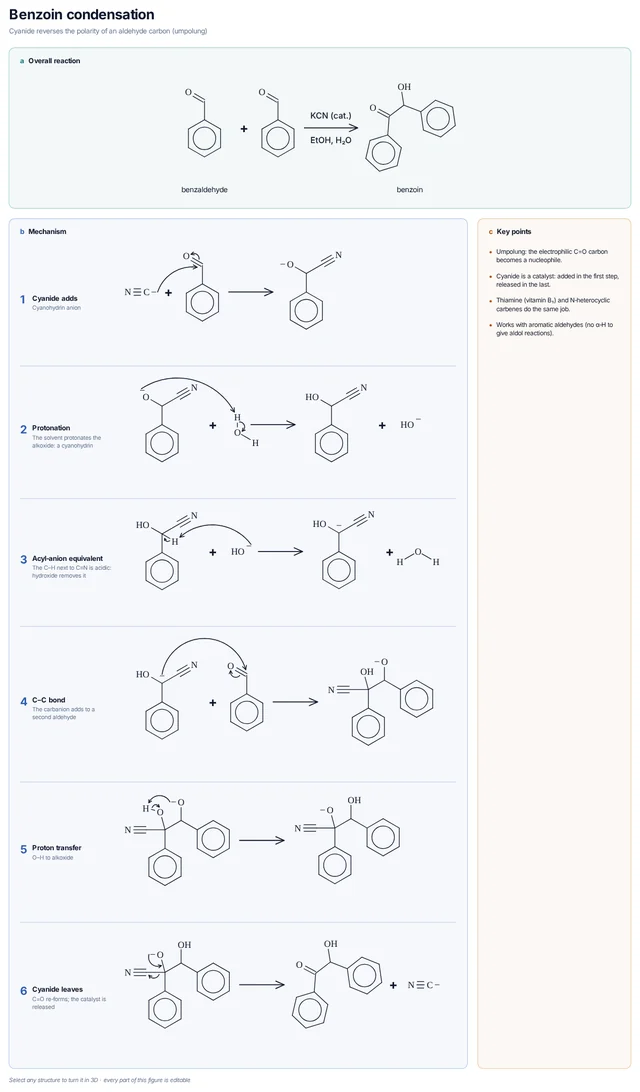
aldehyde → α-hydroxy ketone
Cyanide reverses the polarity of an aldehyde carbon (umpolung).
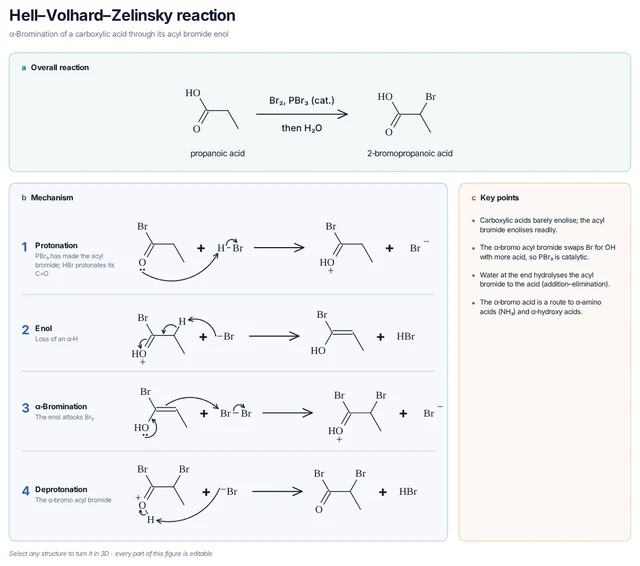
carboxylic acid → α-halo acid
α-Bromination of a carboxylic acid through its acyl bromide enol.
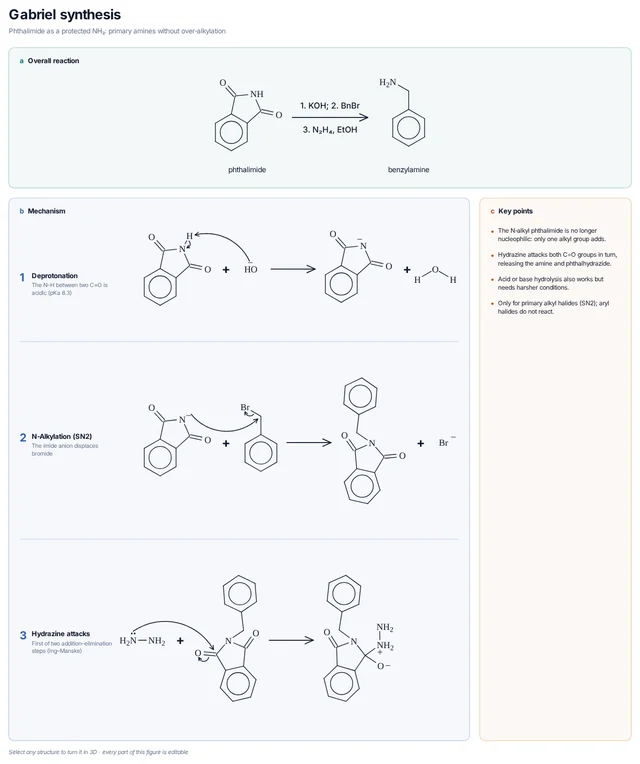
alkyl halide + imide → amine
Phthalimide as a protected NH₂: primary amines without over-alkylation.
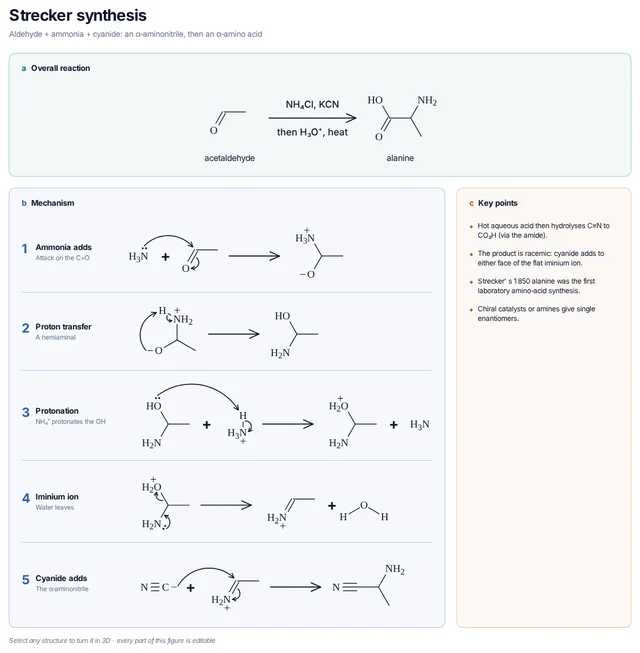
aldehyde → α-amino acid + nitrile
Aldehyde + ammonia + cyanide: an α-aminonitrile, then an α-amino acid.
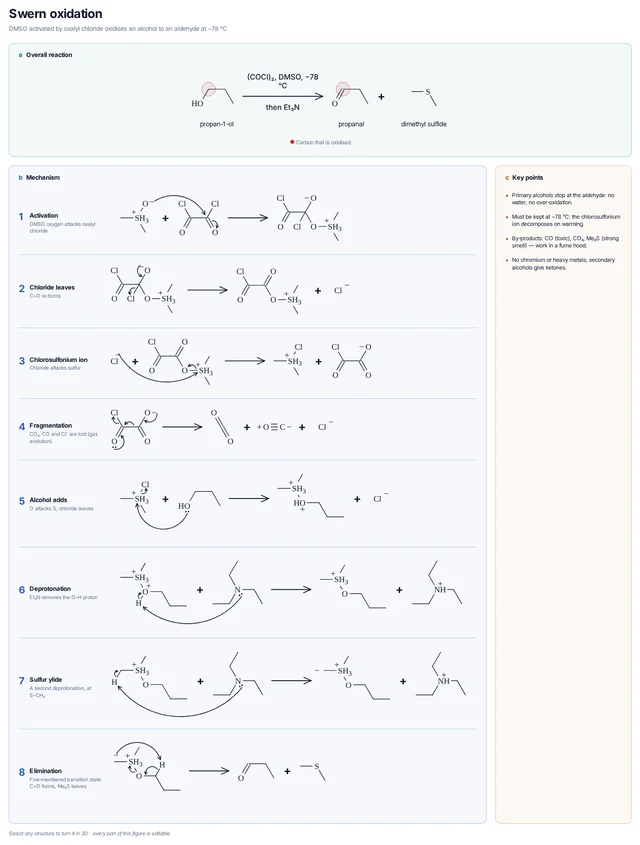
alcohol → aldehyde + ketone
DMSO activated by oxalyl chloride oxidises an alcohol to an aldehyde at −78 °C.
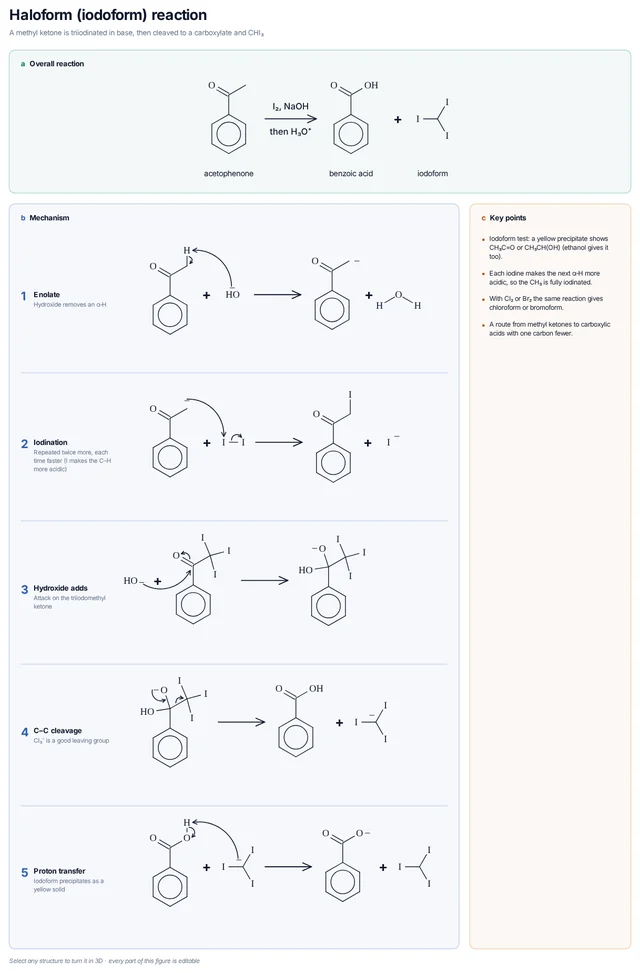
ketone + alcohol → carboxylic acid
A methyl ketone is triiodinated in base, then cleaved to a carboxylate and CHI₃.
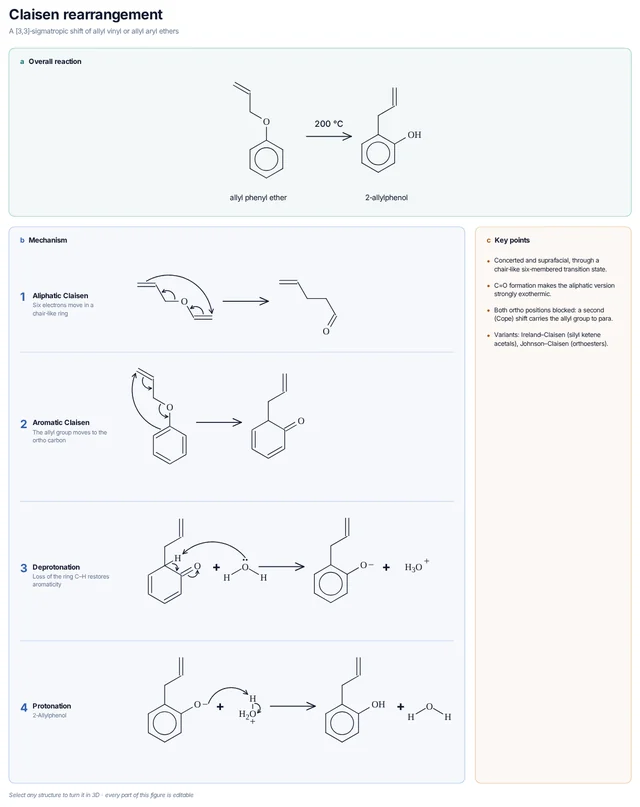
ether → aldehyde + ketone + phenol
A [3,3]-sigmatropic shift of allyl vinyl or allyl aryl ethers.
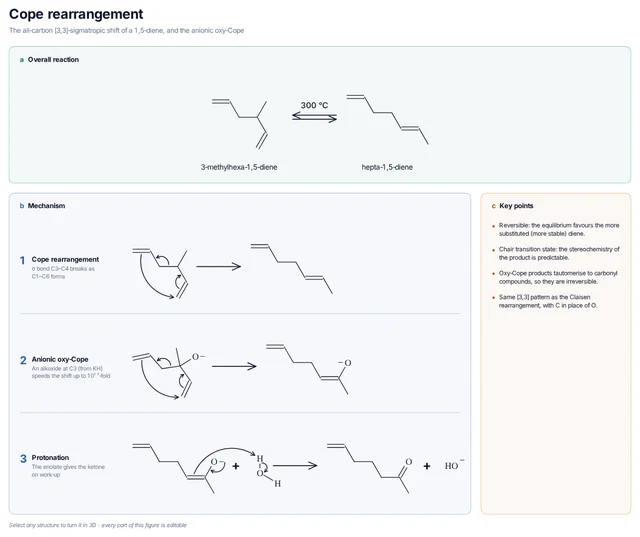
alkene → alkene
The all-carbon [3,3]-sigmatropic shift of a 1,5-diene, and the anionic oxy-Cope.
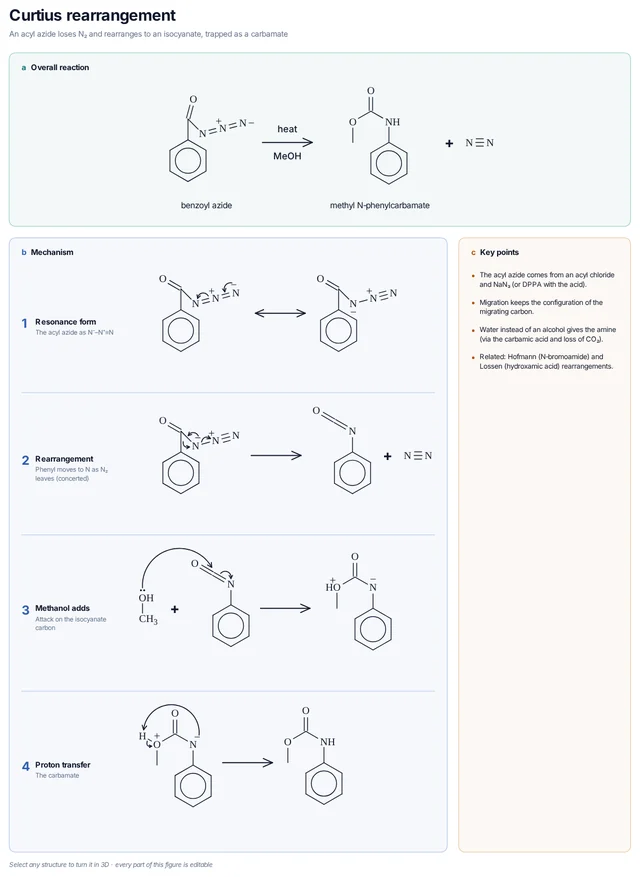
acid chloride + carboxylic acid → carbamate / isocyanate + amine
An acyl azide loses N₂ and rearranges to an isocyanate, trapped as a carbamate.
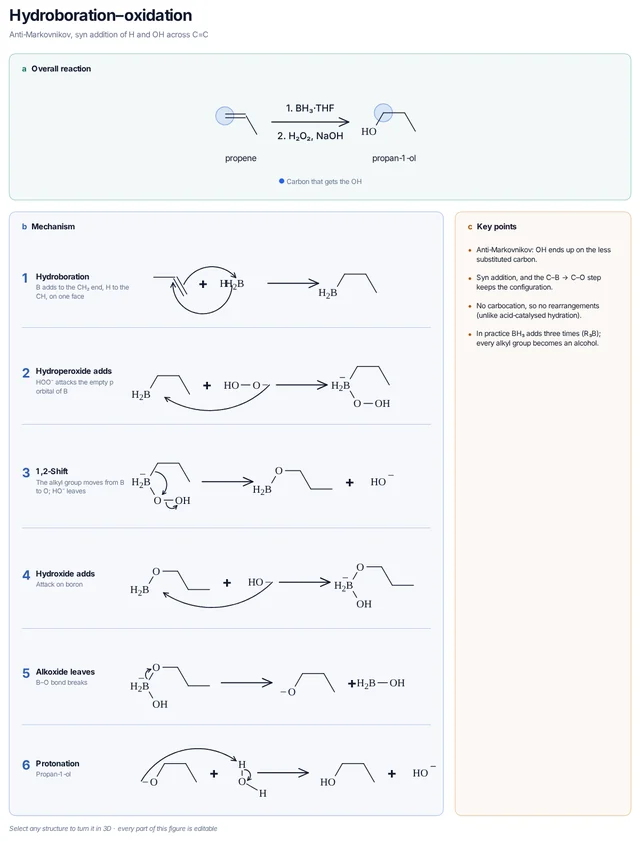
alkene → alcohol
Anti-Markovnikov, syn addition of H and OH across C=C.
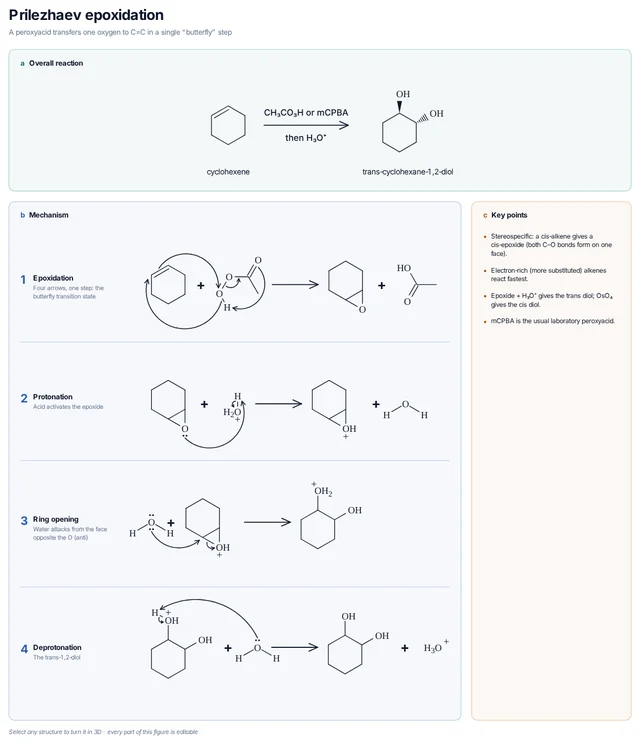
alkene → epoxide
A peroxyacid transfers one oxygen to C=C in a single “butterfly” step.
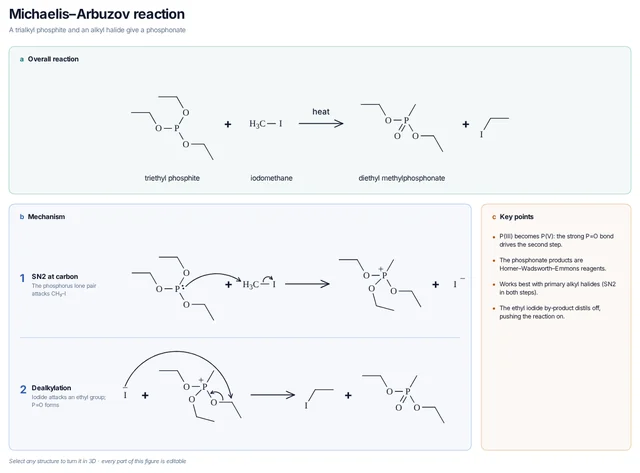
alkyl halide → phosphonate
A trialkyl phosphite and an alkyl halide give a phosphonate.
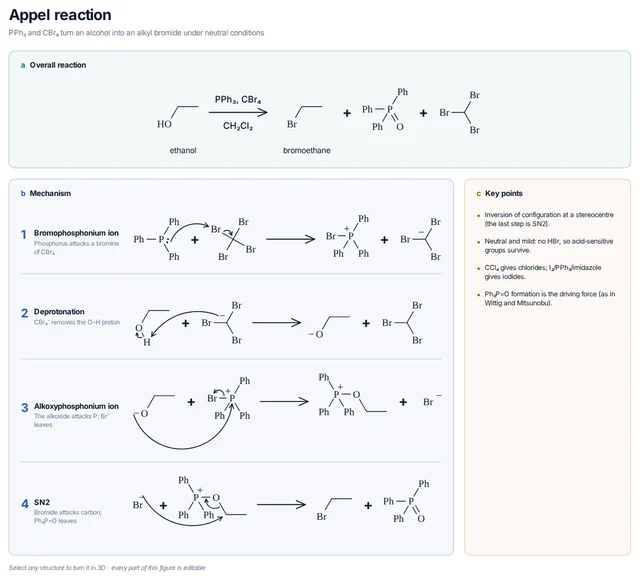
alcohol → alkyl halide
PPh₃ and CBr₄ turn an alcohol into an alkyl bromide under neutral conditions.
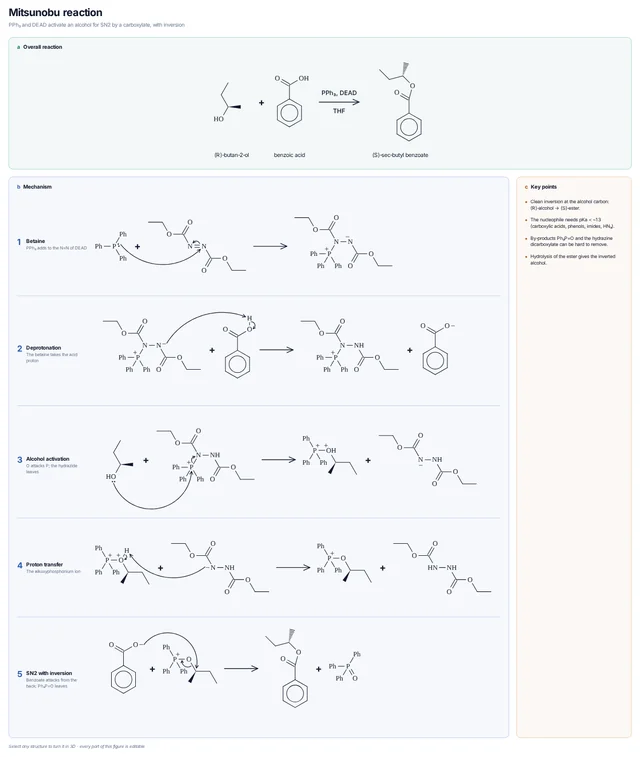
alcohol + carboxylic acid → ester
PPh₃ and DEAD activate an alcohol for SN2 by a carboxylate, with inversion.
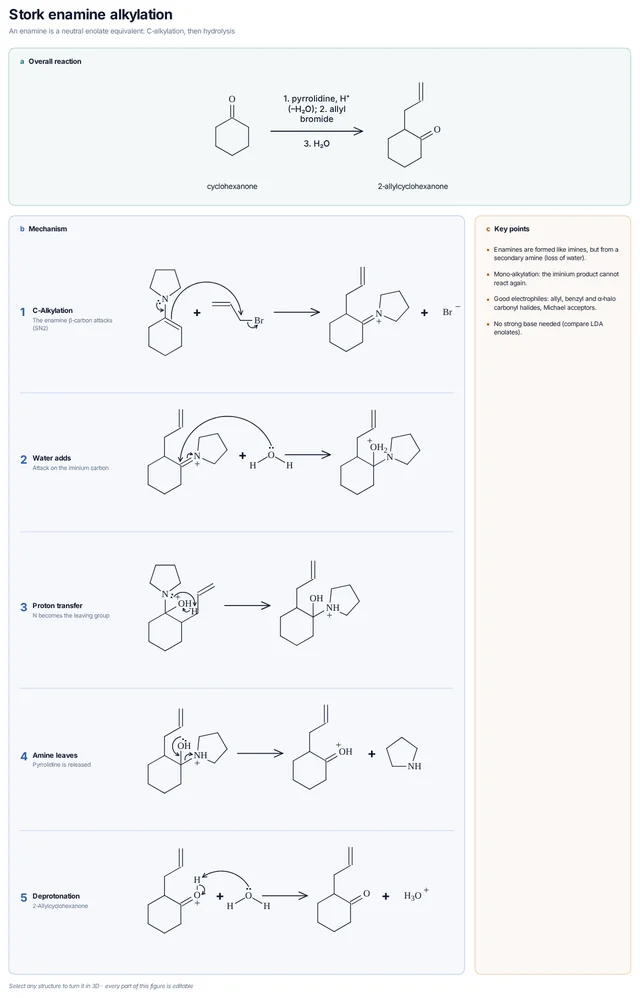
ketone + alkyl halide → ketone
An enamine is a neutral enolate equivalent: C-alkylation, then hydrolysis.
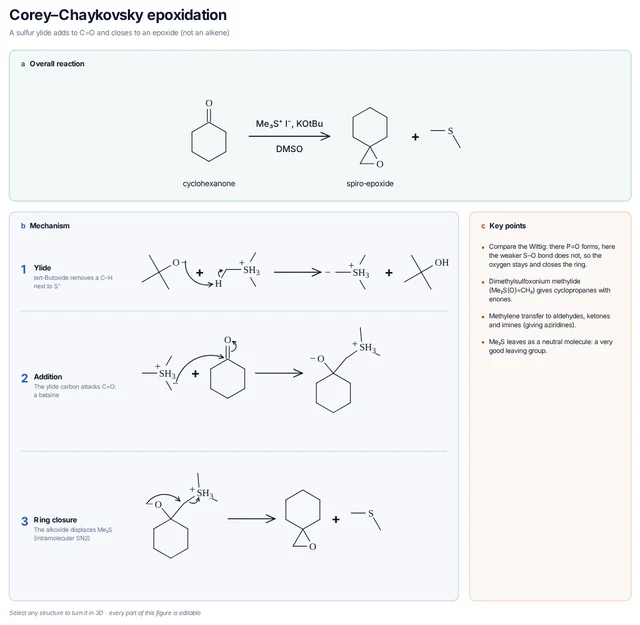
ketone + aldehyde → epoxide
A sulfur ylide adds to C=O and closes to an epoxide (not an alkene).
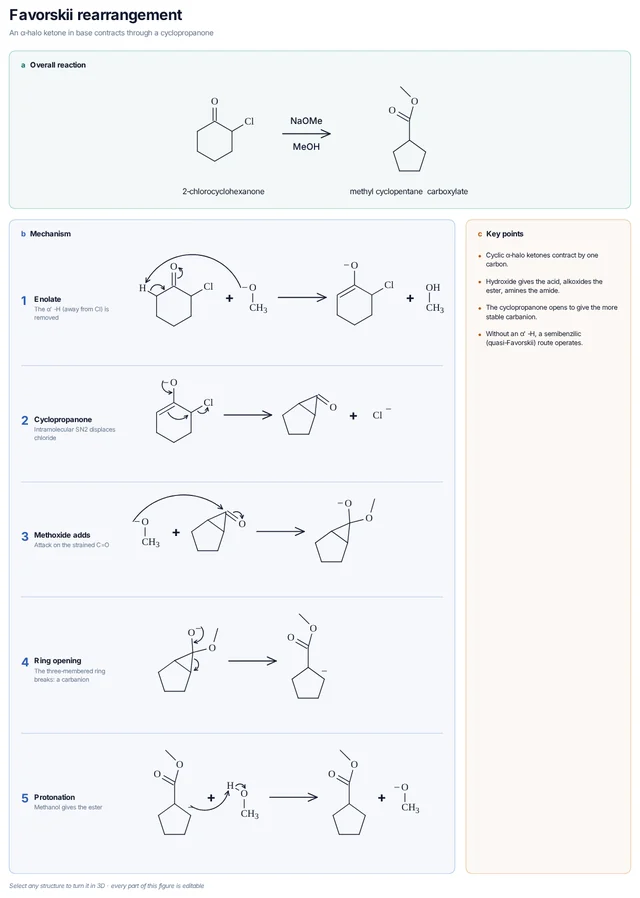
α-halo ketone → carboxylic acid + ester
An α-halo ketone in base contracts through a cyclopropanone.
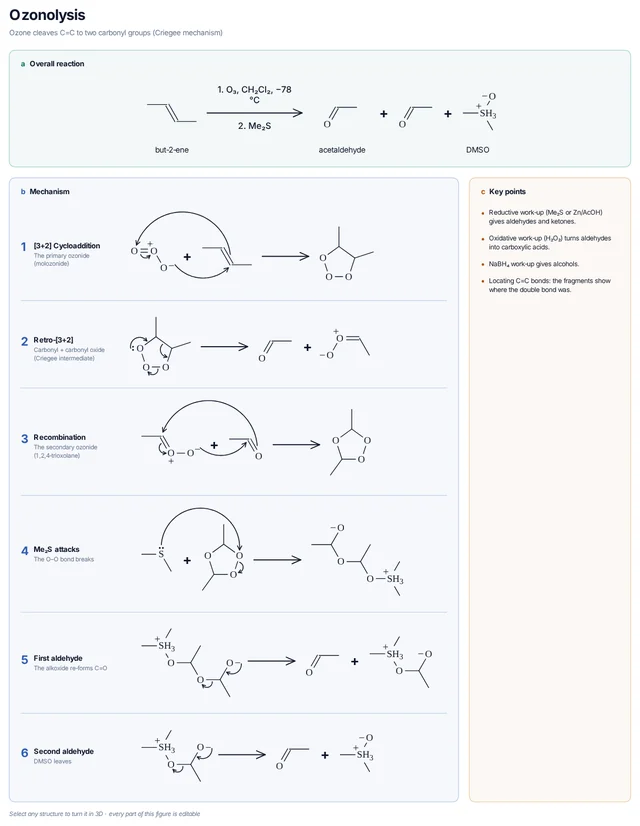
alkene → aldehyde + ketone
Ozone cleaves C=C to two carbonyl groups (Criegee mechanism).
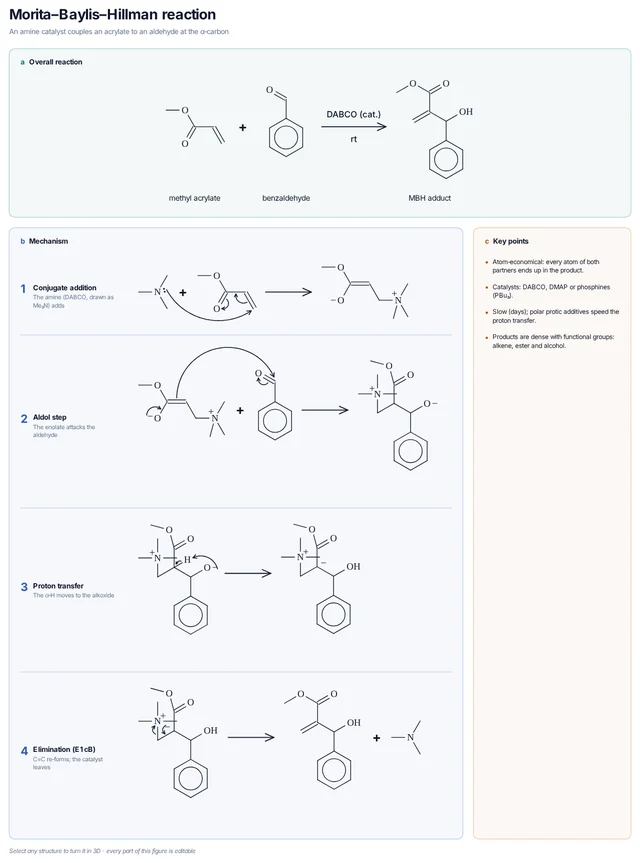
aldehyde + α,β-unsaturated carbonyl → alcohol + α,β-unsaturated carbonyl
An amine catalyst couples an acrylate to an aldehyde at the α-carbon.
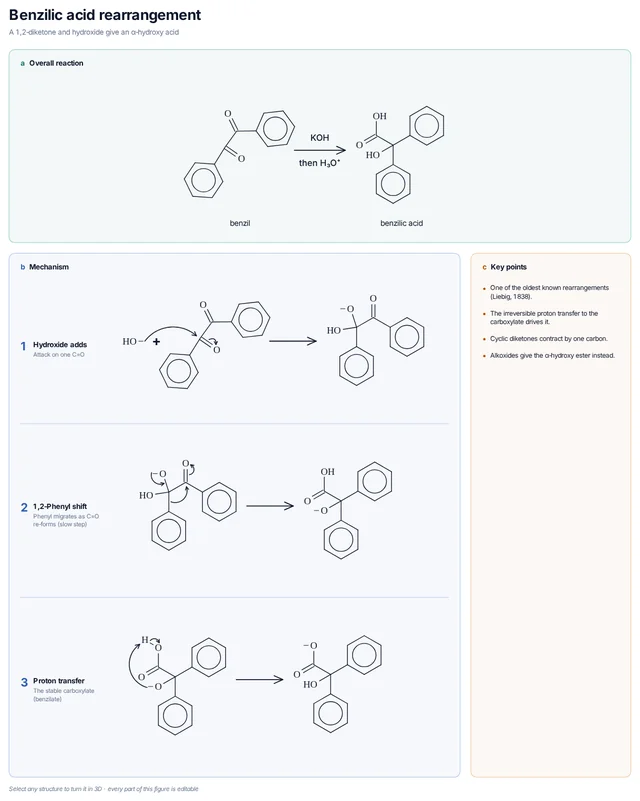
1,2-diketone → α-hydroxy acid
A 1,2-diketone and hydroxide give an α-hydroxy acid.
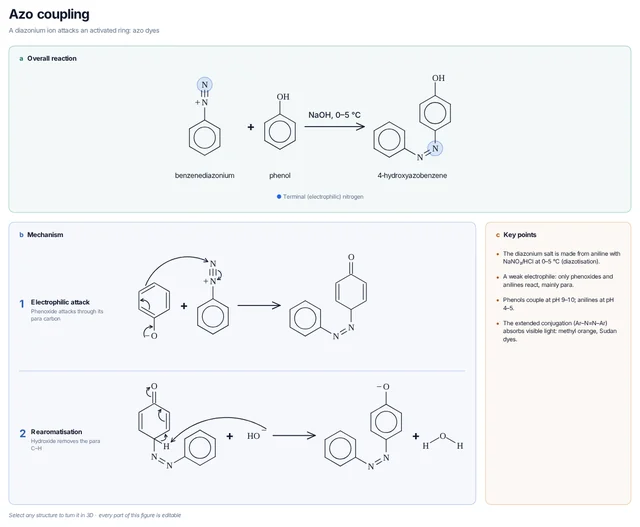
diazonium salt + phenol + amine → azo compound
A diazonium ion attacks an activated ring: azo dyes.
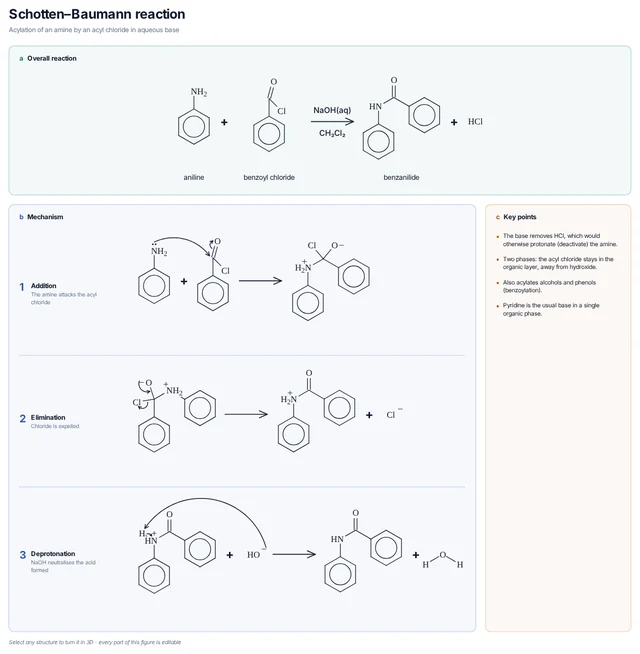
amine + acid chloride + alcohol + phenol → amide + ester
Acylation of an amine by an acyl chloride in aqueous base.
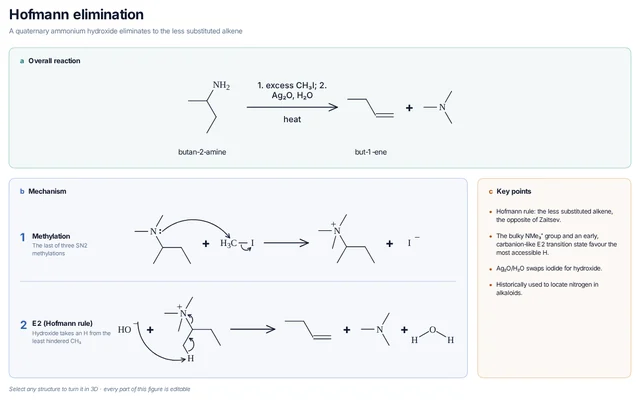
amine + quaternary ammonium salt → alkene
A quaternary ammonium hydroxide eliminates to the less substituted alkene.
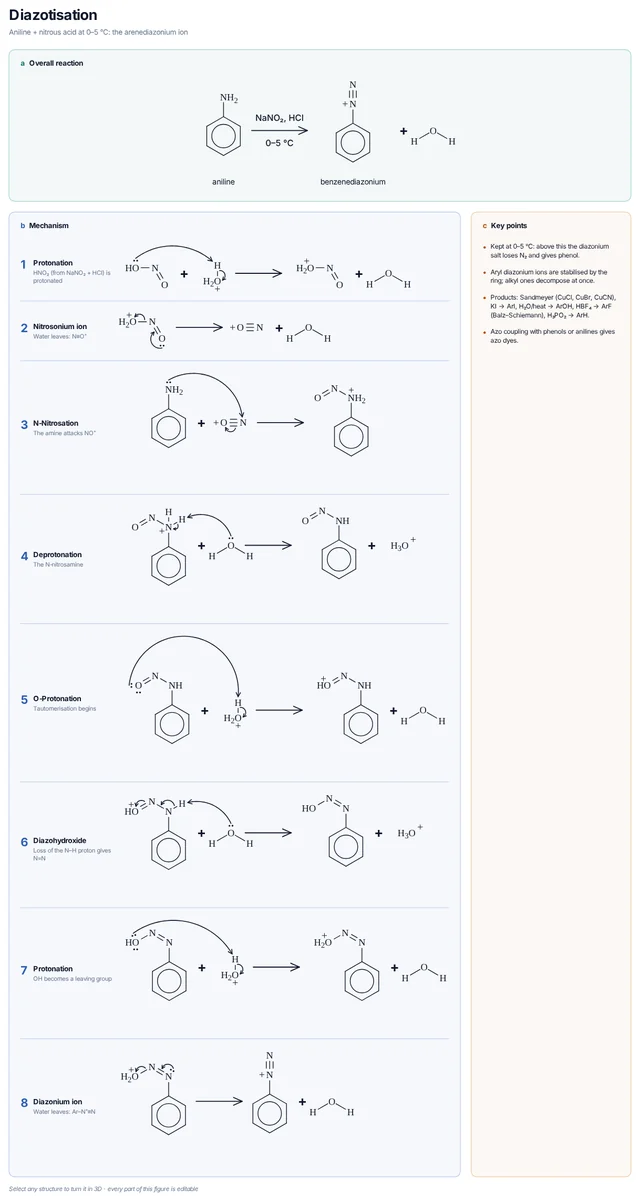
amine → diazonium salt
Aniline + nitrous acid at 0–5 °C: the arenediazonium ion.
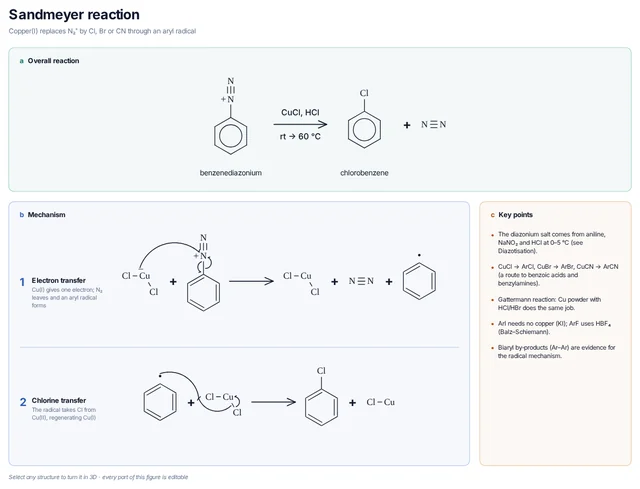
diazonium salt + amine → aryl halide + nitrile
Copper(I) replaces N₂⁺ by Cl, Br or CN through an aryl radical.
No named reaction matches these filters. Try "Any" for one of the groups.
| Conversion | Name reaction | Reagents |
|---|---|---|
| Amide → amine (one C fewer) | Hofmann bromamide | Br₂, NaOH |
| Phenol → salicylaldehyde | Reimer–Tiemann | CHCl₃, NaOH |
| Phenol → salicylic acid | Kolbe | NaOH, CO₂, 400 K, pressure |
| Aniline → chlorobenzene / benzonitrile | Sandmeyer | NaNO₂/HCl 0–5 °C; CuCl or CuCN |
| Alkyl halide → primary amine | Gabriel | potassium phthalimide; N₂H₄ |
| Alkyl halide + alkoxide → ether | Williamson | RONa + R′X (SN2) |
| Ketone → alkane (C=O → CH₂) | Wolff–Kishner | N₂H₄, KOH, glycol, heat |
| Aldehyde (no α-H) → alcohol + acid salt | Cannizzaro | conc. NaOH |
| Carboxylic acid → α-bromo acid | HVZ | Br₂, red P |
| Methyl ketone → acid + CHI₃ | Iodoform (haloform) | I₂, NaOH |
| Alkene → anti-Markovnikov alcohol | Hydroboration–oxidation | BH₃; H₂O₂, NaOH |
| Alkene → aldehydes / ketones | Ozonolysis | O₃; Zn/H₂O |
Draw it properly. Open the structure in the free MolDraw editor to add wedges, arrows and labels, then export a PNG or SVG for notes and slides.
Open full MolDraw editorAn organic reaction known by the name of the chemist who discovered or developed it, such as the Wittig, Cannizzaro or Hofmann reaction.
Choose the starting group and the product group in the finder. It lists every named reaction that makes that conversion, with reagents and mechanism.
Reimer–Tiemann, Kolbe, Hofmann bromamide, Sandmeyer, Gabriel, Williamson, Cannizzaro, Wolff–Kishner, HVZ, iodoform, Friedel–Crafts, diazotisation and azo coupling, hydroboration and ozonolysis. Filter by "JEE/NEET" to see them.
Yes. Every card opens the full mechanism in MolDraw, with each curly-arrow step checked electron by electron. You can edit it and export it.
Yes. It runs in your browser with no sign-up.
Last updated: