Reaction Scheme
R-MgX + carbonyl -> alcohol after workupRequires dry ether or THF; water and acids quench the reagent.
Primary reaction SMILES: C=O.C[Mg]Br>>CCO
A Grignard reaction uses an organomagnesium reagent to add a carbon group to electrophiles such as aldehydes, ketones, esters, and carbon dioxide.
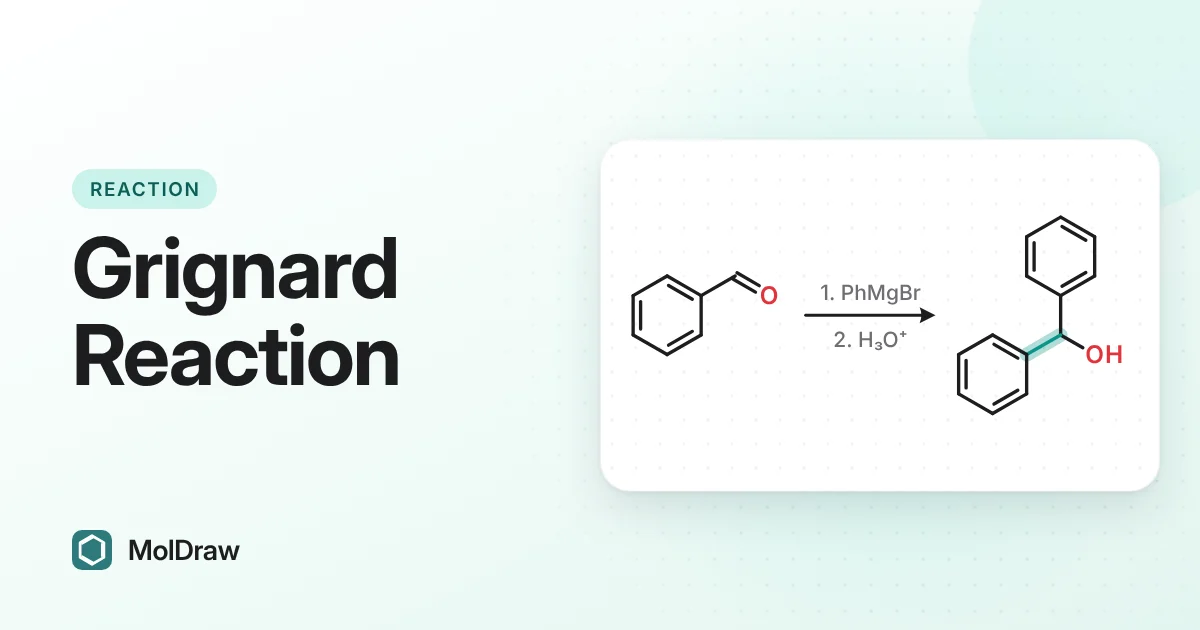
Primary reaction SMILES: C=O.C[Mg]Br>>CCO
Forms ethanol after protonation.
Forms diphenylmethanol after acidic workup.
Use MolDraw to draw the organomagnesium reagent, carbonyl partner, workup arrow, and product.
A Grignard reagent, R–MgX, is made by inserting magnesium metal into a carbon–halogen bond in a dry ether solvent such as diethyl ether or THF. The carbon bonded to magnesium is strongly nucleophilic and basic. It adds to the electrophilic carbon of a carbonyl group, forming a magnesium alkoxide, which is protonated on acidic workup to give an alcohol.
Why must the conditions be anhydrous? R–MgX is a strong base; water converts it to R–H. How should I draw the scheme? Show two steps over the arrow: "1. RMgBr, Et2O" and "2. H3O+", which makes clear that the acid is added only after the addition is complete.