Hofmann Bromamide Reaction: Mechanism, Isocyanate Step and JEE/NEET Questions
Short answer: A primary amide R–CONH2 with Br2 and NaOH gives the primary amine R–NH2, with one carbon fewer. The amide is N-brominated, the anion rearranges to an isocyanate (R moves from C to N as Br− leaves), and the isocyanate is hydrolysed and loses CO2.
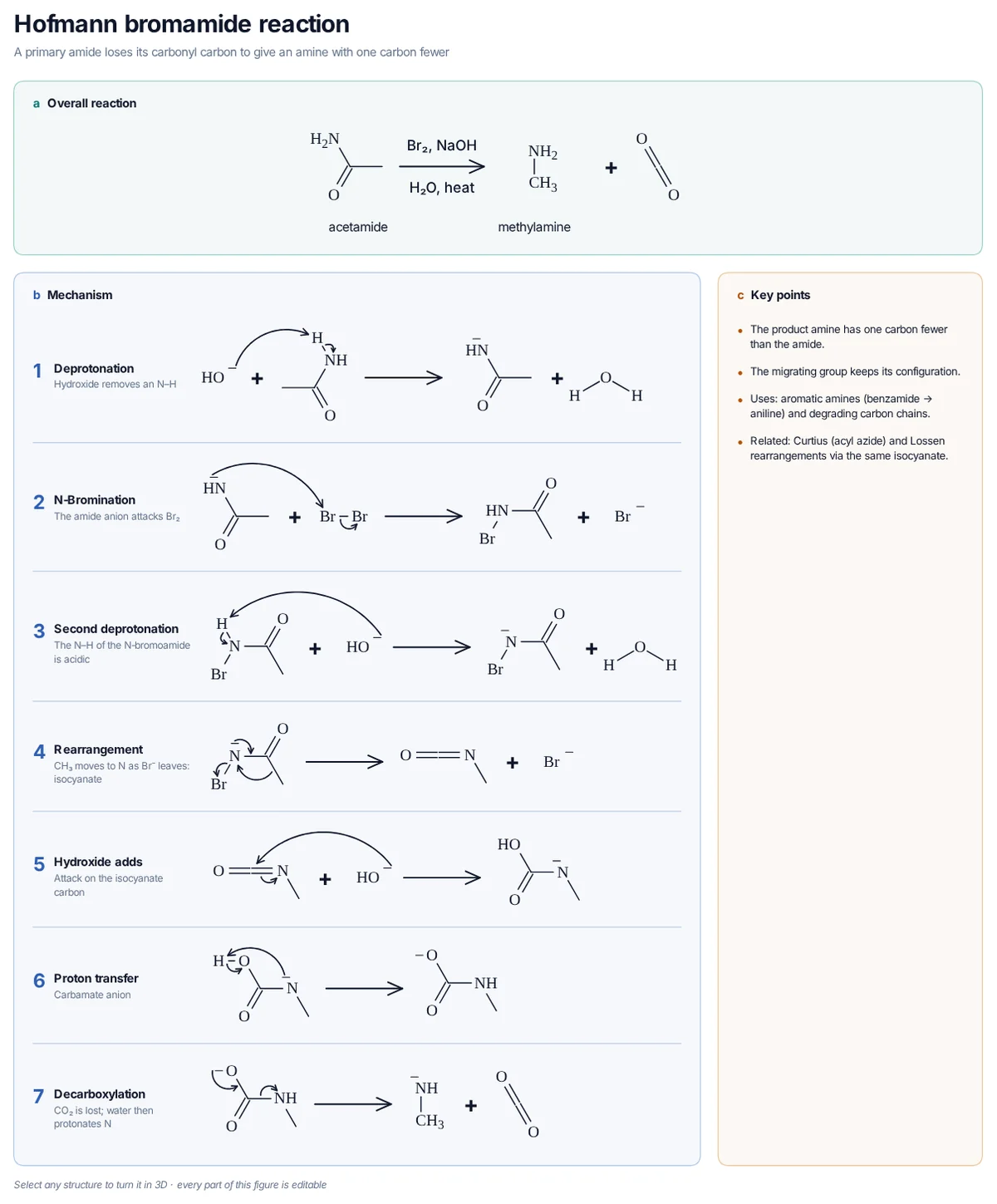
What is the Hofmann Bromamide?
The Hofmann bromamide reaction (Hofmann degradation or Hofmann rearrangement) is the standard way to shorten a carbon chain by one carbon while making a primary amine. It is a favourite of JEE and NEET because the product looks surprising until you know the isocyanate step.
The MolDraw template draws all seven steps for acetamide → methylamine. Open it and change the methyl to phenyl to see benzamide → aniline.
Reaction at a glance
| Substrate | Primary amide, R–CONH2 |
|---|---|
| Reagents | Br2 + 4 NaOH (aqueous), warm |
| Key intermediate | Isocyanate, R–N=C=O |
| Product | R–NH2 (one C fewer) + Na2CO3 |
| Equation | RCONH2 + Br2 + 4NaOH → RNH2 + Na2CO3 + 2NaBr + 2H2O |
Mechanism step by step
- Deprotonation. Hydroxide removes an N–H proton from the amide.
- N-Bromination. The amide anion attacks Br2, giving the N-bromoamide and bromide.
- Second deprotonation. The remaining N–H is now more acidic (Br and C=O pull electron density); hydroxide removes it.
- Rearrangement to the isocyanate. In one step the R group moves from carbon to nitrogen while bromide leaves and the N lone pair forms the C=N: R–N=C=O. The migrating group keeps its configuration.
- Hydroxide adds to the isocyanate. Attack at the central carbon gives a carbamate-type anion.
- Proton transfer. The negative charge moves to oxygen: a carbamate (carbamic acid salt).
- Decarboxylation. CO2 is lost (as carbonate in base) and water protonates nitrogen to give the amine.
Every step in the template is checked electron by electron: the curly arrows give exactly the structures that are drawn. Open it in MolDraw to follow the arrows one step at a time.
Worked examples
- Acetamide → methylamine. CH3CONH2 → CH3NH2.
- Benzamide → aniline. C6H5CONH2 → C6H5NH2 — a common route to aromatic amines.
- Propanamide → ethylamine. CH3CH2CONH2 → CH3CH2NH2.
- Stereochemistry kept. (S)-2-Methylbutanamide gives (S)-butan-2-amine: the migrating carbon keeps its configuration (and here its CIP label).
JEE and NEET practice questions
Q1. Propanamide with Br2/NaOH gives:
Show answer
Ethylamine — One carbon fewer: the carbonyl carbon is lost as CO2.
Q2. How many moles of NaOH are consumed per mole of amide?
Show answer
4 — RCONH2 + Br2 + 4NaOH → RNH2 + Na2CO3 + 2NaBr + 2H2O.
Q3. Which intermediate is formed in the Hofmann bromamide reaction?
Show answer
Isocyanate — R–N=C=O, formed in the rearrangement step.
Q4. Which amide gives aniline?
Show answer
Benzamide, C6H5CONH2 — The phenyl group migrates to nitrogen.
Common mistakes
- Keeping the carbonyl carbon in the product — the amine has one carbon fewer.
- Using a secondary amide (R–CONHR′): it has no second N–H and does not react.
- Drawing a carbocation for the migration — the shift is concerted with loss of Br−.
- Forgetting that the migrating group keeps its stereochemistry.
Edit this mechanism in MolDraw
- Click Open in MolDraw. The editor opens with the whole figure on the canvas: the overall reaction, each numbered step and the key points.
- Everything is an ordinary structure. Change a substituent, recolour atoms or move an arrow, and the arrows stay attached to their atoms.
- Download it as PNG, SVG or PDF, or copy it into your notes or slides.
- The same figure is in the editor under Templates → Schemes → Name reactions.
Questions and answers
Why is it called a degradation?
The carbon chain gets one carbon shorter: the carbonyl carbon leaves as CO₂.
What is the difference between Hofmann bromamide and Hofmann elimination?
Bromamide converts amides to amines. Hofmann elimination converts quaternary ammonium hydroxides to the less substituted alkene.
Which related reactions go through the same isocyanate?
Curtius (acyl azides) and Lossen (hydroxamic acids) rearrangements.