Reaction Scheme
arene + acyl chloride -> aryl ketoneAlCl3 or another Lewis acid generates the acylium electrophile.
Primary reaction SMILES: c1ccccc1.CC(=O)Cl>>CC(=O)c1ccccc1
Friedel-Crafts acylation installs an acyl group onto an aromatic ring through electrophilic aromatic substitution, commonly using an acyl chloride and Lewis acid.
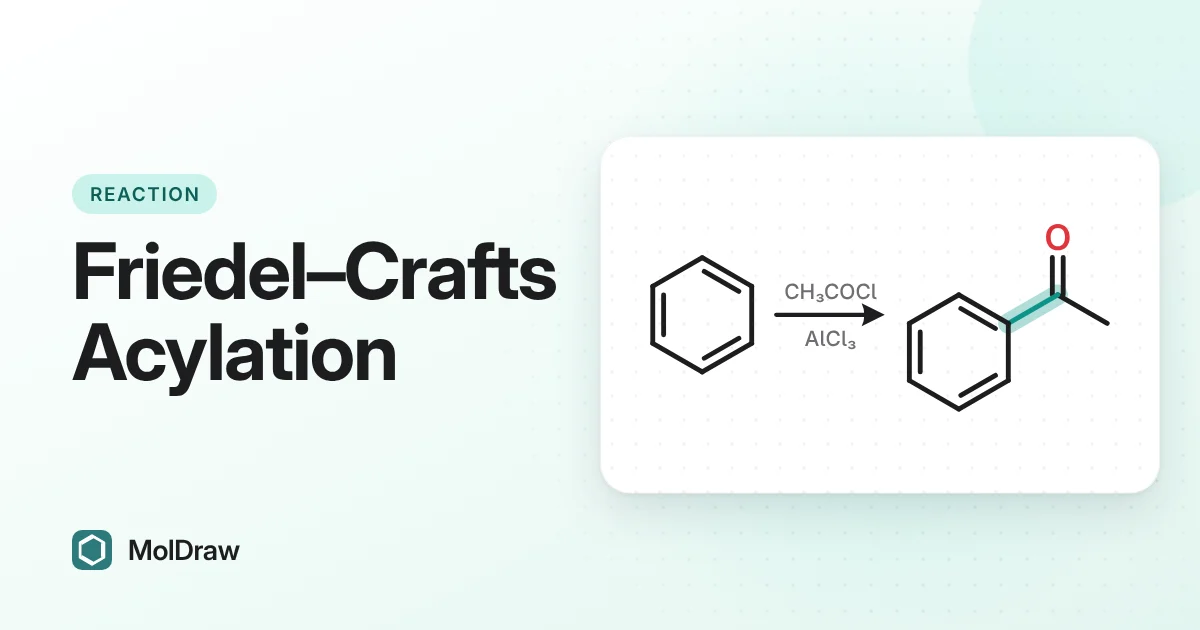
Primary reaction SMILES: c1ccccc1.CC(=O)Cl>>CC(=O)c1ccccc1
Forms acetophenone under AlCl3 conditions.
Electron-rich anisole gives mostly para-acylated product.
Draw substituent effects, acyl chloride partners, and product regiochemistry in MolDraw.
Friedel–Crafts acylation is an electrophilic aromatic substitution. A Lewis acid, typically AlCl3, coordinates to an acyl chloride (or anhydride) and generates a resonance-stabilised acylium ion, R–C≡O+. The aromatic ring attacks the acylium ion to form a σ-complex (arenium ion), and loss of a proton restores aromaticity, giving an aryl ketone.
How do I get a straight-chain alkylbenzene? Acylate first, then reduce the ketone (for example by Clemmensen or Wolff–Kishner reduction), avoiding the carbocation rearrangements of direct alkylation. Where does the new group go? Existing substituents direct it: activating groups such as OMe direct ortho/para, with para usually favoured for steric reasons.