Overall reaction
C₆H₅NH₂ + NaNO₂ + 2 HCl (0–5 °C) → C₆H₅N₂⁺Cl⁻ + NaCl + 2 H₂O
Aniline + nitrous acid at 0–5 °C: the arenediazonium ion.
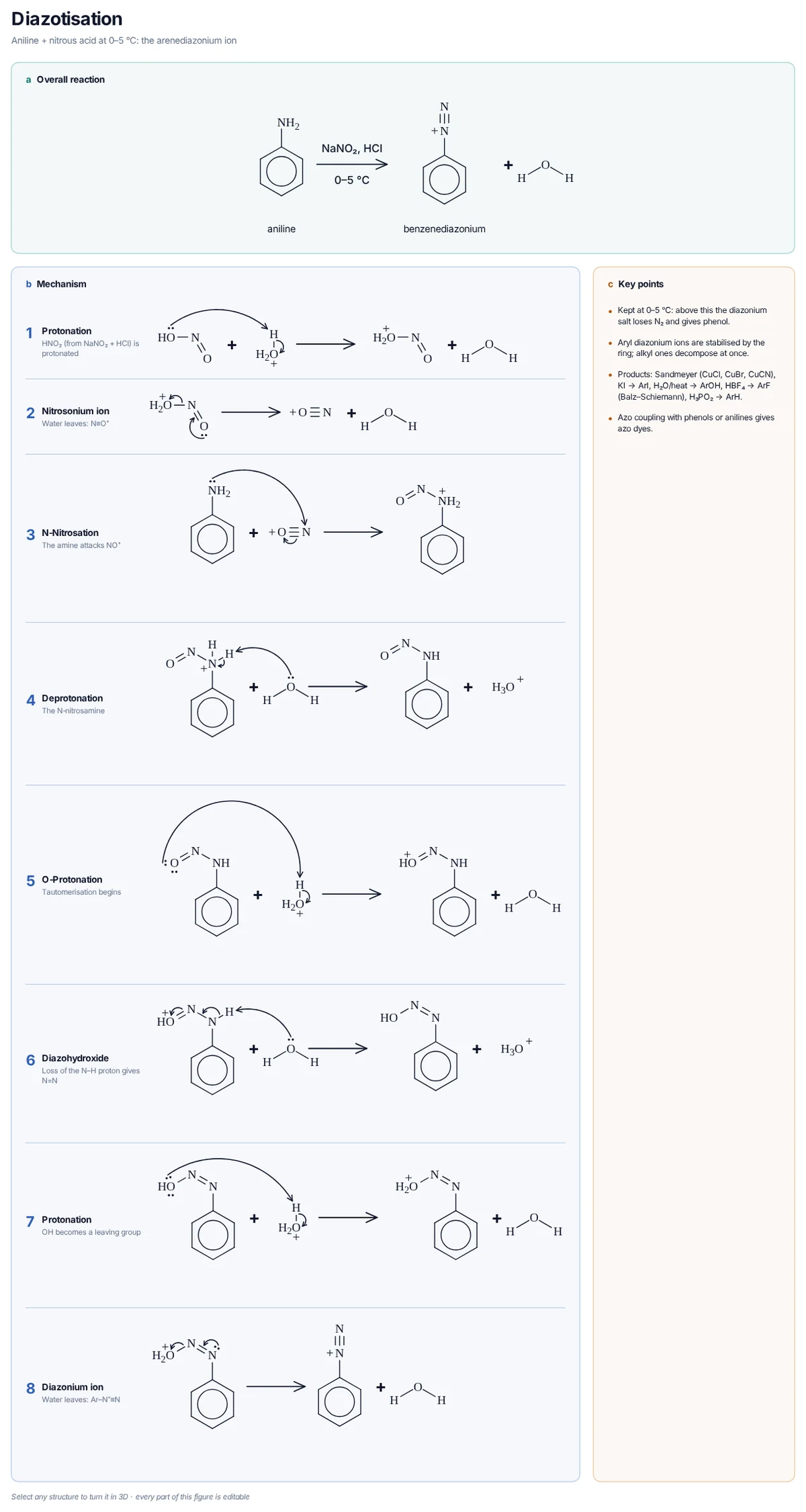
Diazotization converts a primary aromatic amine into an arenediazonium salt with sodium nitrite and a mineral acid at 0–5 °C. Nitrous acid forms the nitrosonium ion (NO⁺), the amine attacks it, and a series of proton transfers and loss of water give Ar–N⁺≡N.
C₆H₅NH₂ + NaNO₂ + 2 HCl (0–5 °C) → C₆H₅N₂⁺Cl⁻ + NaCl + 2 H₂O
Aniline + nitrous acid at 0–5 °C: the arenediazonium ion.
Each step is checked electron by electron: the curly arrows give exactly the structures drawn.
Arenediazonium salts lose N₂ when warmed, and the aryl cation reacts with water to give phenol.
The nitrosonium ion, N≡O⁺, from protonation of HNO₂ and loss of water.
The C–N bond to an sp² ring carbon is stronger, an aryl cation is very unstable, and the N₂⁺ group is conjugated with the ring.
The button above opens the complete figure — overall reaction, numbered mechanism and key points — as ordinary editable structures. Change substituents, recolour atoms, or export a PNG, SVG or chemfig code for notes and slides. The same figure is in the Templates panel under Name reactions.