Gabriel Phthalimide Synthesis: Mechanism, Limits and JEE/NEET Questions
Short answer: Phthalimide is deprotonated by KOH (its N–H has pKa ≈ 8.3), the anion is alkylated by a primary alkyl halide (SN2), and hydrazine (or hydrolysis) releases the primary amine. Because the N-alkylphthalimide cannot be alkylated again, no secondary or tertiary amine forms.
What is the Gabriel Phthalimide Synthesis?
Ammonia and alkyl halides give a mixture of primary, secondary and tertiary amines and quaternary salts. The Gabriel synthesis avoids this by using phthalimide as a protected NH2 that can take only one alkyl group.
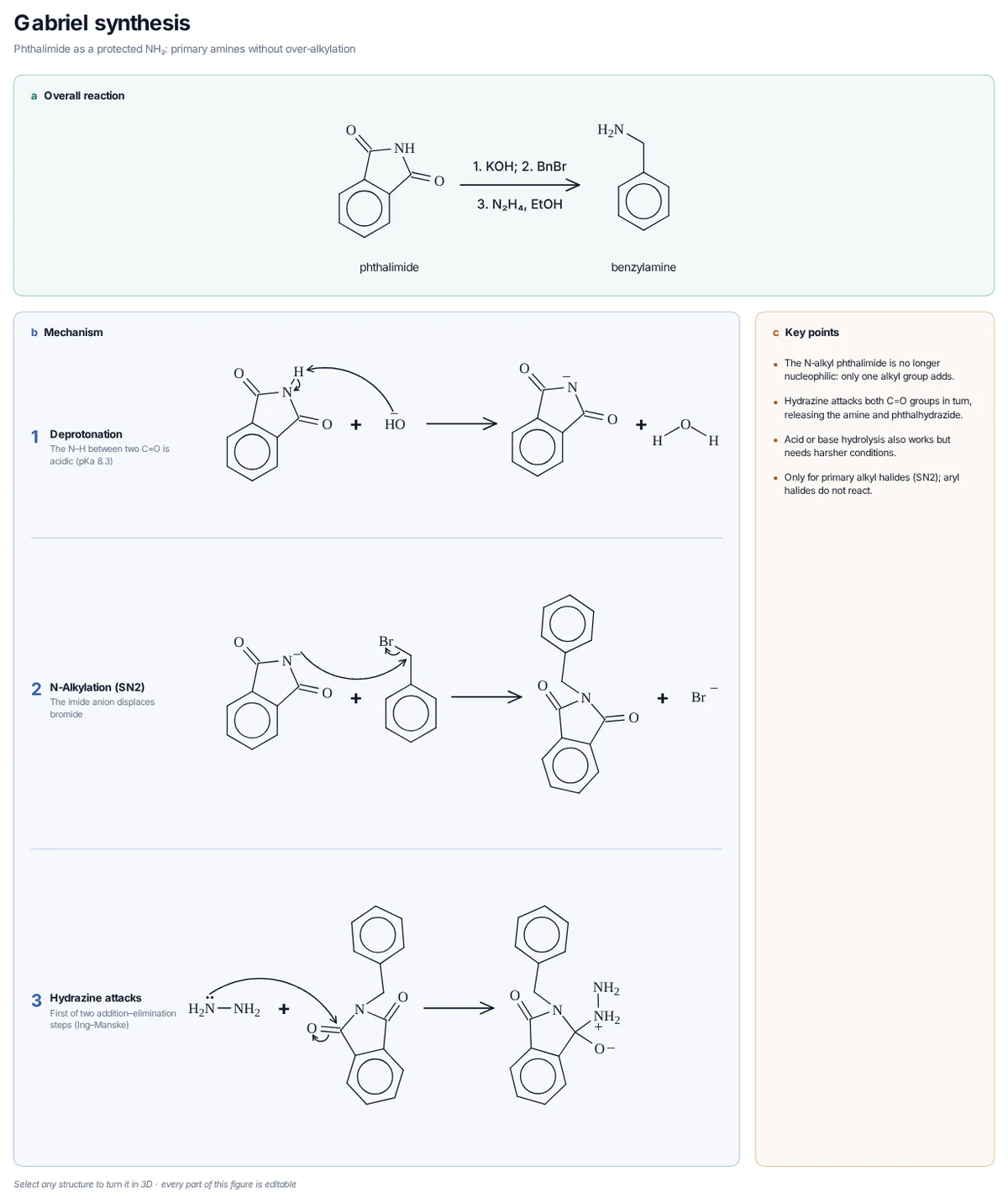
The template draws deprotonation, the SN2 alkylation and the first hydrazine attack. Open it to swap benzyl bromide for another primary halide.
Reaction at a glance
| Starting material | Phthalimide (benzene-1,2-dicarboximide) |
|---|---|
| Step 1 | KOH (ethanolic) → potassium phthalimide |
| Step 2 | R–X (methyl, primary; SN2) → N-alkylphthalimide |
| Step 3 | N2H4 (Ing–Manske) or H3O+/OH− → R–NH2 |
| Gives | Pure primary aliphatic amines only |
Mechanism step by step
- Deprotonation. Hydroxide removes the N–H proton. The anion is stabilised by delocalisation onto both carbonyl oxygens, which is why phthalimide is acidic.
- N-Alkylation (SN2). The imide nitrogen attacks the carbon of the alkyl halide from the back, displacing bromide. The product N-alkylphthalimide has no N–H left.
- Hydrazinolysis. Hydrazine attacks one carbonyl (addition–elimination), then the other intramolecularly. The six-membered phthalhydrazide is expelled and the primary amine is released.
Every step in the template is checked electron by electron: the curly arrows give exactly the structures that are drawn. Open it in MolDraw to follow the arrows one step at a time.
Worked examples
- Benzyl bromide → benzylamine. The template example.
- Ethyl bromide → ethylamine. Any methyl or primary halide works.
- Ethyl bromoacetate → glycine. Gabriel–malonic variants make α-amino acids.
- Not possible: aniline, tert-butylamine. Aryl halides do not undergo SN2; tertiary halides eliminate instead.
JEE and NEET practice questions
Q1. Which amine cannot be prepared by the Gabriel phthalimide synthesis?
Show answer
Aniline — Chlorobenzene does not undergo SN2 with the phthalimide anion.
Q2. Why is phthalimide acidic?
Show answer
The N–H is flanked by two C=O groups, so the conjugate base is resonance-stabilised. — pKa ≈ 8.3, so KOH deprotonates it completely.
Q3. Why does the Gabriel synthesis give only primary amines?
Show answer
The N-alkylphthalimide has no N–H and its nitrogen is not nucleophilic, so a second alkylation cannot happen. — Unlike NH3 + R–X.
Q4. Which reagent releases the amine under mild conditions?
Show answer
N2H4 — Hydrazinolysis (Ing–Manske) gives the amine and phthalhydrazide.
Common mistakes
- Trying to make aromatic amines — the alkylation is SN2.
- Using secondary or tertiary halides: secondary react poorly, tertiary eliminate.
- Forgetting the final release step (hydrazine or hydrolysis).
Edit this mechanism in MolDraw
- Click Open in MolDraw. The editor opens with the whole figure on the canvas: the overall reaction, each numbered step and the key points.
- Everything is an ordinary structure. Change a substituent, recolour atoms or move an arrow, and the arrows stay attached to their atoms.
- Download it as PNG, SVG or PDF, or copy it into your notes or slides.
- The same figure is in the editor under Templates → Schemes → Name reactions.
Questions and answers
What is the product of potassium phthalimide and an alkyl halide?
An N-alkylphthalimide, which gives the primary amine after hydrazinolysis or hydrolysis.
What is the by-product of hydrazinolysis?
Phthalhydrazide (2,3-dihydrophthalazine-1,4-dione).
Is the Gabriel synthesis SN1 or SN2?
SN2: methyl and primary halides work best.