Overall reaction
(R)-butan-2-ol + PhCOOH → (PPh₃, DEAD, THF) (S)-sec-butyl benzoate
PPh₃ and DEAD activate an alcohol for SN2 by a carboxylate, with inversion.
The Mitsunobu reaction converts an alcohol into an ester (or ether, imide, azide) with clean inversion at the alcohol carbon. Triphenylphosphine adds to DEAD, the betaine deprotonates the acidic nucleophile, the alcohol attacks phosphorus to form an alkoxyphosphonium ion, and the carboxylate displaces triphenylphosphine oxide by SN2.
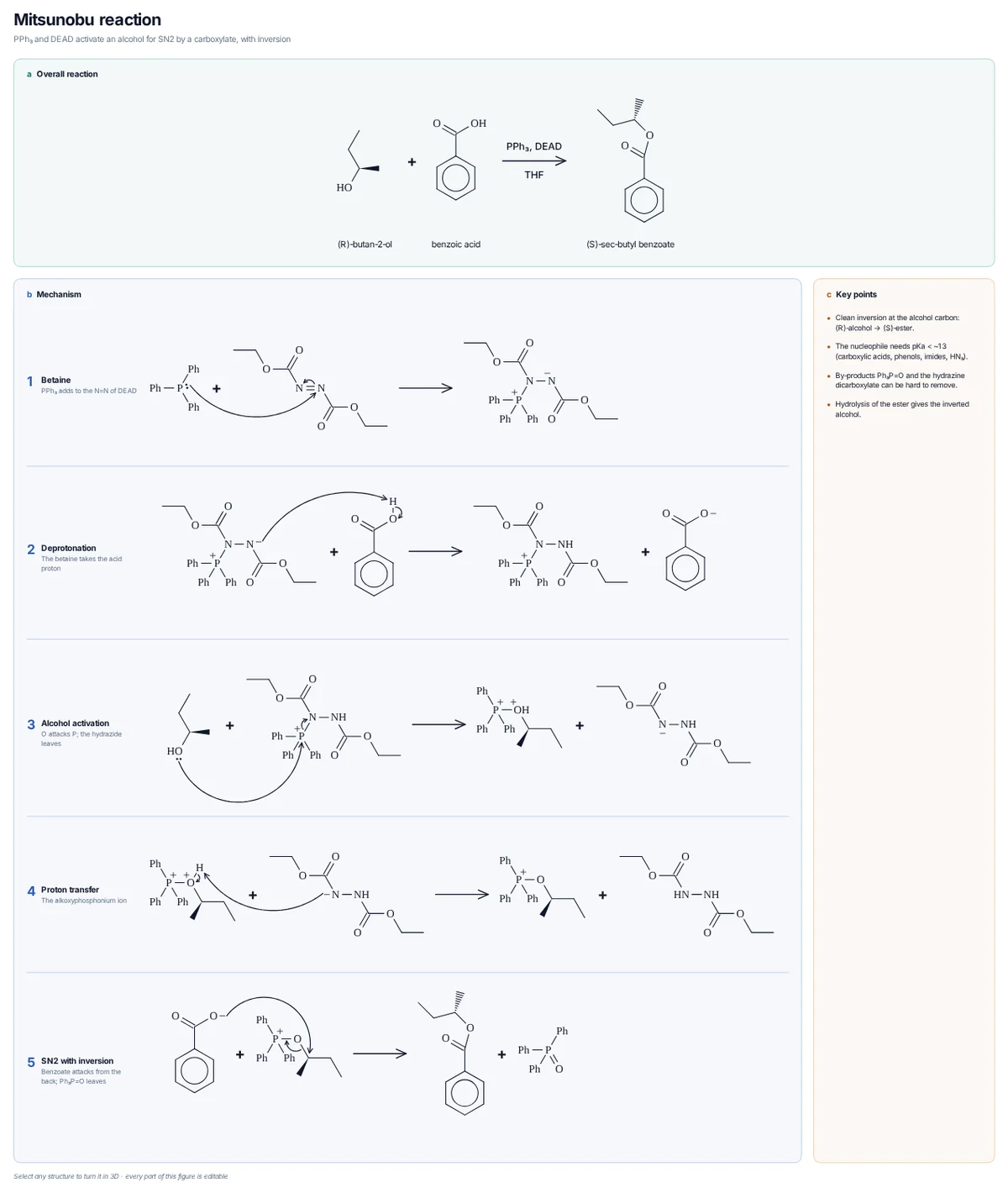
(R)-butan-2-ol + PhCOOH → (PPh₃, DEAD, THF) (S)-sec-butyl benzoate
PPh₃ and DEAD activate an alcohol for SN2 by a carboxylate, with inversion.
Each step is checked electron by electron: the curly arrows give exactly the structures drawn.
The last step is an SN2 backside attack of the nucleophile on the carbon bonded to the O–P⁺Ph₃ leaving group.
It must protonate the betaine; weakly acidic partners leave the hydrazide anion to compete as the nucleophile.
Triphenylphosphine oxide and diethyl hydrazine-1,2-dicarboxylate.
The button above opens the complete figure — overall reaction, numbered mechanism and key points — as ordinary editable structures. Change substituents, recolour atoms, or export a PNG, SVG or chemfig code for notes and slides. The same figure is in the Templates panel under Name reactions.