Overall reaction
Phenol + CHCl₃ + NaOH (aq), 60–70 °C, then H₃O⁺ → salicylaldehyde
Dichlorocarbene from chloroform formylates a phenoxide at the ortho position.
The Reimer–Tiemann reaction turns phenol into salicylaldehyde (2-hydroxybenzaldehyde) with chloroform and aqueous sodium hydroxide. The electrophile is dichlorocarbene, :CCl₂, made from chloroform by the base; phenoxide attacks it mainly at the ortho carbon, and hydrolysis of the CHCl₂ group gives the aldehyde.
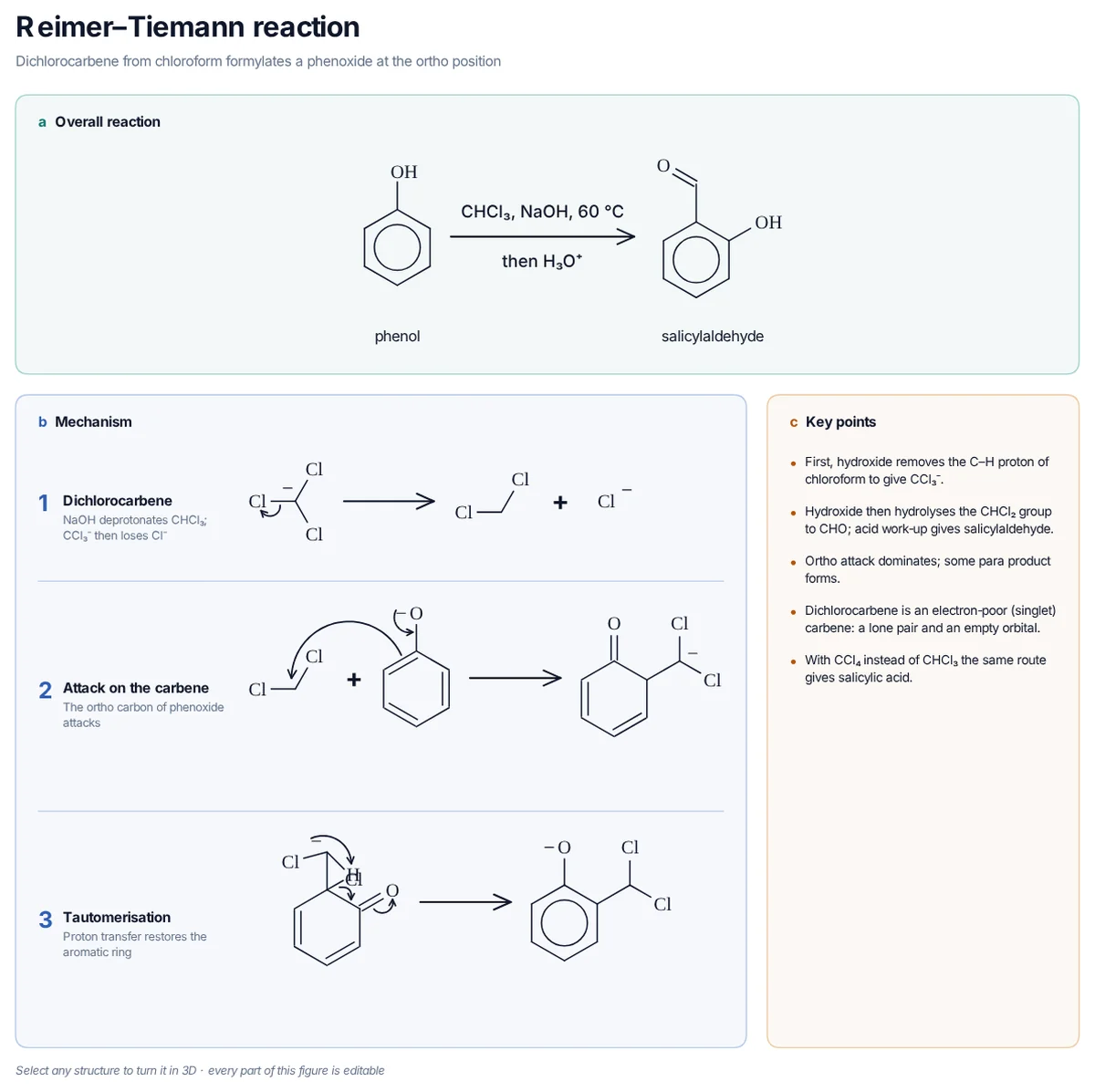
Phenol + CHCl₃ + NaOH (aq), 60–70 °C, then H₃O⁺ → salicylaldehyde
Dichlorocarbene from chloroform formylates a phenoxide at the ortho position.
Each step is checked electron by electron: the curly arrows give exactly the structures drawn.
Dichlorocarbene, :CCl₂. Hydroxide removes the acidic proton of chloroform to give CCl₃⁻, which loses chloride (α-elimination).
The phenoxide oxygen and the ortho carbon are close to the sodium counter-ion and the carbene in the two-phase system, and the ortho intermediate is stabilised by the neighbouring O⁻; para attack also happens but is minor.
Hydroxide replaces the two chlorines (via a chlorohydrin) and the gem-diol loses water, giving the aldehyde; acidification gives neutral salicylaldehyde.
The button above opens the complete figure — overall reaction, numbered mechanism and key points — as ordinary editable structures. Change substituents, recolour atoms, or export a PNG, SVG or chemfig code for notes and slides. The same figure is in the Templates panel under Name reactions.