Overall reaction
CH₂(COOEt)₂ + CH₂=CHCOCH₃ → (NaOEt) (EtOOC)₂CH–CH₂CH₂COCH₃
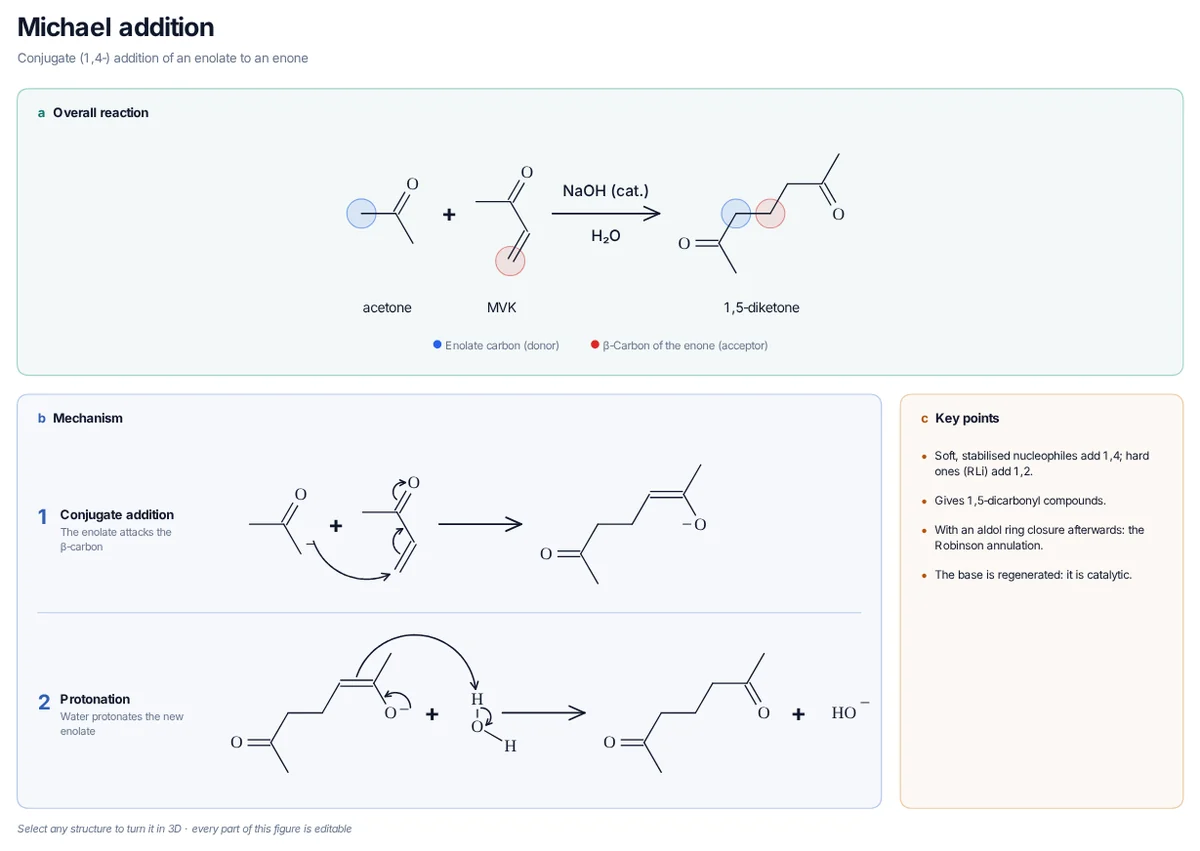
Conjugate (1,4-) addition of an enolate to an enone.
The Michael addition is the conjugate (1,4-) addition of a stabilised carbanion — a malonate, β-keto ester or nitroalkane anion — to the β-carbon of an α,β-unsaturated carbonyl compound. The enolate formed is then protonated to give a 1,5-dicarbonyl compound.
CH₂(COOEt)₂ + CH₂=CHCOCH₃ → (NaOEt) (EtOOC)₂CH–CH₂CH₂COCH₃
Conjugate (1,4-) addition of an enolate to an enone.
Each step is checked electron by electron: the curly arrows give exactly the structures drawn.
Conjugation with C=O makes the β-carbon electrophilic, and soft stabilised carbanions prefer this orbital-controlled site.
The donor is the stabilised carbanion (malonate, acetoacetate); the acceptor is the α,β-unsaturated carbonyl or nitrile.
The Robinson annulation is a Michael addition followed by an intramolecular aldol condensation that closes a six-membered ring.
The button above opens the complete figure — overall reaction, numbered mechanism and key points — as ordinary editable structures. Change substituents, recolour atoms, or export a PNG, SVG or chemfig code for notes and slides. The same figure is in the Templates panel under Name reactions.