Overall reaction
R–CON₃ → (heat) R–N=C=O + N₂ → (R′OH) R–NH–COOR′
An acyl azide loses N₂ and rearranges to an isocyanate, trapped as a carbamate.
In the Curtius rearrangement an acyl azide loses nitrogen on heating while its R group moves from carbon to nitrogen, giving an isocyanate. Alcohols trap the isocyanate as carbamates (Boc and Cbz amines), and water gives the amine with one carbon fewer after loss of CO₂.
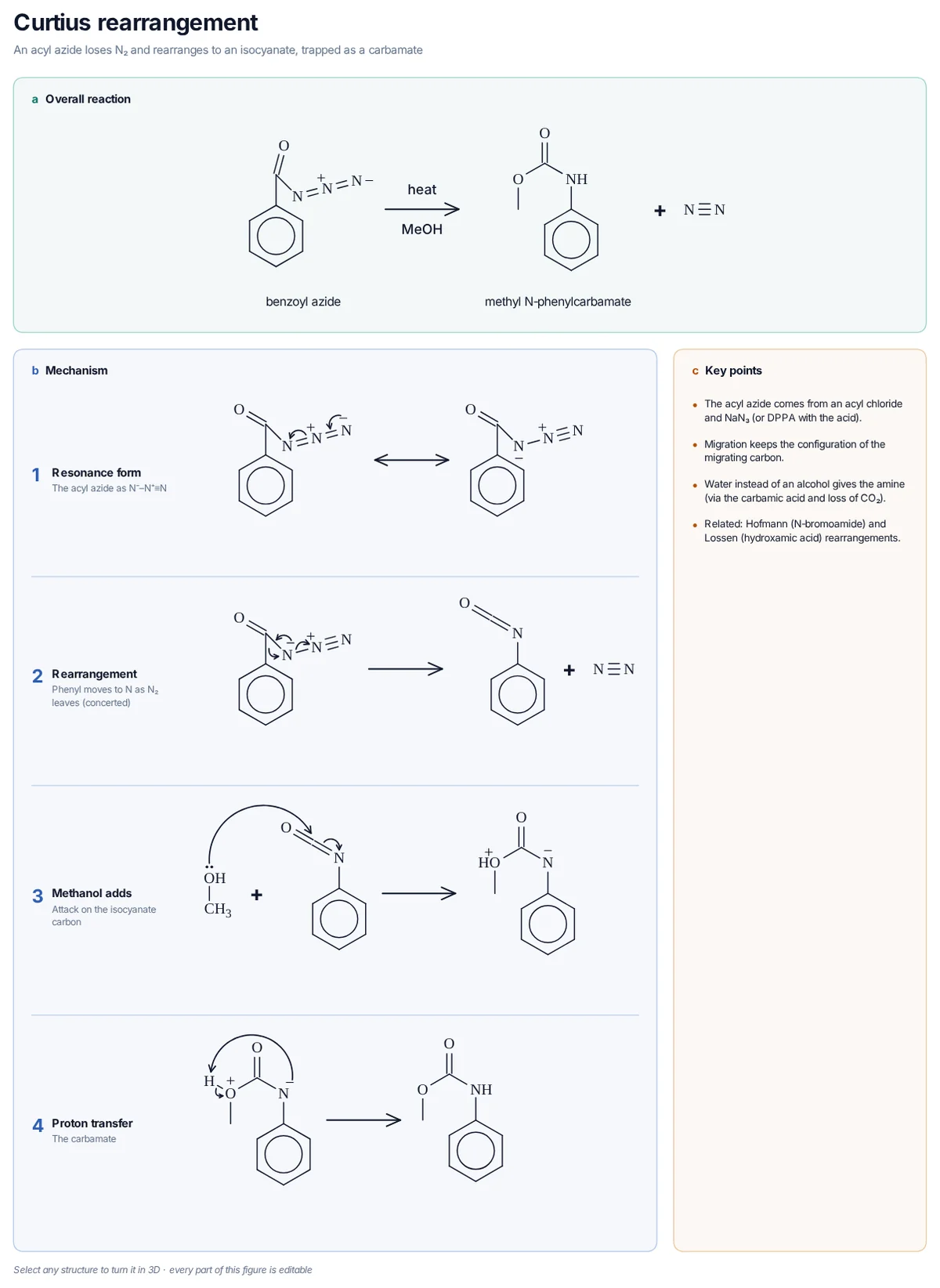
R–CON₃ → (heat) R–N=C=O + N₂ → (R′OH) R–NH–COOR′
An acyl azide loses N₂ and rearranges to an isocyanate, trapped as a carbamate.
Each step is checked electron by electron: the curly arrows give exactly the structures drawn.
Both give an isocyanate. Hofmann starts from a primary amide with Br₂/NaOH; Curtius from an acyl azide on heating, under neutral conditions.
Alcohols give carbamates, amines give ureas, water gives the amine after CO₂ loss.
Yes, migration occurs with retention of configuration.
The button above opens the complete figure — overall reaction, numbered mechanism and key points — as ordinary editable structures. Change substituents, recolour atoms, or export a PNG, SVG or chemfig code for notes and slides. The same figure is in the Templates panel under Name reactions.