Overall reaction
CH₃CH=CHCH₃ → (1. O₃, −78 °C; 2. Me₂S or Zn/H₂O) 2 CH₃CHO
Ozone cleaves C=C to two carbonyl groups (Criegee mechanism).
Ozonolysis cleaves a carbon–carbon double bond into two carbonyl groups. Ozone adds across the C=C (1,3-dipolar cycloaddition) to give the primary ozonide, which breaks into a carbonyl compound and a carbonyl oxide; these recombine to the secondary ozonide, which is reduced (Me₂S, Zn/H₂O) to aldehydes and ketones.
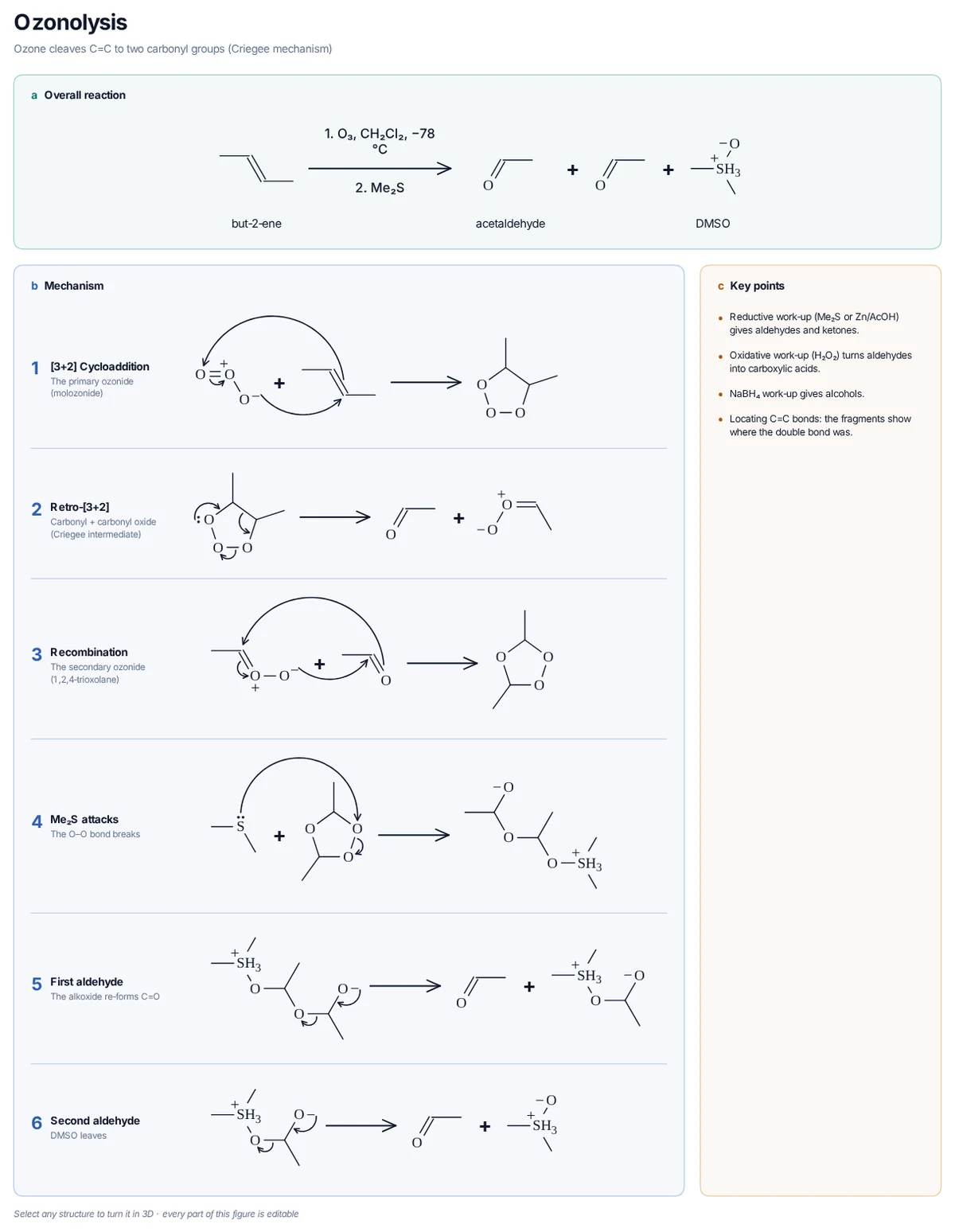
CH₃CH=CHCH₃ → (1. O₃, −78 °C; 2. Me₂S or Zn/H₂O) 2 CH₃CHO
Ozone cleaves C=C to two carbonyl groups (Criegee mechanism).
Each step is checked electron by electron: the curly arrows give exactly the structures drawn.
Reductive (Zn/H₂O, Me₂S) gives aldehydes and ketones; oxidative (H₂O₂) oxidises any aldehyde to a carboxylic acid.
The 1,2,4-trioxolane formed when the carbonyl oxide and carbonyl fragments recombine; it is explosive and is not isolated.
Two molecules of acetaldehyde (ethanal) with a reductive work-up.
The button above opens the complete figure — overall reaction, numbered mechanism and key points — as ordinary editable structures. Change substituents, recolour atoms, or export a PNG, SVG or chemfig code for notes and slides. The same figure is in the Templates panel under Name reactions.