Reaction Scheme
aldehyde or ketone + phosphonium ylide -> alkeneOften run in ether, THF, or hydrocarbon solvents depending on ylide stability.
Primary reaction SMILES: O=Cc1ccccc1.C=P(c1ccccc1)(c1ccccc1)c1ccccc1>>C=Cc1ccccc1
The Wittig reaction converts aldehydes or ketones into alkenes using a phosphonium ylide. It is one of the most searched named reactions for alkene synthesis.
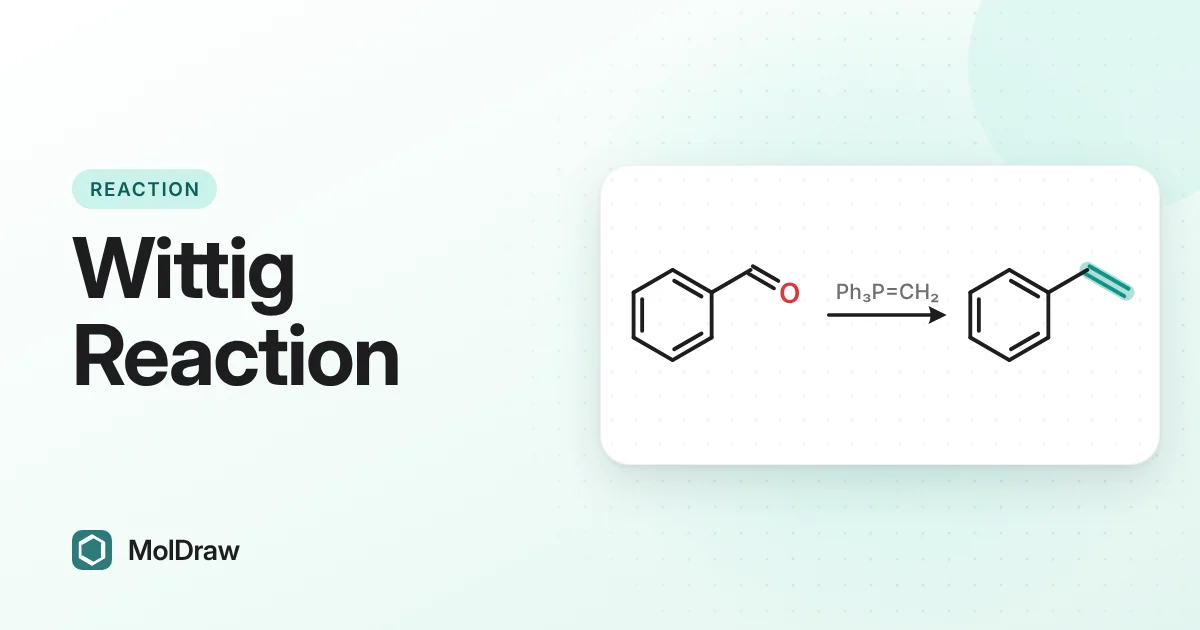
Primary reaction SMILES: O=Cc1ccccc1.C=P(c1ccccc1)(c1ccccc1)c1ccccc1>>C=Cc1ccccc1
Benzaldehyde plus methylene ylide gives styrene.
Cyclohexanone can be converted to methylenecyclohexane.
Open the reaction in MolDraw to edit reactant labels, add conditions, or export a clean scheme.
The Wittig reaction converts an aldehyde or ketone into an alkene. A phosphonium salt, made from triphenylphosphine and an alkyl halide, is deprotonated by a strong base to give a phosphorus ylide (Ph3P=CHR). The ylide adds to the carbonyl to form a four-membered oxaphosphetane, which breaks down to the alkene and triphenylphosphine oxide. The very strong P=O bond formed drives the reaction.
Example: benzaldehyde + Ph3P=CH2 gives styrene and Ph3P=O. How do I draw it? Show the ylide in both resonance forms if you are teaching the mechanism, draw the oxaphosphetane intermediate in brackets, and show E or Z geometry explicitly on the product.