Williamson Ether Synthesis: SN2 Mechanism, Choosing Partners and JEE/NEET Questions
Short answer: An alkoxide or phenoxide attacks a methyl or primary alkyl halide in one SN2 step to give an ether: R–O− + R′–X → R–O–R′ + X−. Put the bulky group on the alkoxide; tertiary halides give alkenes (E2) instead.
What is the Williamson Ether Synthesis?
The Williamson synthesis is the most general way to make unsymmetrical ethers. Exam questions almost always test one idea: which combination of alkoxide and halide works, and which one gives an alkene instead.
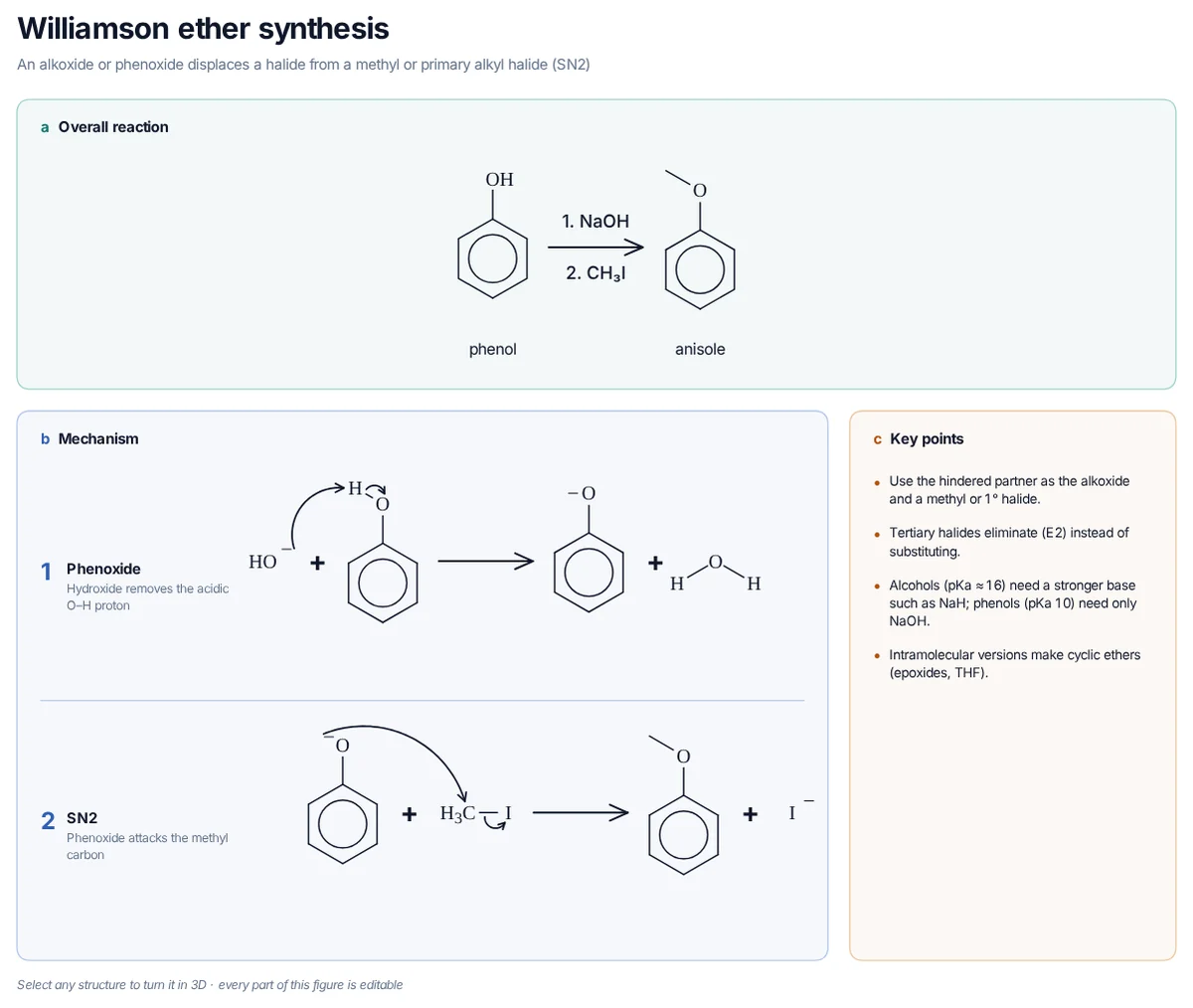
The template draws phenol → anisole in two steps. Open it in MolDraw to try ethoxide or a different halide.
Reaction at a glance
| Nucleophile | Alkoxide (from ROH + Na or NaH) or phenoxide (from ArOH + NaOH) |
|---|---|
| Electrophile | Methyl or primary alkyl halide / tosylate |
| Mechanism | SN2 (backside attack, inversion) |
| Example | Phenol + NaOH, then CH3I → anisole |
| Fails with | Tertiary halides (E2), aryl halides (no SN2) |
Mechanism step by step
- Making the alkoxide. Phenols (pKa ≈ 10) are deprotonated by NaOH. Alcohols (pKa ≈ 16) need sodium metal or NaH.
- SN2 attack. The negative oxygen attacks the carbon bonded to the halogen from the opposite side, and the halide leaves in the same step. A stereocentre at that carbon is inverted.
Every step in the template is checked electron by electron: the curly arrows give exactly the structures that are drawn. Open it in MolDraw to follow the arrows one step at a time.
Worked examples
- Phenol → anisole. NaOH, then CH3I (or dimethyl sulfate).
- Ethanol → diethyl ether. Na, then C2H5Br.
- tert-Butyl methyl ether (MTBE). (CH3)3CO−Na+ + CH3Br works; CH3O− + (CH3)3CBr gives 2-methylpropene instead.
- Intramolecular: epoxides and THF. A halohydrin in base closes to an epoxide; 4-chlorobutanol gives tetrahydrofuran.
JEE and NEET practice questions
Q1. The best way to prepare tert-butyl methyl ether is:
Show answer
(CH3)3CONa + CH3Br — SN2 needs the unhindered methyl halide; the tertiary halide would undergo E2.
Q2. Sodium methoxide + tert-butyl bromide mainly gives:
Show answer
2-Methylpropene — The strong base removes a β-H (E2).
Q3. Anisole can be prepared from:
Show answer
Sodium phenoxide + CH3I — Aryl halides do not undergo SN2, so the aryl group must be on the oxygen nucleophile.
Q4. What happens to the configuration of (R)-2-bromobutane with ethoxide in a Williamson reaction?
Show answer
It is inverted: (S)-2-ethoxybutane (with some elimination). — SN2 backside attack.
Common mistakes
- Putting the bulky group on the halide — it must be on the alkoxide.
- Using an aryl halide as the electrophile.
- Forgetting that secondary halides give ether + alkene mixtures.
- Using NaOH to deprotonate an ordinary alcohol (it is not strong enough).
Edit this mechanism in MolDraw
- Click Open in MolDraw. The editor opens with the whole figure on the canvas: the overall reaction, each numbered step and the key points.
- Everything is an ordinary structure. Change a substituent, recolour atoms or move an arrow, and the arrows stay attached to their atoms.
- Download it as PNG, SVG or PDF, or copy it into your notes or slides.
- The same figure is in the editor under Templates → Schemes → Name reactions.
Questions and answers
Why can di-tert-butyl ether not be made by Williamson synthesis?
Every combination needs a tertiary halide, which eliminates (E2) with the strongly basic alkoxide.
Is the Williamson synthesis SN1 or SN2?
SN2: one step, backside attack, inversion of configuration at the carbon attacked.
Which solvents are best?
Polar aprotic solvents such as DMF, DMSO or acetone speed up the SN2 step.