Overall reaction
2 C₆H₅CHO → (KCN, aqueous ethanol) C₆H₅CO–CH(OH)C₆H₅
Cyanide reverses the polarity of an aldehyde carbon (umpolung).
In the benzoin condensation two molecules of an aromatic aldehyde join to form an α-hydroxy ketone (benzoin) under catalysis by cyanide. Cyanide adds to one aldehyde; the C–H next to C≡N becomes acidic, and the resulting carbanion — a masked acyl anion — attacks a second aldehyde before cyanide is expelled.
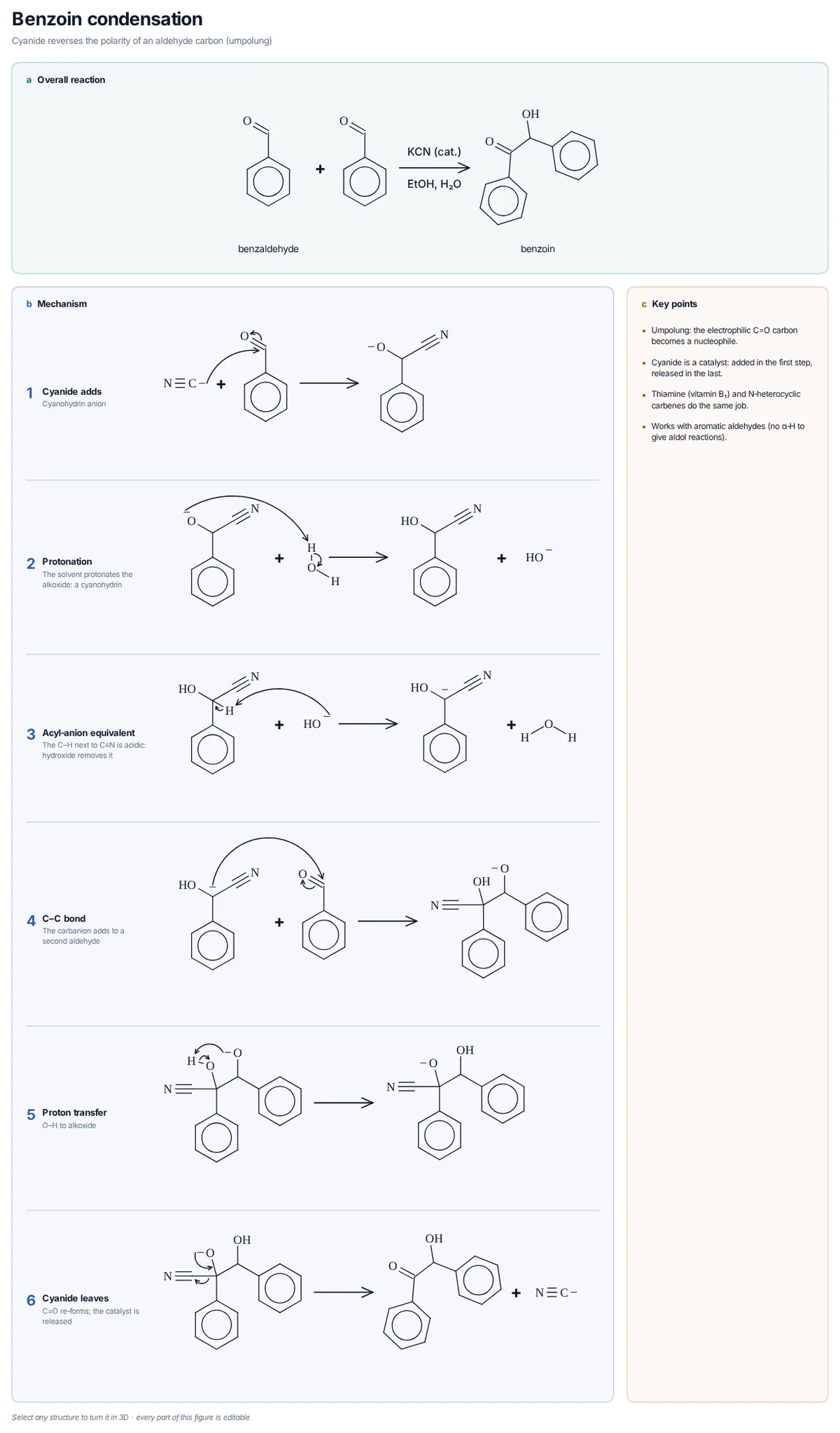
2 C₆H₅CHO → (KCN, aqueous ethanol) C₆H₅CO–CH(OH)C₆H₅
Cyanide reverses the polarity of an aldehyde carbon (umpolung).
Each step is checked electron by electron: the curly arrows give exactly the structures drawn.
It is a good nucleophile, it acidifies the neighbouring C–H, and it is a good leaving group at the end.
Polarity reversal: the normally electrophilic aldehyde carbon acts as a nucleophile while bonded to CN.
Not easily with cyanide; enolisable aldehydes undergo aldol reactions. Thiazolium/NHC catalysts extend the scope.
The button above opens the complete figure — overall reaction, numbered mechanism and key points — as ordinary editable structures. Change substituents, recolour atoms, or export a PNG, SVG or chemfig code for notes and slides. The same figure is in the Templates panel under Name reactions.