Name reaction · mechanism

Swern Oxidation

The Swern oxidation turns primary alcohols into aldehydes and secondary alcohols into ketones without over-oxidation or heavy metals. DMSO is activated by oxalyl chloride at −78 °C (releasing CO₂, CO and chloride), the alcohol adds to sulfur, triethylamine forms a sulfur ylide, and an intramolecular elimination gives the carbonyl compound and dimethyl sulfide.
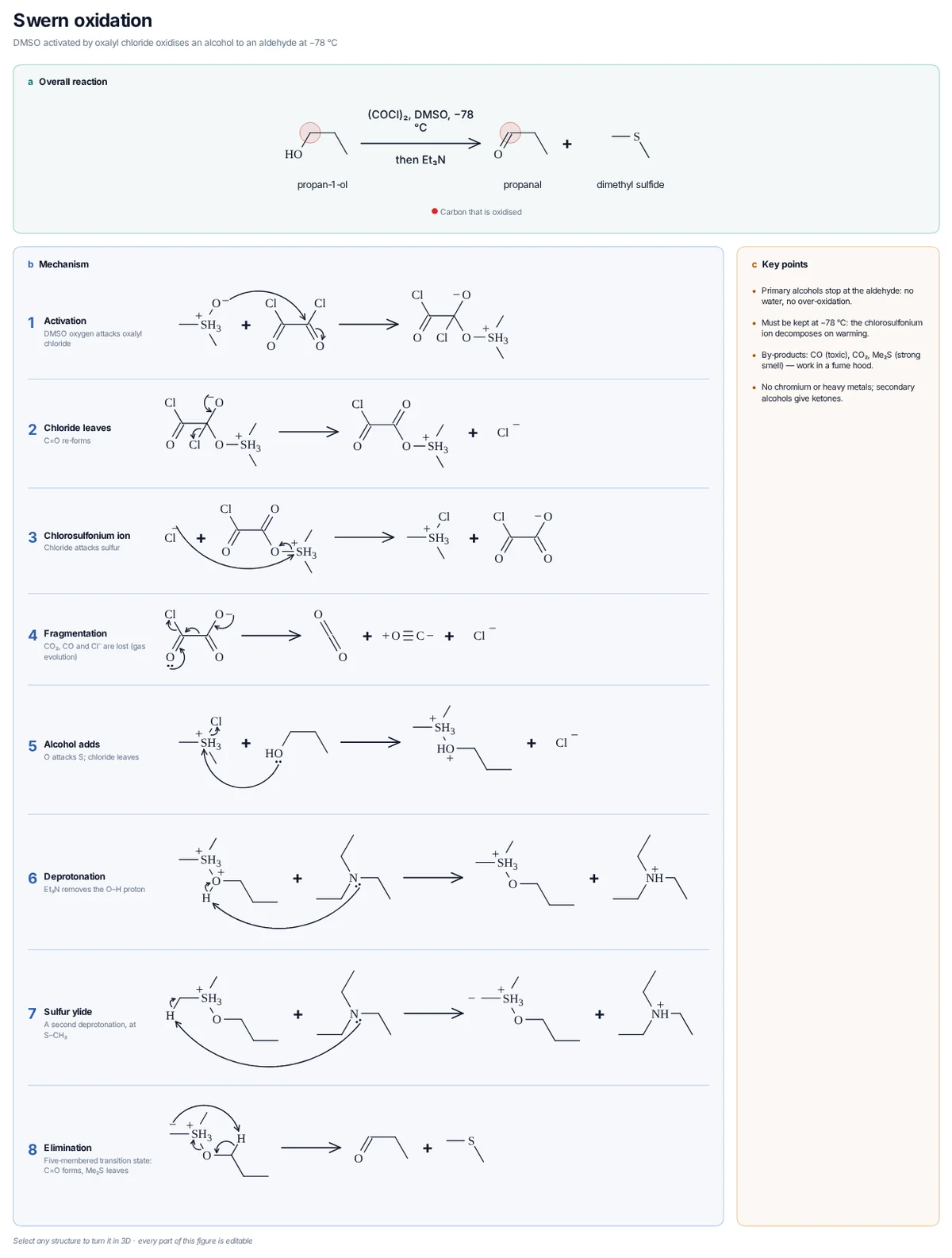
Swern Oxidation mechanism: DMSO and oxalyl chloride give the chlorosulfonium ion (with CO₂, CO and Cl⁻); the alcohol adds, Et₃N forms the ylide and a five-membered elimination gives propanal and Me₂S.
Swern oxidation: overall reaction, every curly-arrow step and key points. Click to open and edit it in MolDraw.

Overall reaction

RCH₂OH → (1. (COCl)₂, DMSO, −78 °C; 2. Et₃N) RCHO + Me₂S + CO + CO₂

DMSO activated by oxalyl chloride oxidises an alcohol to an aldehyde at −78 °C.

Mechanism step by step

  1. Activation. DMSO oxygen attacks oxalyl chloride
  2. Chloride leaves. C=O re-forms
  3. Chlorosulfonium ion. Chloride attacks sulfur
  4. Fragmentation. CO₂, CO and Cl⁻ are lost (gas evolution)
  5. Alcohol adds. O attacks S; chloride leaves
  6. Deprotonation. Et₃N removes the O–H proton
  7. Sulfur ylide. A second deprotonation, at S–CH₃
  8. Elimination. Five-membered transition state: C=O forms, Me₂S leaves

Each step is checked electron by electron: the curly arrows give exactly the structures drawn.

Open and edit this mechanism

Key points

  • Primary alcohols stop at the aldehyde: no water, no over-oxidation.
  • Must be kept at −78 °C: the chlorosulfonium ion decomposes on warming.
  • By-products: CO (toxic), CO₂, Me₂S (strong smell) — work in a fume hood.
  • No chromium or heavy metals; secondary alcohols give ketones.

For JEE and NEET

  • Stops at the aldehyde (no water present).
  • Needs −78 °C until the base is added.
  • By-products: dimethyl sulfide (smell), CO (toxic) and CO₂.
  • Alternatives: PCC, Dess–Martin periodinane.

FAQ

Why does the Swern oxidation not over-oxidise to the acid?

No water is present, so the aldehyde cannot form a hydrate that would be oxidised further.

What is the role of triethylamine?

It deprotonates the alkoxysulfonium ion to a sulfur ylide, which removes the C–H through a five-membered transition state.

Why −78 °C?

The activated DMSO species decomposes above about −60 °C.

Draw it in MolDraw

The button above opens the complete figure — overall reaction, numbered mechanism and key points — as ordinary editable structures. Change substituents, recolour atoms, or export a PNG, SVG or chemfig code for notes and slides. The same figure is in the Templates panel under Name reactions.