Name reaction · mechanism

Hydroboration–Oxidation

Hydroboration–oxidation converts an alkene into an alcohol with the OH on the less substituted carbon (anti-Markovnikov) and with syn addition of H and OH. Borane adds H and B across the C=C in a single four-centre step; alkaline hydrogen peroxide then replaces boron by OH with retention of configuration.
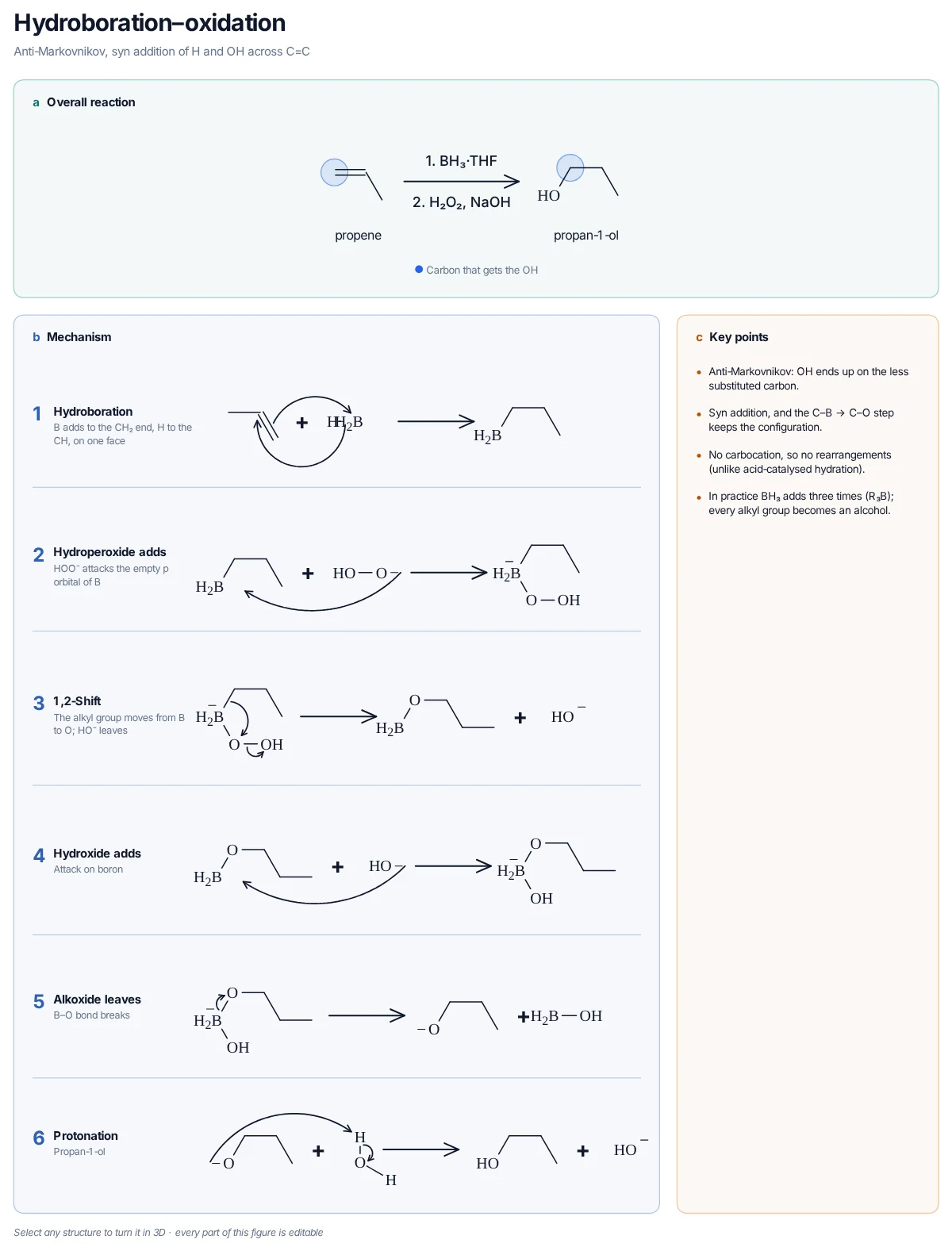
Hydroboration–Oxidation mechanism: BH₃ adds H and B in one four-centre step, B on the less hindered carbon; HOO⁻ adds to boron, the alkyl shifts to oxygen and hydrolysis gives propan-1-ol.
Hydroboration–oxidation: overall reaction, every curly-arrow step and key points. Click to open and edit it in MolDraw.

Overall reaction

CH₃CH=CH₂ → (1. BH₃·THF; 2. H₂O₂, NaOH) CH₃CH₂CH₂OH

Anti-Markovnikov, syn addition of H and OH across C=C.

Mechanism step by step

  1. Hydroboration. B adds to the CH₂ end, H to the CH, on one face
  2. Hydroperoxide adds. HOO⁻ attacks the empty p orbital of B
  3. 1,2-Shift. The alkyl group moves from B to O; HO⁻ leaves
  4. Hydroxide adds. Attack on boron
  5. Alkoxide leaves. B–O bond breaks
  6. Protonation. Propan-1-ol

Each step is checked electron by electron: the curly arrows give exactly the structures drawn.

Open and edit this mechanism

Key points

  • Anti-Markovnikov: OH ends up on the less substituted carbon.
  • Syn addition, and the C–B → C–O step keeps the configuration.
  • No carbocation, so no rearrangements (unlike acid-catalysed hydration).
  • In practice BH₃ adds three times (R₃B); every alkyl group becomes an alcohol.

For JEE and NEET

  • Anti-Markovnikov: propene gives propan-1-ol (acid-catalysed hydration gives propan-2-ol).
  • Syn addition; no carbocation, so no rearrangements.
  • The C–B → C–O step keeps the configuration.
  • Each BH₃ adds to three alkenes (trialkylborane) before oxidation.

FAQ

Why is hydroboration anti-Markovnikov?

Boron, the larger and electron-poor end of B–H, bonds to the less hindered carbon, and the partial positive charge in the transition state develops on the more substituted carbon.

Why are there no rearrangements?

The addition is concerted through a four-centre transition state; no free carbocation forms.

What does the oxidation step do?

Hydroperoxide adds to boron, an alkyl group shifts from B to O with retention, and hydrolysis releases the alcohol.

Draw it in MolDraw

The button above opens the complete figure — overall reaction, numbered mechanism and key points — as ordinary editable structures. Change substituents, recolour atoms, or export a PNG, SVG or chemfig code for notes and slides. The same figure is in the Templates panel under Name reactions.