Kolbe Reaction (Kolbe–Schmitt): Mechanism, Aspirin Route and JEE/NEET Questions
Short answer: Sodium phenoxide heated with CO2 (about 125 °C, 4–7 atm), then acidified, gives salicylic acid. The ortho carbon of phenoxide attacks CO2, the dienone tautomerises back to an aromatic ring, and acid protonates the carboxylate and phenoxide.
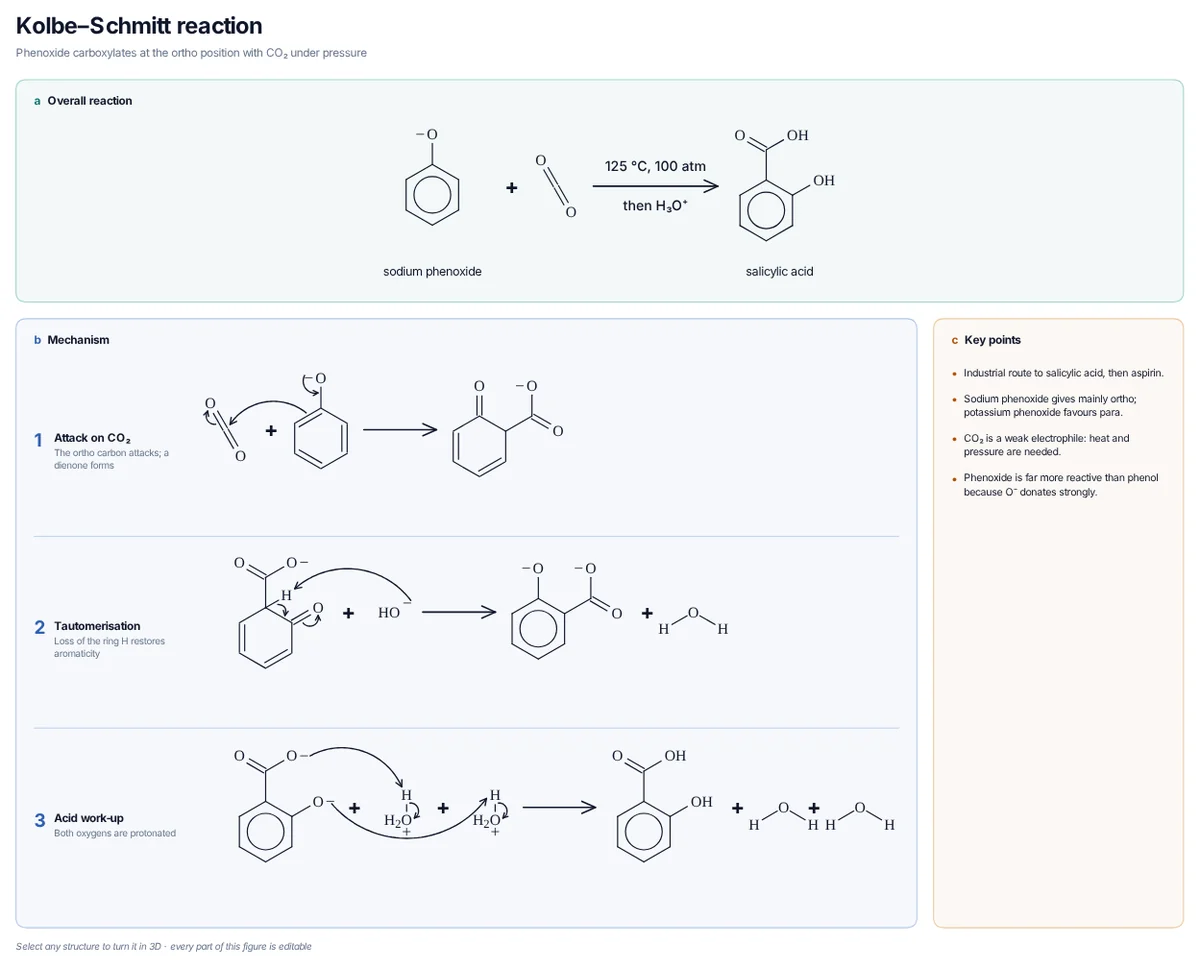
What is the Kolbe Reaction: Phenol to Salicylic Acid?
In Indian textbooks this reaction is usually called the Kolbe reaction; chemists elsewhere call it the Kolbe–Schmitt reaction. It is the industrial route to salicylic acid and therefore to aspirin.
The template shows the three curly-arrow steps. Open it in MolDraw to try potassium phenoxide or a substituted phenol.
Reaction at a glance
| Substrate | Sodium phenoxide (phenol + NaOH) |
|---|---|
| Reagents | CO2 under pressure, ~125 °C (400 K); then H3O+ |
| Electrophile | Carbon dioxide (weak electrophile) |
| Product | Salicylic acid (2-hydroxybenzoic acid) |
| Use | Salicylic acid + acetic anhydride → aspirin |
Mechanism step by step
- Phenoxide attacks CO2. The negative oxygen donates into the ring and the ortho carbon attacks the carbon of CO2; one C=O π bond moves onto oxygen. The ring is briefly a cyclohexadienone carrying a carboxylate.
- Tautomerisation. The ring C–H next to the new C–C bond is removed and the electrons restore the aromatic ring, re-forming the phenoxide. Now the ring carries COO− ortho to O−.
- Acid work-up. Dilute acid protonates the carboxylate and the phenoxide, giving neutral salicylic acid.
Every step in the template is checked electron by electron: the curly arrows give exactly the structures that are drawn. Open it in MolDraw to follow the arrows one step at a time.
Worked examples
- Sodium phenoxide → salicylic acid. Mainly ortho. Chelation of Na+ between the phenoxide O and CO2 is thought to steer the attack to the ortho carbon.
- Potassium phenoxide → 4-hydroxybenzoic acid. With K+ and higher temperature the para product dominates.
- Salicylic acid → aspirin. Acetylation of the OH with acetic anhydride (H2SO4 catalyst) gives acetylsalicylic acid.
JEE and NEET practice questions
Q1. Sodium phenoxide is heated with CO2 at 400 K and 4–7 atm, then acidified. The product is:
Show answer
Salicylic acid — Ortho carboxylation of phenoxide (Kolbe reaction).
Q2. Why is phenoxide used rather than phenol?
Show answer
CO2 is a weak electrophile; only the strongly activated phenoxide ring is nucleophilic enough. — O− is a much stronger electron donor than OH.
Q3. Salicylic acid reacts with acetic anhydride to give:
Show answer
Aspirin — The phenolic OH is acetylated.
Q4. Electrolysis of aqueous sodium acetate (Kolbe electrolysis) gives:
Show answer
Ethane — A different reaction: CH3• radicals couple at the anode.
Common mistakes
- Confusing the Kolbe reaction (phenoxide + CO2) with Kolbe electrolysis (carboxylate salts → alkanes).
- Starting from phenol instead of sodium phenoxide.
- Forgetting acidification — the product is formed first as the sodium salt.
- Drawing the CO2 attacking oxygen instead of the ortho carbon.
Edit this mechanism in MolDraw
- Click Open in MolDraw. The editor opens with the whole figure on the canvas: the overall reaction, each numbered step and the key points.
- Everything is an ordinary structure. Change a substituent, recolour atoms or move an arrow, and the arrows stay attached to their atoms.
- Download it as PNG, SVG or PDF, or copy it into your notes or slides.
- The same figure is in the editor under Templates → Schemes → Name reactions.
Questions and answers
What is the difference between the Kolbe and Kolbe–Schmitt reactions?
They are the same carboxylation of phenoxide; Schmitt introduced the pressure conditions. Kolbe electrolysis is a different reaction.
Why is high pressure needed?
CO₂ is a gas and a weak electrophile; pressure raises its concentration in the reaction mixture.
What is salicylic acid used for?
Making aspirin and methyl salicylate (oil of wintergreen), and in skin-care products.