Name reaction · mechanism

Hofmann Bromamide Reaction (Hofmann Rearrangement)

The Hofmann bromamide reaction converts a primary amide into a primary amine with one carbon fewer, using bromine and sodium hydroxide. The amide is N-brominated, the N-bromoamide anion rearranges to an isocyanate as the alkyl group moves from carbon to nitrogen, and the isocyanate is hydrolysed and decarboxylated.
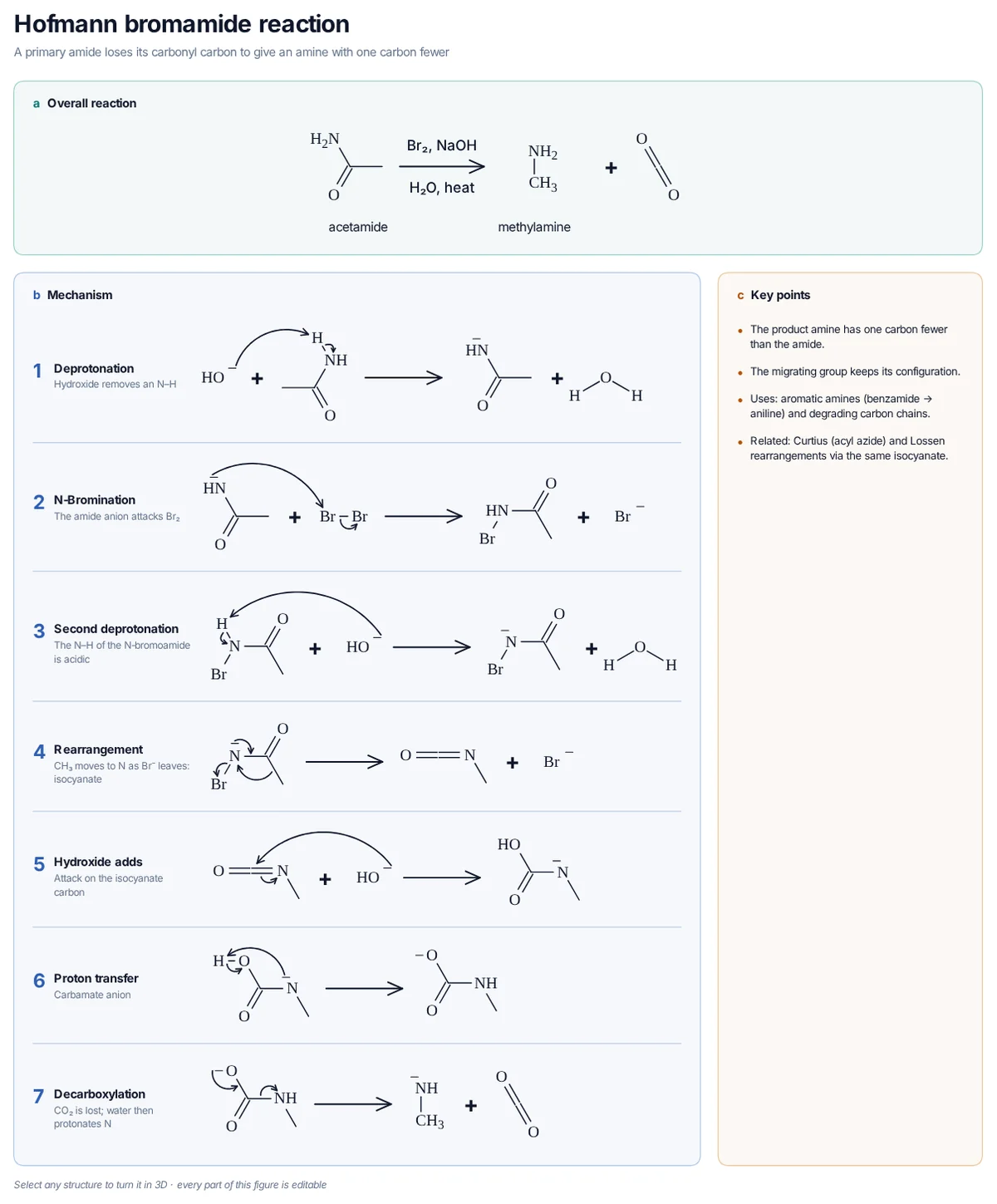
Hofmann Bromamide Reaction mechanism: N-bromination, migration of the alkyl group to nitrogen (isocyanate), hydration and decarboxylation turn acetamide into methylamine.
Hofmann bromamide reaction: overall reaction, every curly-arrow step and key points. Click to open and edit it in MolDraw.

Overall reaction

R–CONH₂ + Br₂ + 4 NaOH → R–NH₂ + Na₂CO₃ + 2 NaBr + 2 H₂O

A primary amide loses its carbonyl carbon to give an amine with one carbon fewer.

Mechanism step by step

  1. Deprotonation. Hydroxide removes an N–H
  2. N-Bromination. The amide anion attacks Br₂
  3. Second deprotonation. The N–H of the N-bromoamide is acidic
  4. Rearrangement. CH₃ moves to N as Br⁻ leaves: isocyanate
  5. Hydroxide adds. Attack on the isocyanate carbon
  6. Proton transfer. Carbamate anion
  7. Decarboxylation. CO₂ is lost; water then protonates N

Each step is checked electron by electron: the curly arrows give exactly the structures drawn.

Open and edit this mechanism

Key points

  • The product amine has one carbon fewer than the amide.
  • The migrating group keeps its configuration.
  • Uses: aromatic amines (benzamide → aniline) and degrading carbon chains.
  • Related: Curtius (acyl azide) and Lossen rearrangements via the same isocyanate.

For JEE and NEET

  • The product amine has one carbon fewer than the amide (e.g. acetamide → methylamine, benzamide → aniline).
  • Intermediate: isocyanate, R–N=C=O; the migrating group keeps its configuration.
  • Only primary amides (–CONH₂) react.
  • Related rearrangements via the same isocyanate: Curtius (acyl azide) and Lossen (hydroxamic acid).

FAQ

Why does the amine have one carbon fewer?

The carbonyl carbon becomes the carbon of the isocyanate, which is lost as CO₂ (carbonate) after hydrolysis.

What is the key intermediate?

The isocyanate R–N=C=O, formed when R migrates from carbon to nitrogen as bromide leaves the N-bromoamide anion.

What does benzamide give?

Aniline (C₆H₅NH₂).

Draw it in MolDraw

The button above opens the complete figure — overall reaction, numbered mechanism and key points — as ordinary editable structures. Change substituents, recolour atoms, or export a PNG, SVG or chemfig code for notes and slides. The same figure is in the Templates panel under Name reactions.