Sandmeyer Reaction: Diazotisation, Radical Mechanism and JEE/NEET Questions
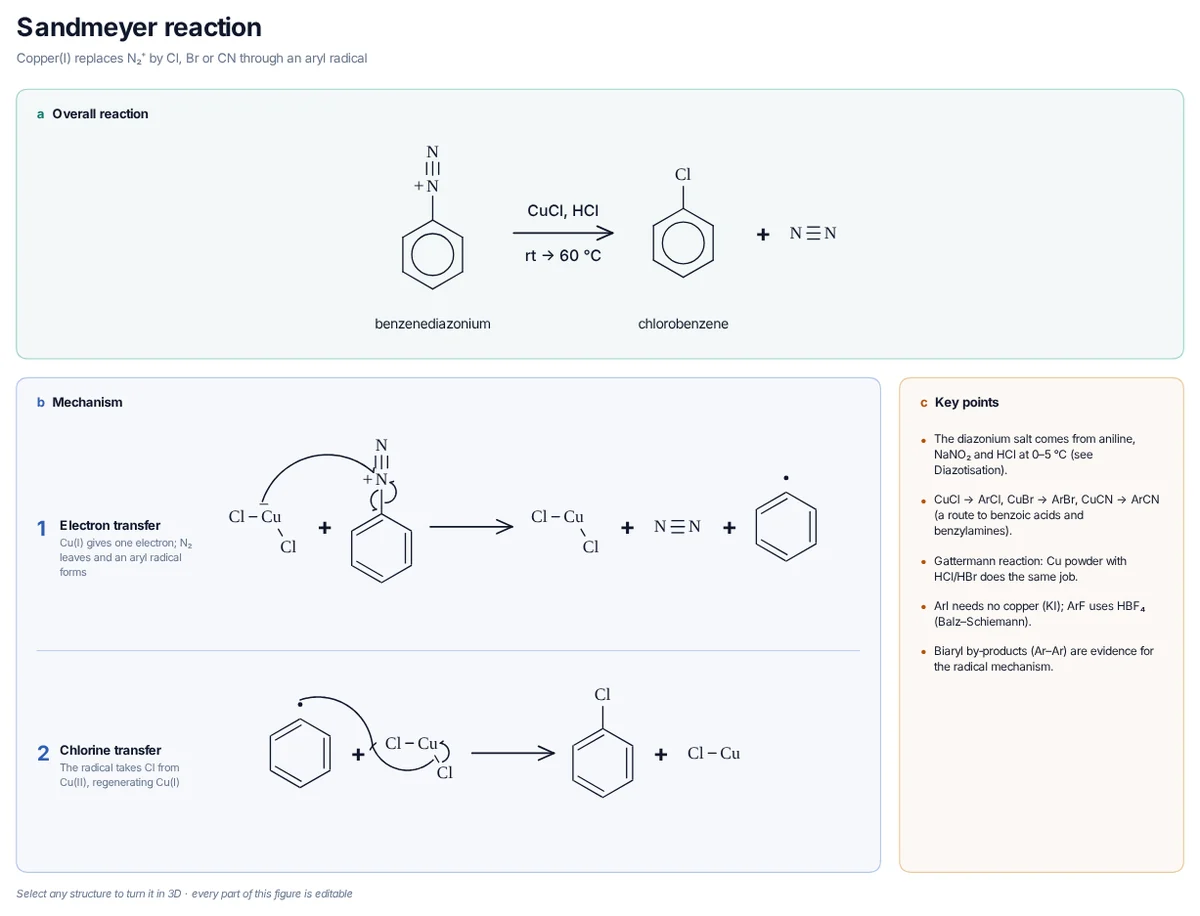
Short answer: Aniline is first converted into benzenediazonium chloride with NaNO2 and HCl at 0–5 °C. Warming it with CuCl, CuBr or CuCN replaces N2 by Cl, Br or CN. Copper(I) gives one electron to the diazonium ion, N2 leaves as gas to give an aryl radical, and the radical takes the halogen from copper(II).
What is the Sandmeyer Reaction and Diazotisation?
The Sandmeyer reaction is the most useful way to put Cl, Br or CN on a benzene ring in a specific position. Because the amino group can be placed first and then replaced, it gives substitution patterns that direct halogenation cannot.
MolDraw has two templates: the diazotisation (eight steps, from nitrous acid to the diazonium ion) and the Sandmeyer step itself with fish-hook arrows for the radical chemistry.
Reaction at a glance
| Step 1 (diazotisation) | ArNH2 + NaNO2 + HCl, 0–5 °C → ArN2+Cl− |
|---|---|
| Step 2 (Sandmeyer) | CuCl/HCl → ArCl; CuBr/HBr → ArBr; CuCN/KCN → ArCN |
| Intermediate | Aryl radical (after loss of N2) |
| Copper | Cu(I) → Cu(II) → Cu(I): regenerated |
| Related | Gattermann (Cu powder), KI (ArI), Balz–Schiemann (ArF) |
Mechanism step by step
- Nitrosonium ion. NaNO2 + HCl gives HNO2. Protonation and loss of water give the electrophile N≡O+.
- N-Nitrosation. The amine nitrogen attacks NO+; loss of a proton gives the N-nitrosamine Ar–NH–N=O.
- Tautomerisation. Protonation on oxygen and loss of the N–H proton turn it into the diazohydroxide Ar–N=N–OH.
- Diazonium ion. The OH is protonated and leaves as water, giving Ar–N+≡N. Kept at 0–5 °C, it is stable enough to use.
- Electron transfer (Sandmeyer). Copper(I) (as CuCl2−) gives one electron to the diazonium ion. N2 leaves and an aryl radical forms; copper becomes Cu(II).
- Halogen transfer. The aryl radical takes Cl from CuCl2, giving chlorobenzene and regenerating copper(I).
Every step in the template is checked electron by electron: the curly arrows give exactly the structures that are drawn. Open it in MolDraw to follow the arrows one step at a time.
Worked examples
- Aniline → chlorobenzene. NaNO2/HCl, 0–5 °C, then CuCl/HCl.
- Aniline → benzonitrile → benzoic acid. CuCN/KCN gives PhCN; hydrolysis gives benzoic acid. This adds one carbon to the ring.
- Aniline → iodobenzene. KI alone — no copper needed.
- Aniline → fluorobenzene. Balz–Schiemann: HBF4 gives ArN2+BF4−, which loses N2 and BF3 on heating.
- Aniline → benzene. H3PO2 replaces N2+ by H (useful to remove an NH2 used as a directing group).
JEE and NEET practice questions
Q1. Benzenediazonium chloride + CuCN, then hydrolysis, gives:
Show answer
Benzoic acid — CuCN gives benzonitrile; hydrolysis converts CN to COOH.
Q2. Which conversion does not need a copper salt?
Show answer
ArN2+ → ArI — Iodide is a good enough reducing agent and nucleophile: KI alone works.
Q3. Fluorobenzene is best made from aniline by:
Show answer
Diazotisation, then HBF4 and heat (Balz–Schiemann) — CuF does not work in a Sandmeyer reaction.
Q4. Why is diazotisation carried out at 0–5 °C?
Show answer
The diazonium salt decomposes on warming (to phenol + N2). — Aryl diazonium salts are only stable cold.
Q5. Sandmeyer vs Gattermann reaction:
Show answer
Sandmeyer uses Cu(I) salts; Gattermann uses copper powder with HX. — Both give ArCl/ArBr; Gattermann usually in lower yield.
Common mistakes
- Writing an SN1 aryl cation mechanism — the Sandmeyer reaction goes through an aryl radical.
- Using CuF or CuI: fluorides use HBF4 and iodides use KI.
- Doing diazotisation at room temperature.
- Forgetting that copper(I) is regenerated (catalytic in principle).
Edit this mechanism in MolDraw
- Click Open in MolDraw. The editor opens with the whole figure on the canvas: the overall reaction, each numbered step and the key points.
- Everything is an ordinary structure. Change a substituent, recolour atoms or move an arrow, and the arrows stay attached to their atoms.
- Download it as PNG, SVG or PDF, or copy it into your notes or slides.
- The same figure is in the editor under Templates → Schemes → Name reactions.
Questions and answers
What is the role of copper in the Sandmeyer reaction?
Copper(I) transfers one electron to the diazonium ion; after N₂ leaves, the aryl radical takes the halogen from copper(II), which regenerates copper(I).
What is the evidence for a radical mechanism?
Biaryl (Ar–Ar) by-products form from two aryl radicals coupling.
Can aliphatic amines be used?
No. Aliphatic diazonium ions lose N₂ at once and give alcohols and alkenes.