Overall reaction
Acetophenone + CH₃CO₃H (or mCPBA) → phenyl acetate
A peroxyacid inserts an oxygen next to the carbonyl: ketone → ester.
The Baeyer–Villiger oxidation inserts an oxygen atom between a carbonyl carbon and one of its neighbours, turning ketones into esters and cyclic ketones into lactones. A peroxyacid adds to the carbonyl to give the Criegee intermediate; the group best able to carry positive charge migrates to oxygen as a carboxylate leaves.
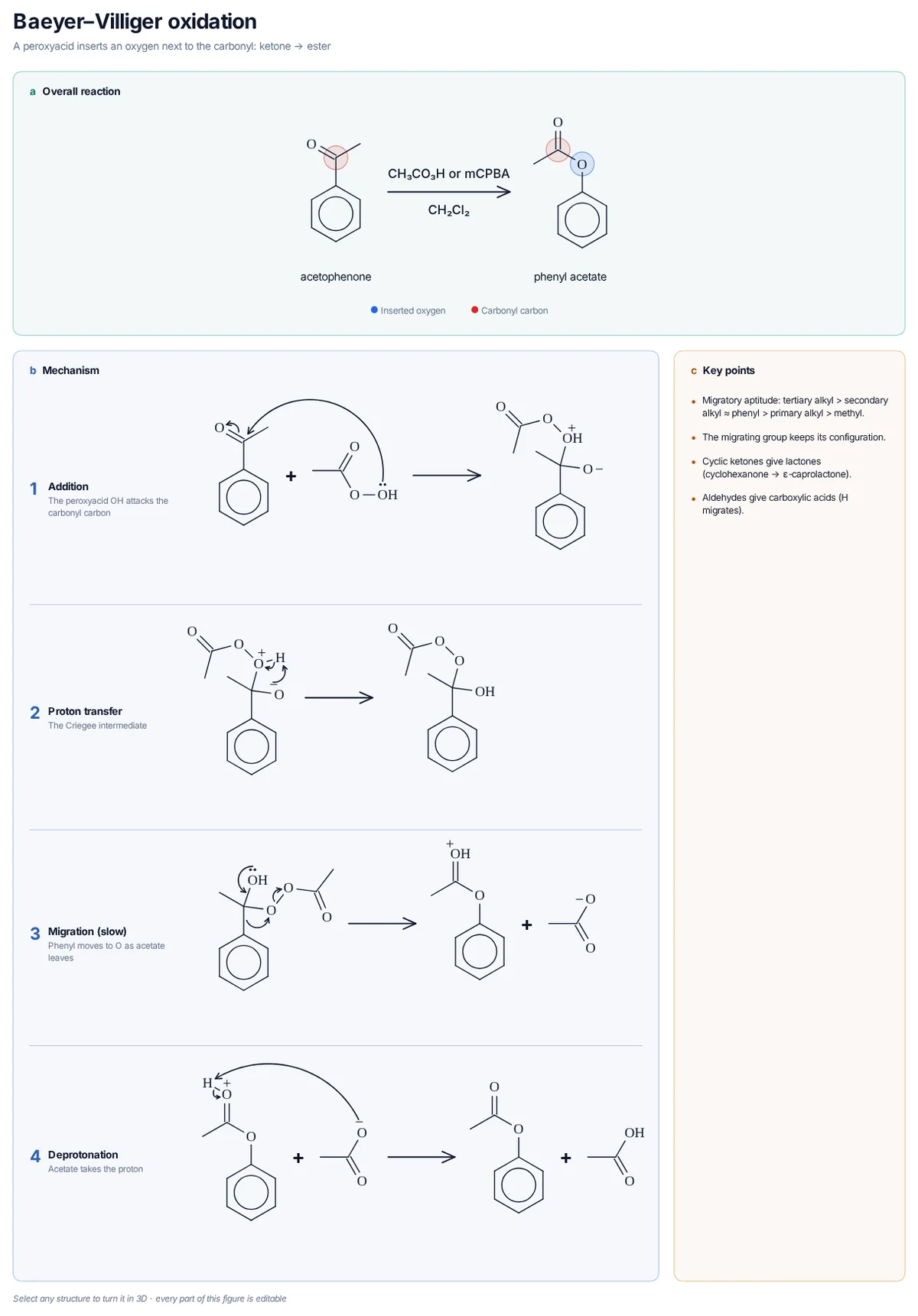
Acetophenone + CH₃CO₃H (or mCPBA) → phenyl acetate
A peroxyacid inserts an oxygen next to the carbonyl: ketone → ester.
Each step is checked electron by electron: the curly arrows give exactly the structures drawn.
The group best able to stabilise positive charge in the transition state: tertiary > secondary ≈ aryl > primary > methyl.
The tetrahedral adduct of the peroxyacid and the ketone, R₂C(OH)–O–O–C(O)R′.
Usually the carboxylic acid (H migrates); some electron-rich aryl aldehydes give formate esters (Dakin-type).
The button above opens the complete figure — overall reaction, numbered mechanism and key points — as ordinary editable structures. Change substituents, recolour atoms, or export a PNG, SVG or chemfig code for notes and slides. The same figure is in the Templates panel under Name reactions.