Overall reaction
C₆H₆ + (CH₃)₃CCl → (AlCl₃) C₆H₅C(CH₃)₃ + HCl
AlCl₃ turns an alkyl halide into a carbocation that alkylates the ring.
Friedel–Crafts alkylation attaches an alkyl group to an aromatic ring using an alkyl halide and a Lewis acid such as AlCl₃. The Lewis acid generates a carbocation (or a polarised complex), the ring attacks it to form an arenium ion, and loss of a proton restores aromaticity.
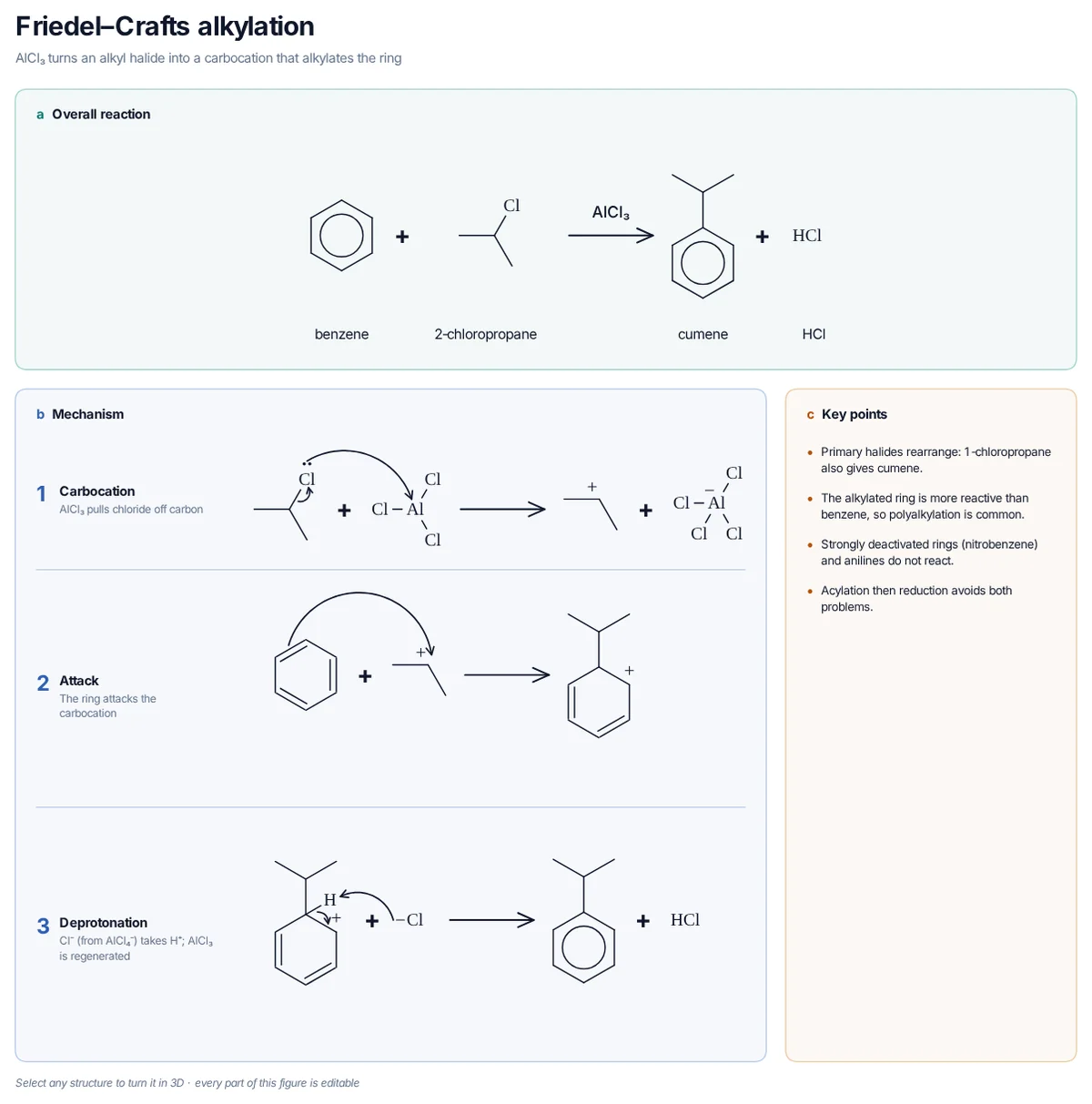
C₆H₆ + (CH₃)₃CCl → (AlCl₃) C₆H₅C(CH₃)₃ + HCl
AlCl₃ turns an alkyl halide into a carbocation that alkylates the ring.
Each step is checked electron by electron: the curly arrows give exactly the structures drawn.
Primary carbocations (or their complexes) undergo hydride/alkyl shifts to more stable secondary or tertiary cations before attack.
Use a large excess of the arene, or do Friedel–Crafts acylation and then reduce the ketone (Clemmensen or Wolff–Kishner).
The basic NH₂ group complexes with AlCl₃, putting a positive charge next to the ring and deactivating it.
The button above opens the complete figure — overall reaction, numbered mechanism and key points — as ordinary editable structures. Change substituents, recolour atoms, or export a PNG, SVG or chemfig code for notes and slides. The same figure is in the Templates panel under Name reactions.