Overall reaction
C₆H₅N₂⁺ + C₆H₅O⁻ (pH 9–10, 0–5 °C) → p-HO–C₆H₄–N=N–C₆H₅ (orange)
A diazonium ion attacks an activated ring: azo dyes.
In azo coupling an arenediazonium ion acts as a weak electrophile towards strongly activated rings — phenoxides and anilines. Attack at the para carbon (ortho if para is blocked) followed by loss of the ring proton gives an azo compound Ar–N=N–Ar′, whose extended conjugation makes it coloured.
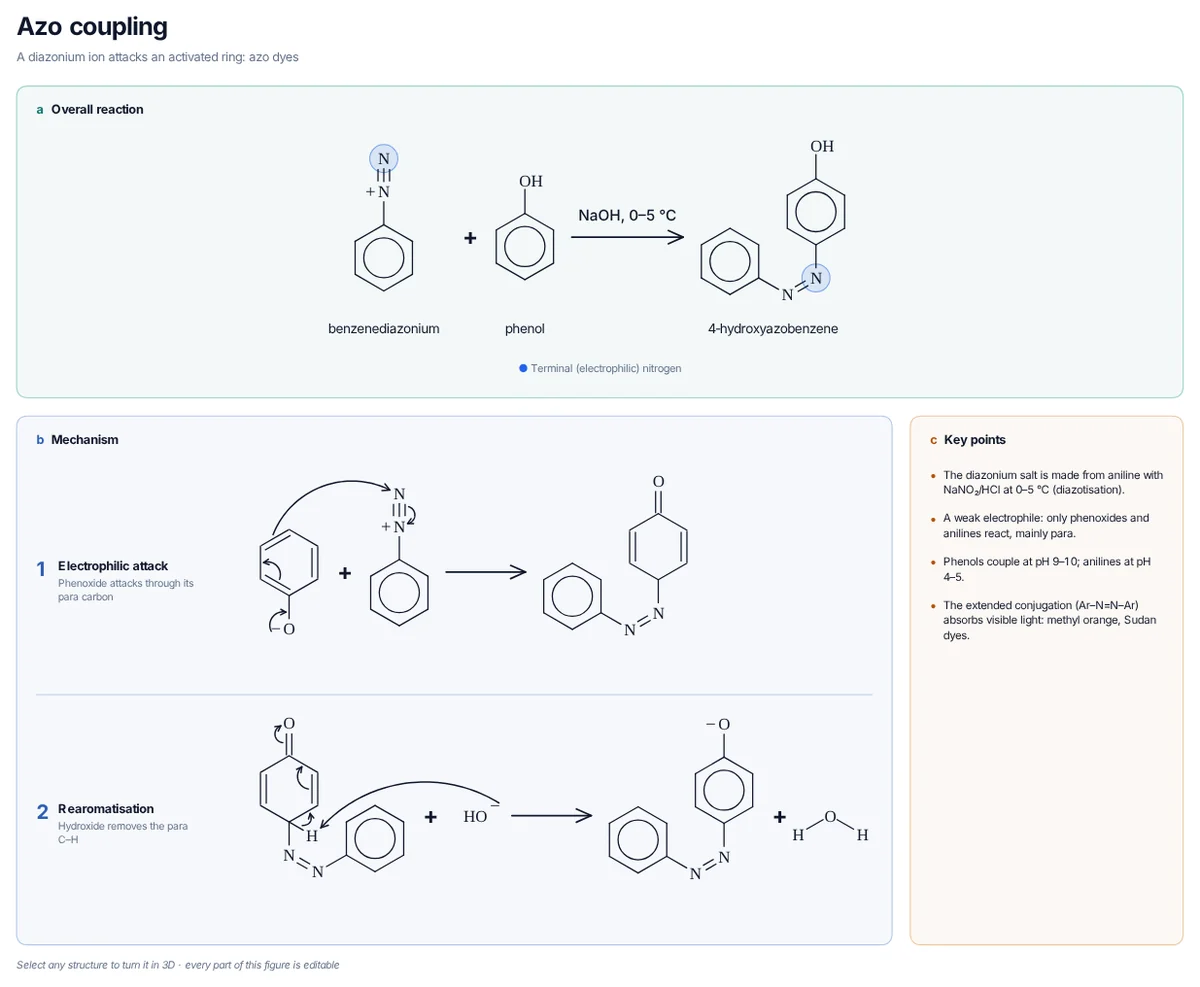
C₆H₅N₂⁺ + C₆H₅O⁻ (pH 9–10, 0–5 °C) → p-HO–C₆H₄–N=N–C₆H₅ (orange)
A diazonium ion attacks an activated ring: azo dyes.
Each step is checked electron by electron: the curly arrows give exactly the structures drawn.
The para carbon is activated by O⁻ (or NH₂) and is less hindered than ortho; ortho attack occurs only if para is blocked.
Phenol must be ionised to phenoxide to be reactive enough, but at very high pH the diazonium ion is converted to an unreactive diazotate.
The –N=N– group links two aromatic rings into one long conjugated system that absorbs visible light.
The button above opens the complete figure — overall reaction, numbered mechanism and key points — as ordinary editable structures. Change substituents, recolour atoms, or export a PNG, SVG or chemfig code for notes and slides. The same figure is in the Templates panel under Name reactions.