Overall reaction
2 CH₃COOC₂H₅ → (NaOEt, then H₃O⁺) CH₃COCH₂COOC₂H₅ (ethyl acetoacetate) + C₂H₅OH
Ester enolate attacks a second ester; methoxide is expelled.
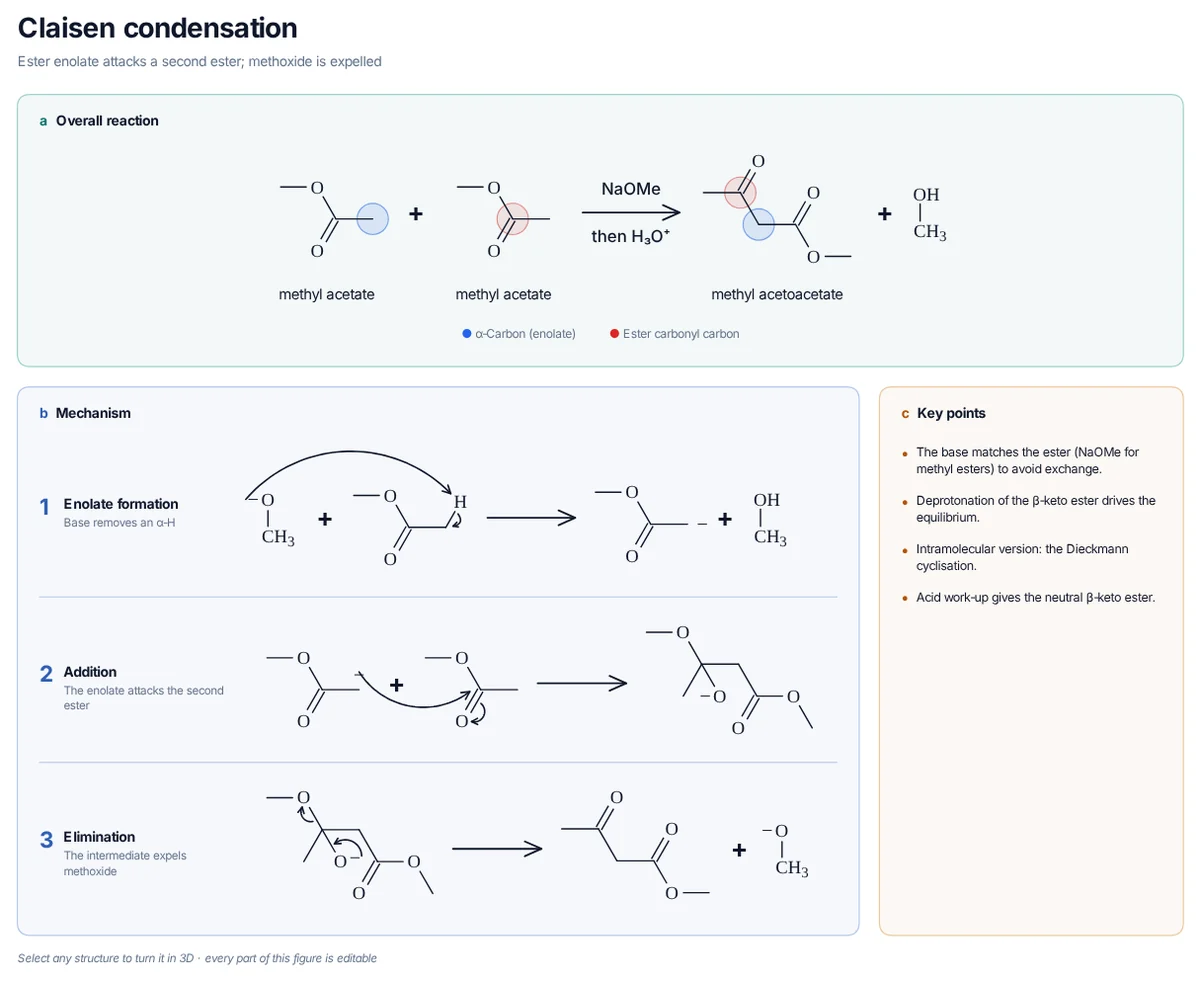
The Claisen condensation joins two ester molecules into a β-keto ester. An alkoxide removes an α-hydrogen to form an ester enolate, which adds to the carbonyl of a second ester; the tetrahedral intermediate expels alkoxide. Deprotonation of the doubly activated β-keto ester drives the reaction, and acid work-up gives the neutral product.
2 CH₃COOC₂H₅ → (NaOEt, then H₃O⁺) CH₃COCH₂COOC₂H₅ (ethyl acetoacetate) + C₂H₅OH
Ester enolate attacks a second ester; methoxide is expelled.
Each step is checked electron by electron: the curly arrows give exactly the structures drawn.
The β-keto ester (pKa ≈ 11) is deprotonated by the alkoxide; this irreversible-looking step pulls the unfavourable equilibria over.
A different alkoxide would cause transesterification and give mixtures of esters.
Aldol: enolate adds to an aldehyde/ketone (addition). Claisen: enolate adds to an ester and an alkoxide leaves (substitution).
The button above opens the complete figure — overall reaction, numbered mechanism and key points — as ordinary editable structures. Change substituents, recolour atoms, or export a PNG, SVG or chemfig code for notes and slides. The same figure is in the Templates panel under Name reactions.