Name reaction · mechanism

Pinacol–Pinacolone Rearrangement

Pinacol (2,3-dimethylbutane-2,3-diol) rearranges in acid to pinacolone (3,3-dimethylbutan-2-one). One OH is protonated and leaves as water, a methyl group shifts to the cationic carbon, and the new cation — stabilised by the neighbouring oxygen — loses a proton to form the C=O.
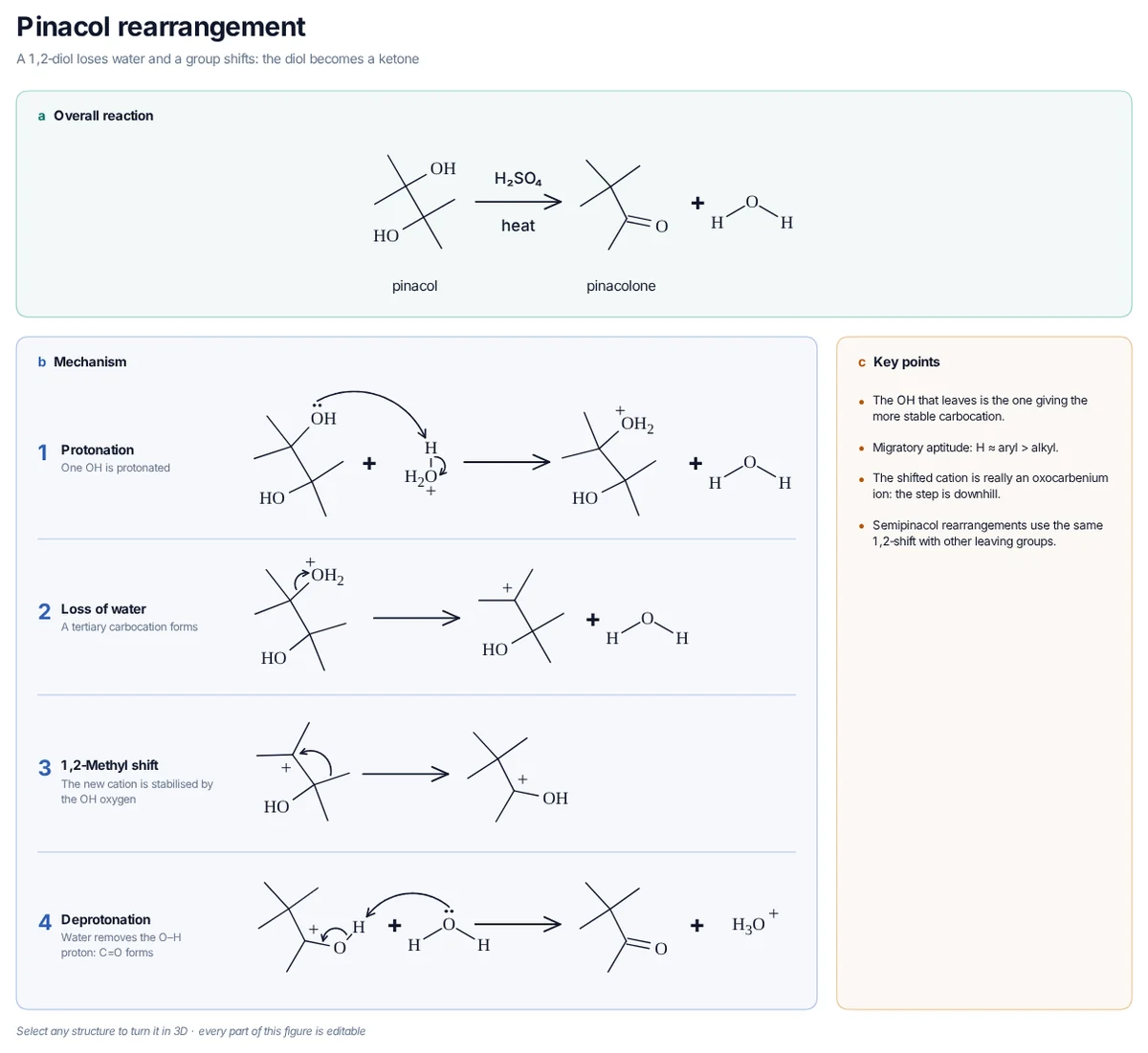
Pinacol–Pinacolone Rearrangement mechanism: Pinacol is protonated, loses water to a tertiary cation, a methyl shifts and loss of a proton gives pinacolone.
Pinacol rearrangement: overall reaction, every curly-arrow step and key points. Click to open and edit it in MolDraw.

Overall reaction

(CH₃)₂C(OH)–C(OH)(CH₃)₂ → (H₂SO₄) CH₃COC(CH₃)₃ + H₂O

A 1,2-diol loses water and a group shifts: the diol becomes a ketone.

Mechanism step by step

  1. Protonation. One OH is protonated
  2. Loss of water. A tertiary carbocation forms
  3. 1,2-Methyl shift. The new cation is stabilised by the OH oxygen
  4. Deprotonation. Water removes the O–H proton: C=O forms

Each step is checked electron by electron: the curly arrows give exactly the structures drawn.

Open and edit this mechanism

Key points

  • The OH that leaves is the one giving the more stable carbocation.
  • Migratory aptitude: H ≈ aryl > alkyl.
  • The shifted cation is really an oxocarbenium ion: the step is downhill.
  • Semipinacol rearrangements use the same 1,2-shift with other leaving groups.

For JEE and NEET

  • The OH that leaves is the one that gives the more stable carbocation.
  • Migratory aptitude (general): H ≈ aryl > alkyl; p-anisyl > phenyl > p-chlorophenyl.
  • Driving force: the oxocarbenium ion/C=O formed is more stable than the first carbocation.
  • Unsymmetrical diols: decide the cation first, then the migrating group.

FAQ

Why does the methyl group shift?

After the shift the positive charge sits next to OH, whose lone pair stabilises it (an oxocarbenium ion), which then loses H⁺ to form the ketone.

What is pinacolone?

3,3-Dimethylbutan-2-one, (CH₃)₃C–CO–CH₃ (tert-butyl methyl ketone).

Which group migrates first?

Generally hydride or aryl before alkyl; electron-rich aryl groups migrate fastest.

Draw it in MolDraw

The button above opens the complete figure — overall reaction, numbered mechanism and key points — as ordinary editable structures. Change substituents, recolour atoms, or export a PNG, SVG or chemfig code for notes and slides. The same figure is in the Templates panel under Name reactions.