Name reaction · mechanism

Iodoform (Haloform) Reaction

Methyl ketones (CH₃CO–) and alcohols that oxidise to them (CH₃CH(OH)–) react with iodine and sodium hydroxide to give a yellow precipitate of iodoform, CHI₃. The methyl group is iodinated three times through enolates, then hydroxide attacks the carbonyl and CI₃⁻ leaves as a carbanion, giving a carboxylate one carbon shorter.
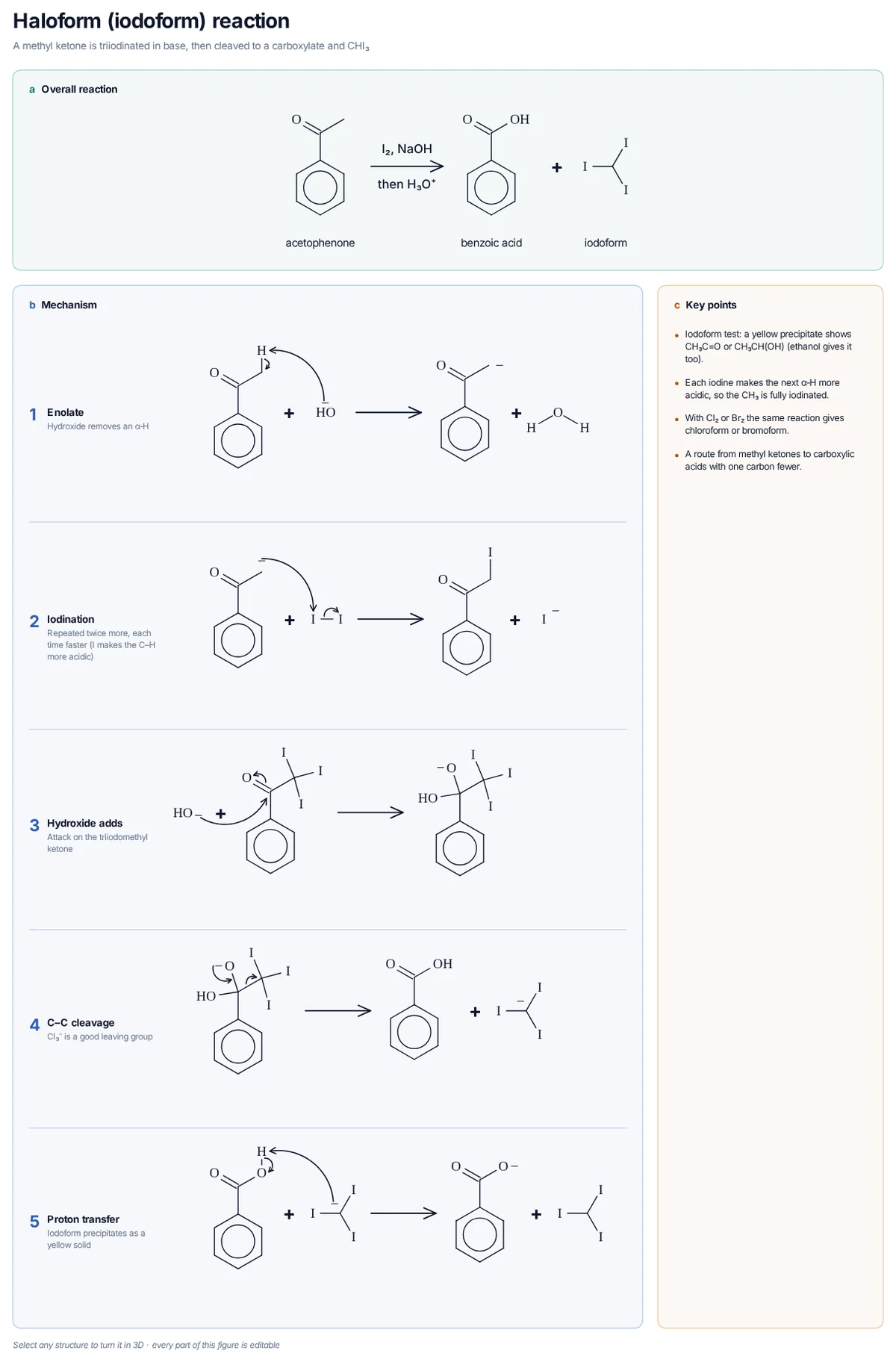
Iodoform (Haloform) Reaction mechanism: Enolate formation and iodination (three times), then hydroxide adds and expels CI₃⁻; proton transfer gives benzoate and yellow iodoform.
Haloform (iodoform) reaction: overall reaction, every curly-arrow step and key points. Click to open and edit it in MolDraw.

Overall reaction

R–CO–CH₃ + 3 I₂ + 4 NaOH → R–COO⁻Na⁺ + CHI₃↓ + 3 NaI + 3 H₂O

A methyl ketone is triiodinated in base, then cleaved to a carboxylate and CHI₃.

Mechanism step by step

  1. Enolate. Hydroxide removes an α-H
  2. Iodination. Repeated twice more, each time faster (I makes the C–H more acidic)
  3. Hydroxide adds. Attack on the triiodomethyl ketone
  4. C–C cleavage. CI₃⁻ is a good leaving group
  5. Proton transfer. Iodoform precipitates as a yellow solid

Each step is checked electron by electron: the curly arrows give exactly the structures drawn.

Open and edit this mechanism

Key points

  • Iodoform test: a yellow precipitate shows CH₃C=O or CH₃CH(OH) (ethanol gives it too).
  • Each iodine makes the next α-H more acidic, so the CH₃ is fully iodinated.
  • With Cl₂ or Br₂ the same reaction gives chloroform or bromoform.
  • A route from methyl ketones to carboxylic acids with one carbon fewer.

For JEE and NEET

  • Positive: ethanol, acetaldehyde, acetone, propan-2-ol, butan-2-one, acetophenone, 1-phenylethanol.
  • Negative: methanol, propan-1-ol, propanal, benzaldehyde, pentan-3-one, acetic acid.
  • Ethanal is the only aldehyde that gives a positive test.
  • Each iodination makes the next α-H more acidic, so the CH₃ is fully iodinated.

FAQ

Why does ethanol give the iodoform test?

Iodine/NaOH oxidises ethanol to acetaldehyde, CH₃CHO, which has the CH₃–C=O group.

Why does the C–C bond break?

After three iodinations, CI₃⁻ is stabilised by the three iodines and is a good enough leaving group from the tetrahedral intermediate.

Does acetic acid give the iodoform test?

No. The carboxylate is not enolised under the conditions.

Draw it in MolDraw

The button above opens the complete figure — overall reaction, numbered mechanism and key points — as ordinary editable structures. Change substituents, recolour atoms, or export a PNG, SVG or chemfig code for notes and slides. The same figure is in the Templates panel under Name reactions.