Reaction Scheme
conjugated diene + dienophile -> cyclohexene derivativeThermal reaction; electron-rich dienes and electron-poor dienophiles are common.
Primary reaction SMILES: C=CC=C.C=CC=O>>O=CC1C=CCCC1
The Diels-Alder reaction is a concerted [4+2] cycloaddition between a conjugated diene and a dienophile, forming cyclohexene frameworks with predictable stereochemical outcomes.
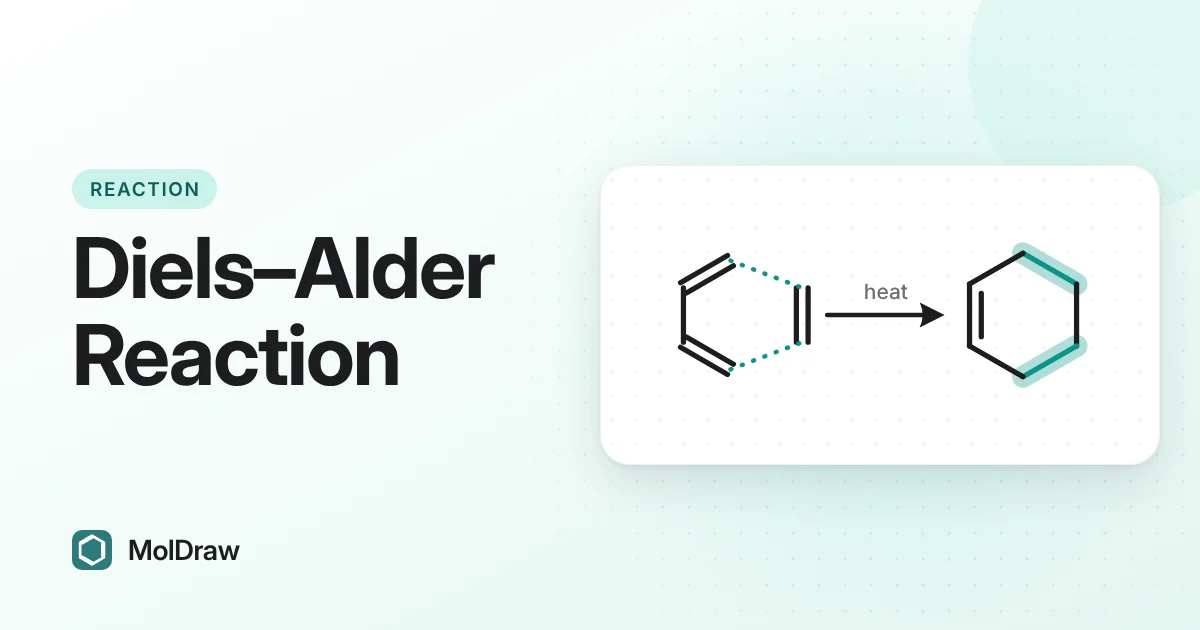
Primary reaction SMILES: C=CC=C.C=CC=O>>O=CC1C=CCCC1
Classic teaching example forming cyclohexene.
Common lab example showing endo selectivity.
Use MolDraw to show diene geometry, dienophile substituents, stereochemistry, and cycloaddition products.
The Diels–Alder reaction is a concerted [4+2] cycloaddition between a conjugated diene and a dienophile (an alkene or alkyne). Six π electrons reorganise in a single step through a cyclic transition state, forming two new C–C σ bonds and a cyclohexene ring. No intermediate is formed, which is why the stereochemistry of the dienophile is kept in the product: a cis dienophile gives cis substituents on the ring.
How do I draw it clearly? Number the diene carbons 1–4 and draw three curved arrows around the ring to show the concerted electron flow. Use wedge and hash bonds on the product to show endo/exo stereochemistry. What is a retro-Diels–Alder? The reverse reaction on heating, used for example to crack dicyclopentadiene back to cyclopentadiene.