Overall reaction
R–CH₂–COOH + Br₂ (red P or PBr₃) → R–CHBr–COOH + HBr
α-Bromination of a carboxylic acid through its acyl bromide enol.
The Hell–Volhard–Zelinsky (HVZ) reaction brominates a carboxylic acid at the α-carbon. Phosphorus tribromide (or red phosphorus + Br₂) turns the acid into the acyl bromide, which enolises far more easily than the acid; the enol attacks bromine, and water finally converts the α-bromo acyl bromide back to the acid.
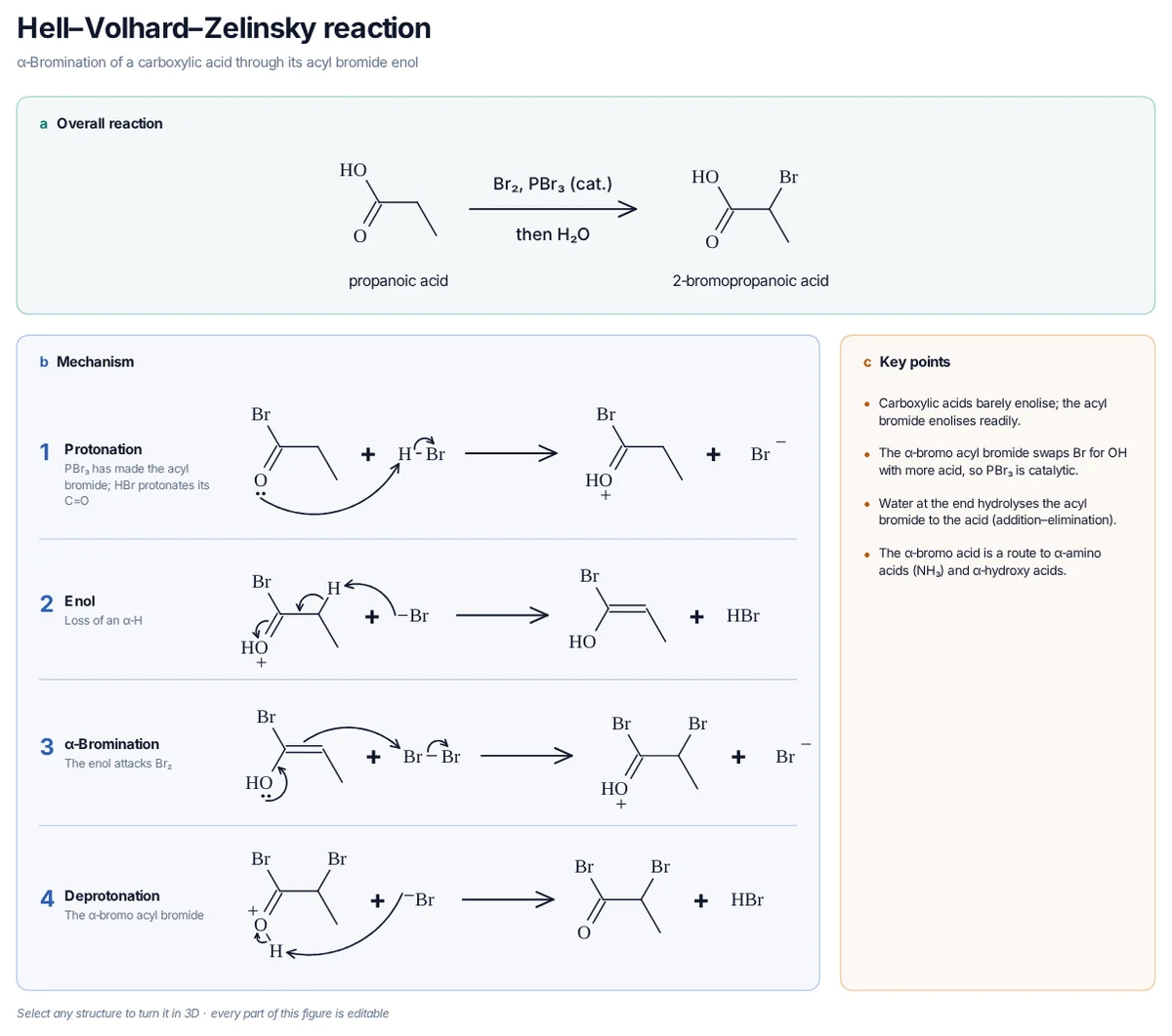
R–CH₂–COOH + Br₂ (red P or PBr₃) → R–CHBr–COOH + HBr
α-Bromination of a carboxylic acid through its acyl bromide enol.
Each step is checked electron by electron: the curly arrows give exactly the structures drawn.
Carboxylic acids barely enolise. PBr₃ converts the acid to the acyl bromide, whose enol forms readily and reacts with Br₂.
No — for example, (CH₃)₃CCOOH or benzoic acid do not give HVZ products.
2-Bromopropanoic acid, CH₃CHBrCOOH.
The button above opens the complete figure — overall reaction, numbered mechanism and key points — as ordinary editable structures. Change substituents, recolour atoms, or export a PNG, SVG or chemfig code for notes and slides. The same figure is in the Templates panel under Name reactions.