Name reaction · mechanism

Beckmann Rearrangement

In the Beckmann rearrangement a ketoxime is converted into an amide by acid (H₂SO₄, PCl₅, SOCl₂, polyphosphoric acid). The OH is made into a leaving group, and the group anti to it moves from carbon to nitrogen as water leaves, giving a nitrilium ion; water adds and tautomerisation gives the amide.
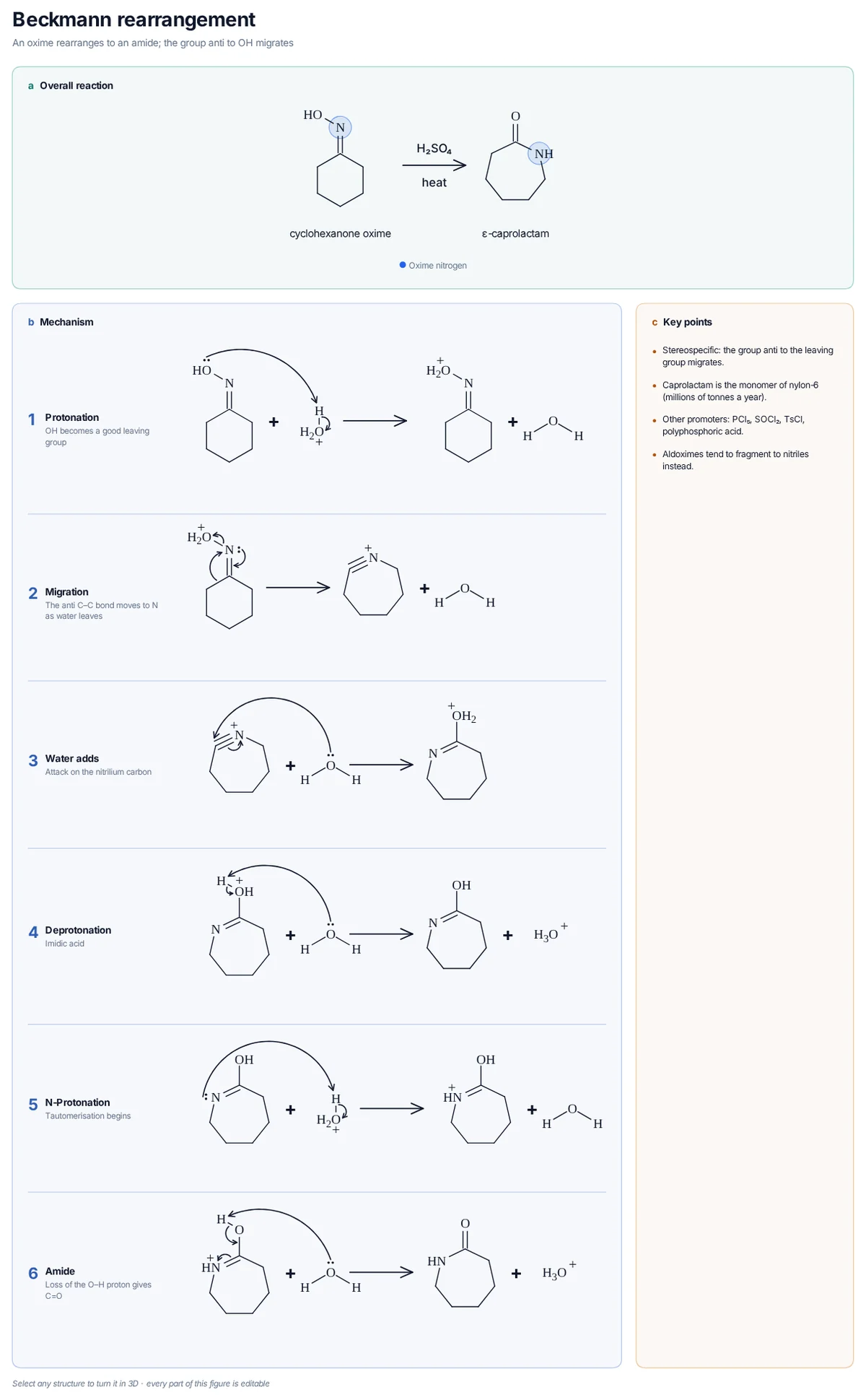
Beckmann Rearrangement mechanism: Cyclohexanone oxime in acid: the ring C–C bond migrates to nitrogen as water leaves; water traps the nitrilium ion and tautomerisation gives caprolactam.
Beckmann rearrangement: overall reaction, every curly-arrow step and key points. Click to open and edit it in MolDraw.

Overall reaction

Cyclohexanone oxime → (H₂SO₄, heat) ε-caprolactam

An oxime rearranges to an amide; the group anti to OH migrates.

Mechanism step by step

  1. Protonation. OH becomes a good leaving group
  2. Migration. The anti C–C bond moves to N as water leaves
  3. Water adds. Attack on the nitrilium carbon
  4. Deprotonation. Imidic acid
  5. N-Protonation. Tautomerisation begins
  6. Amide. Loss of the O–H proton gives C=O

Each step is checked electron by electron: the curly arrows give exactly the structures drawn.

Open and edit this mechanism

Key points

  • Stereospecific: the group anti to the leaving group migrates.
  • Caprolactam is the monomer of nylon-6 (millions of tonnes a year).
  • Other promoters: PCl₅, SOCl₂, TsCl, polyphosphoric acid.
  • Aldoximes tend to fragment to nitriles instead.

For JEE and NEET

  • Stereospecific: the group anti (trans) to the OH migrates.
  • Acetophenone oxime (Ph anti to OH) gives acetanilide.
  • Cyclohexanone oxime → caprolactam → nylon-6.
  • Intermediate: nitrilium ion, R–C≡N⁺–R′.

FAQ

Which group migrates in the Beckmann rearrangement?

The group anti-periplanar to the leaving group on nitrogen, regardless of its migratory aptitude.

What is the product from acetophenone oxime?

For the usual E-oxime (phenyl anti to OH), N-phenylacetamide (acetanilide).

What is the industrial importance?

Cyclohexanone oxime is rearranged to ε-caprolactam, the monomer of nylon-6.

Draw it in MolDraw

The button above opens the complete figure — overall reaction, numbered mechanism and key points — as ordinary editable structures. Change substituents, recolour atoms, or export a PNG, SVG or chemfig code for notes and slides. The same figure is in the Templates panel under Name reactions.