Reimer–Tiemann Reaction: Mechanism, Examples and JEE/NEET Questions
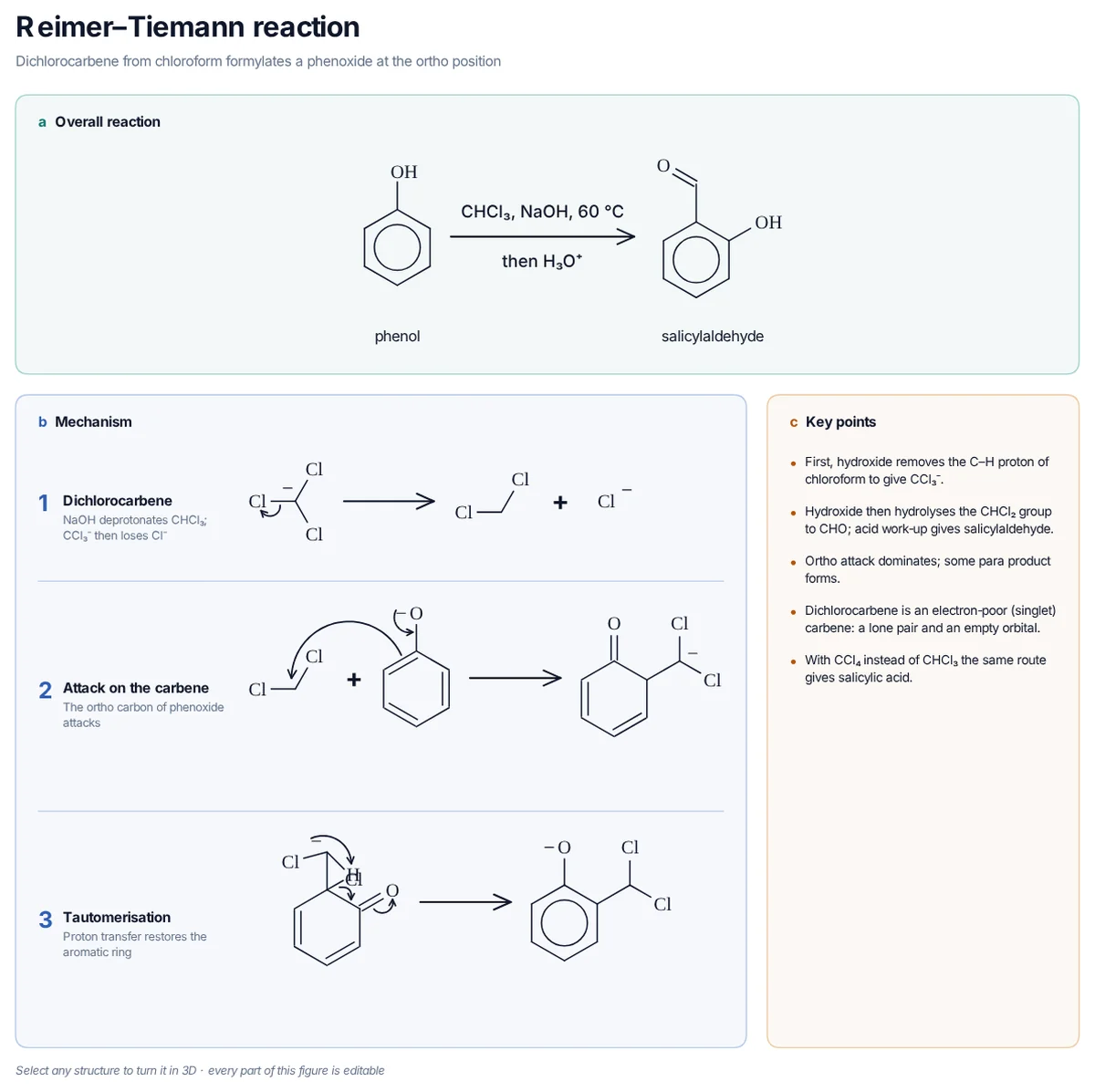
Short answer: Phenol + CHCl3 + NaOH (60–70 °C), then acid, gives salicylaldehyde (2-hydroxybenzaldehyde). The base turns chloroform into dichlorocarbene, :CCl2; phenoxide attacks it through its ortho carbon, and the CHCl2 group is hydrolysed to CHO.
What is the Reimer–Tiemann?
The Reimer–Tiemann reaction is the classic way to put a CHO group onto a phenol ring, and it appears every year in JEE and NEET questions on phenols. It is unusual because the electrophile is a neutral carbene, made in the flask from chloroform and hydroxide.
Below, every curly-arrow step is shown in the MolDraw template. Open it in the editor to change the phenol, recolour atoms or export the figure for your notes.
Reaction at a glance
| Substrate | Phenol (or a substituted phenol / naphthol) |
|---|---|
| Reagents | CHCl3, aqueous NaOH or KOH, 60–70 °C; then dilute HCl |
| Electrophile | Dichlorocarbene, :CCl2 (formed by α-elimination) |
| Main product | Salicylaldehyde (ortho); some p-hydroxybenzaldehyde |
| Type | Electrophilic aromatic substitution (formylation) on phenoxide |
Mechanism step by step
- Chloroform is deprotonated. Hydroxide removes the acidic C–H proton of CHCl3 (the three chlorines stabilise the negative charge), giving the trichloromethyl anion, CCl3−.
- α-Elimination gives dichlorocarbene. CCl3− loses chloride from the same carbon: :CCl2. The carbene carbon has an empty p orbital (electrophilic) and a lone pair — a singlet carbene.
- Phenoxide attacks the carbene. NaOH also turns phenol into phenoxide. The O− pushes electrons into the ring and the ortho carbon attacks :CCl2. The ring loses its aromaticity for a moment: a cyclohexadienone with a CCl2− group.
- Tautomerisation restores the ring. The proton on the attacked carbon moves to the carbanion carbon, the ring becomes aromatic again and the phenoxide is re-formed, now carrying a CHCl2 group.
- Hydrolysis of CHCl2 to CHO. Hydroxide replaces the two chlorines (through a gem-diol), which loses water to form the aldehyde. Acidification gives neutral salicylaldehyde.
Every step in the template is checked electron by electron: the curly arrows give exactly the structures that are drawn. Open it in MolDraw to follow the arrows one step at a time.
Worked examples
- Phenol → salicylaldehyde. The standard example. A little para-hydroxybenzaldehyde forms as a side product; the ortho isomer is separated by steam distillation (it is volatile because of intramolecular H-bonding).
- p-Cresol → 2-hydroxy-5-methylbenzaldehyde. With the para position blocked, formylation happens ortho to OH only.
- Phenol + CCl4 → salicylic acid. Using carbon tetrachloride instead of chloroform gives a CCl3 group, which hydrolyses to COOH.
- 2-Naphthol → 2-hydroxy-1-naphthaldehyde. Electron-rich naphthols react well, at the activated C-1 position.
JEE and NEET practice questions
Q1. The electrophile in the Reimer–Tiemann reaction is:
Show answer
:CCl2 — Dichlorocarbene forms by α-elimination from CCl3−.
Q2. Phenol is heated with CCl4 and aqueous NaOH, then acidified. The product is:
Show answer
Salicylic acid — CCl4 transfers a CCl3 group, which hydrolyses to COOH.
Q3. What does p-cresol give in the Reimer–Tiemann reaction?
Show answer
2-Hydroxy-5-methylbenzaldehyde — The para position is occupied by CH3, so the CHO goes ortho to OH.
Q4. Why does anisole (methoxybenzene) not give the Reimer–Tiemann reaction under the same conditions?
Show answer
It cannot form a phenoxide ion. — The reaction needs O−, a far stronger ring activator than OCH3, to attack the weak carbene electrophile.
Common mistakes
- Writing CHCl3 or CCl3+ as the electrophile — it is :CCl2.
- Forgetting the final acidification: in base the product is the sodium phenoxide salt.
- Putting the CHO para as the major product — ortho is major.
- Mixing it up with the Kolbe reaction (CO2, gives salicylic acid).
Edit this mechanism in MolDraw
- Click Open in MolDraw. The editor opens with the whole figure on the canvas: the overall reaction, each numbered step and the key points.
- Everything is an ordinary structure. Change a substituent, recolour atoms or move an arrow, and the arrows stay attached to their atoms.
- Download it as PNG, SVG or PDF, or copy it into your notes or slides.
- The same figure is in the editor under Templates → Schemes → Name reactions.
Questions and answers
What is the major product of the Reimer–Tiemann reaction of phenol?
Salicylaldehyde (2-hydroxybenzaldehyde), with a small amount of 4-hydroxybenzaldehyde.
Why is NaOH used in excess?
It deprotonates chloroform to make the carbene, deprotonates phenol to phenoxide, and hydrolyses the CHCl₂ group.
Is the Reimer–Tiemann reaction an electrophilic substitution?
Yes. Dichlorocarbene is the electrophile and the phenoxide ring is the nucleophile.