Overall reaction
R₂C=O + N₂H₄ → R₂C=NNH₂ → (KOH, 200 °C) R₂CH₂ + N₂
Hydrazone + strong base at high temperature: C=O becomes CH₂ with loss of N₂.
The Wolff–Kishner reduction converts the C=O of an aldehyde or ketone into CH₂. The carbonyl compound forms a hydrazone with hydrazine; strong base at about 200 °C then removes N–H protons, the molecule loses nitrogen gas, and the carbanion is protonated.
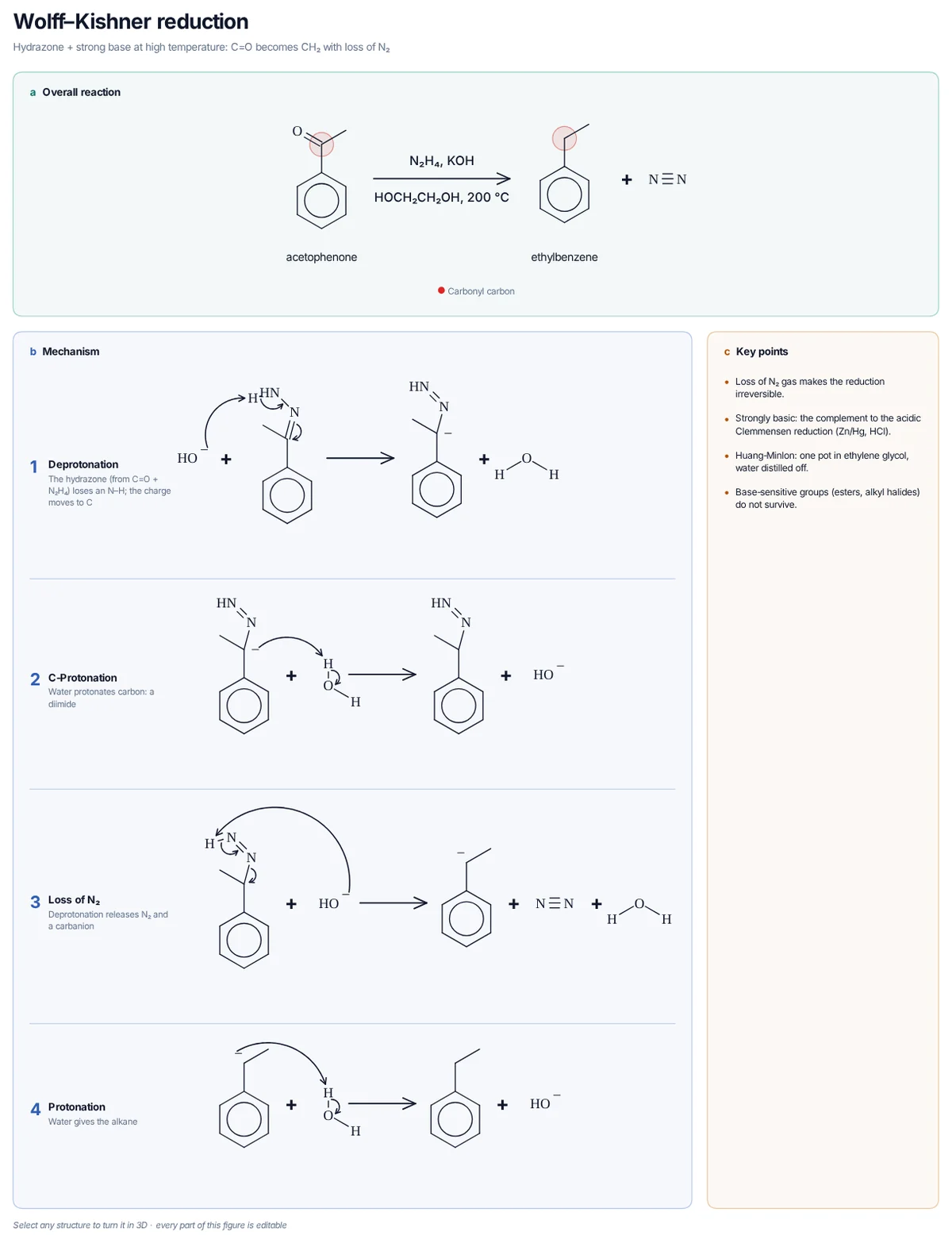
R₂C=O + N₂H₄ → R₂C=NNH₂ → (KOH, 200 °C) R₂CH₂ + N₂
Hydrazone + strong base at high temperature: C=O becomes CH₂ with loss of N₂.
Each step is checked electron by electron: the curly arrows give exactly the structures drawn.
Both reduce C=O to CH₂. Choose Wolff–Kishner for acid-sensitive substrates and Clemmensen for base-sensitive ones.
Deprotonation of the diimide and loss of N₂ have a high barrier; ethylene glycol (b.p. 197 °C) allows the temperature.
It forms the hydrazone (R₂C=N–NH₂), whose N–H protons and N=N bond provide the route to lose N₂.
The button above opens the complete figure — overall reaction, numbered mechanism and key points — as ordinary editable structures. Change substituents, recolour atoms, or export a PNG, SVG or chemfig code for notes and slides. The same figure is in the Templates panel under Name reactions.