Overall reaction
2 C₆H₅CHO + NaOH (conc.) → C₆H₅CH₂OH + C₆H₅COO⁻Na⁺
An aldehyde with no α-H disproportionates in strong base: one is oxidised, one reduced.
In the Cannizzaro reaction an aldehyde without α-hydrogens (HCHO, benzaldehyde, pivalaldehyde) disproportionates in concentrated base: one molecule is oxidised to the carboxylate and another is reduced to the alcohol. Hydroxide adds to one aldehyde, and the tetrahedral anion transfers a hydride to a second aldehyde.
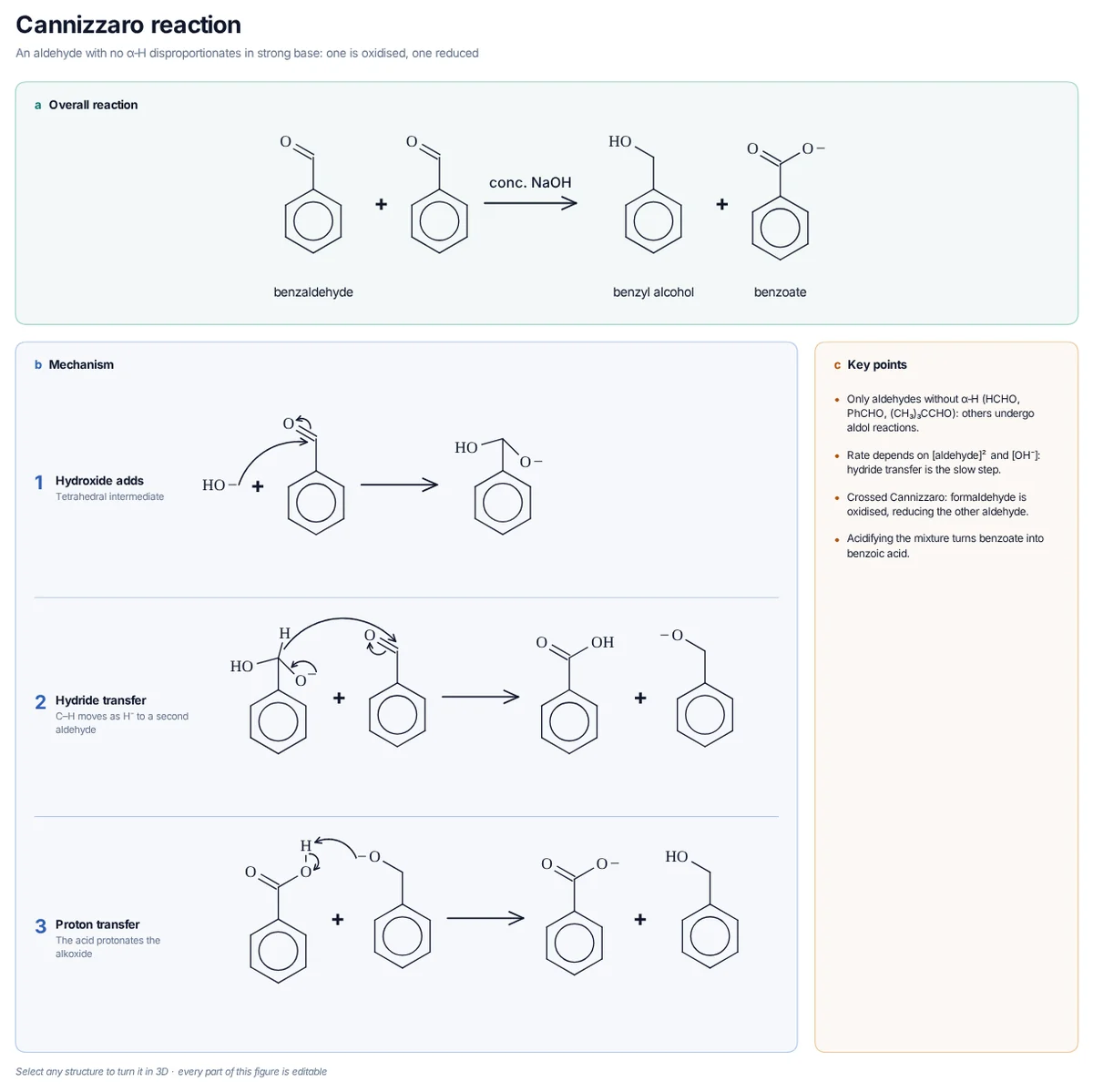
2 C₆H₅CHO + NaOH (conc.) → C₆H₅CH₂OH + C₆H₅COO⁻Na⁺
An aldehyde with no α-H disproportionates in strong base: one is oxidised, one reduced.
Each step is checked electron by electron: the curly arrows give exactly the structures drawn.
Base removes the α-hydrogen first, so they undergo aldol addition/condensation instead.
A mixture of formaldehyde and another non-enolisable aldehyde: formaldehyde (the better hydride donor after OH⁻ addition) becomes formate, and the other aldehyde becomes the alcohol.
No. It moves directly from the carbon of the tetrahedral anion to the carbonyl carbon of the second aldehyde.
The button above opens the complete figure — overall reaction, numbered mechanism and key points — as ordinary editable structures. Change substituents, recolour atoms, or export a PNG, SVG or chemfig code for notes and slides. The same figure is in the Templates panel under Name reactions.