Transition metals on the Periodic Table
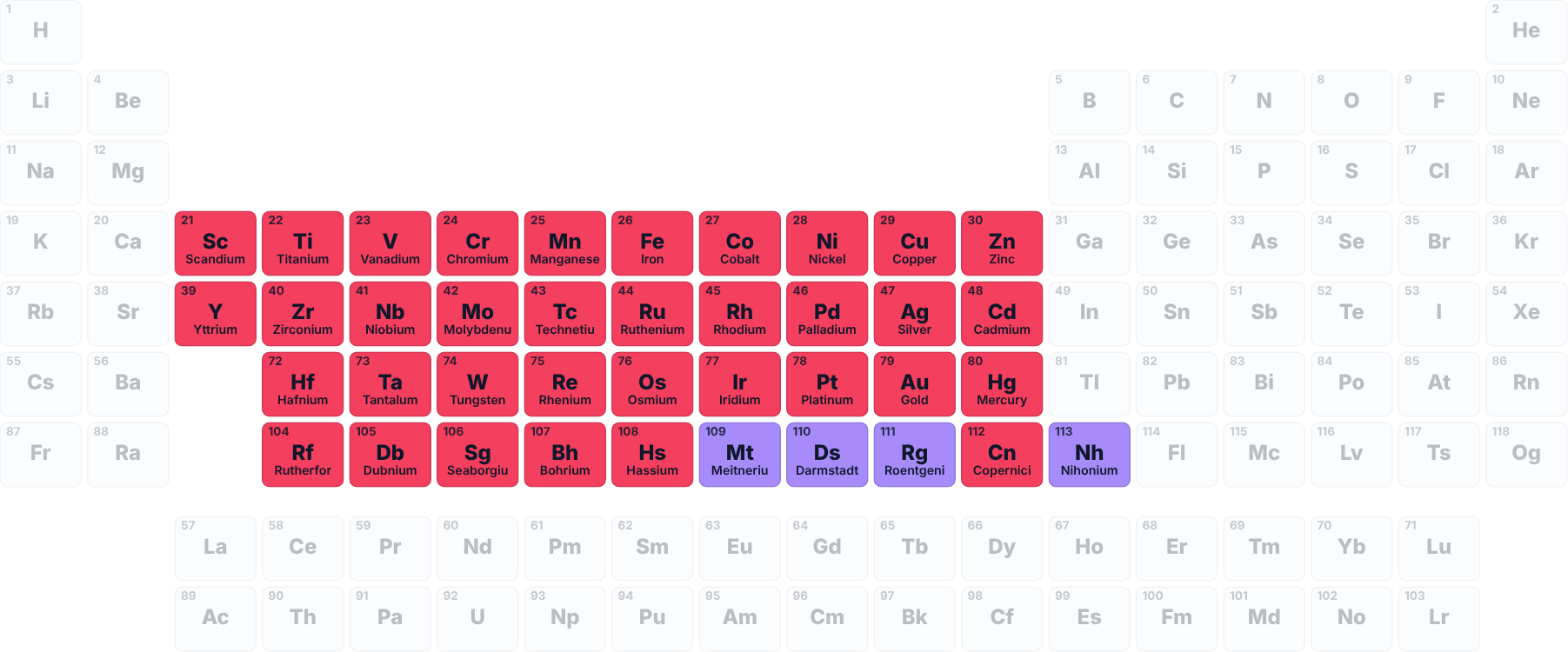
In short: The transition metals fill the d-block in groups 3 to 12, from scandium to copernicium. Their partly filled d orbitals explain their typical properties: several oxidation states, coloured compounds, complex ions and catalytic activity. Iron, copper, nickel, platinum and gold are all transition metals.
Highlighted: the 39 transition metals. Click any tile for the element page.
Key facts about transition metals
- Many show more than one oxidation state, for example iron(II) and iron(III), copper(I) and copper(II).
- Their compounds and complexes are often coloured because of d–d electron transitions.
- Many are catalysts: iron in the Haber process, platinum and palladium in catalytic converters.
Properties of the transition metals
| Z | Symbol | Element | Atomic mass (u) | Melting point (K) | Boiling point (K) | Density (g/cm³; gases g/L) | Electronegativity (Pauling) |
|---|---|---|---|---|---|---|---|
| 21 | Sc | Scandium | 44.956 | 1814 | 3109 | 2.985 | 1.36 |
| 22 | Ti | Titanium | 47.867 | 1941 | 3560 | 4.506 | 1.54 |
| 23 | V | Vanadium | 50.942 | 2183 | 3680 | 6 | 1.63 |
| 24 | Cr | Chromium | 51.996 | 2180 | 2944 | 7.19 | 1.66 |
| 25 | Mn | Manganese | 54.938 | 1519 | 2334 | 7.21 | 1.55 |
| 26 | Fe | Iron | 55.845 | 1811 | 3134 | 7.874 | 1.83 |
| 27 | Co | Cobalt | 58.933 | 1768 | 3200 | 8.9 | 1.88 |
| 28 | Ni | Nickel | 58.693 | 1728 | 3003 | 8.908 | 1.91 |
| 29 | Cu | Copper | 63.546 | 1357.77 | 2835 | 8.96 | 1.9 |
| 30 | Zn | Zinc | 65.38 | 692.68 | 1180 | 7.14 | 1.65 |
| 39 | Y | Yttrium | 88.906 | 1799 | 3203 | 4.472 | 1.22 |
| 40 | Zr | Zirconium | 91.222 | 2128 | 4650 | 6.52 | 1.33 |
| 41 | Nb | Niobium | 92.906 | 2750 | 5017 | 8.57 | 1.6 |
| 42 | Mo | Molybdenum | 95.95 | 2896 | 4912 | 10.28 | 2.16 |
| 43 | Tc | Technetium | [98] | 2430 | 4538 | 11 | 1.9 |
| 44 | Ru | Ruthenium | 101.07 | 2607 | 4423 | 12.45 | 2.2 |
| 45 | Rh | Rhodium | 102.91 | 2237 | 3968 | 12.41 | 2.28 |
| 46 | Pd | Palladium | 106.42 | 1828.05 | 3236 | 12.023 | 2.2 |
| 47 | Ag | Silver | 107.87 | 1234.93 | 2435 | 10.49 | 1.93 |
| 48 | Cd | Cadmium | 112.41 | 594.22 | 1040 | 8.65 | 1.69 |
| 72 | Hf | Hafnium | 178.49 | 2506 | 4876 | 13.31 | 1.3 |
| 73 | Ta | Tantalum | 180.95 | 3290 | 5731 | 16.69 | 1.5 |
| 74 | W | Tungsten | 183.84 | 3695 | 6203 | 19.25 | 2.36 |
| 75 | Re | Rhenium | 186.21 | 3459 | 5869 | 21.02 | 1.9 |
| 76 | Os | Osmium | 190.23 | 3306 | 5285 | 22.59 | 2.2 |
| 77 | Ir | Iridium | 192.22 | 2719 | 4403 | 22.56 | 2.2 |
| 78 | Pt | Platinum | 195.08 | 2041.4 | 4098 | 21.45 | 2.28 |
| 79 | Au | Gold | 196.97 | 1337.33 | 3243 | 19.3 | 2.54 |
| 80 | Hg | Mercury | 200.59 | 234.321 | 629.88 | 13.534 | 2 |
| 104 | Rf | Rutherfordium | [267] | 2400 | 5800 | 23.2 | – |
| 105 | Db | Dubnium | [268] | – | – | 29.3 | – |
| 106 | Sg | Seaborgium | [269] | – | – | 35 | – |
| 107 | Bh | Bohrium | [270] | – | – | 37.1 | – |
| 108 | Hs | Hassium | [269] | – | – | 40.7 | – |
| 109 | Mt | Meitnerium | [278] | – | – | 37.4 | – |
| 110 | Ds | Darmstadtium | [281] | – | – | 34.8 | – |
| 111 | Rg | Roentgenium | [282] | – | – | 28.7 | – |
| 112 | Cn | Copernicium | [285] | 283 | 340 | 14 | – |
| 113 | Nh | Nihonium | [286] | 700 | 1430 | 16 | – |
Sources: IUPAC CIAAW, Abridged standard atomic weights; Periodic-Table-JSON (CC BY-SA 3.0, derived from Wikipedia).
Other families
Frequently asked questions
Which elements are transition metals?
Scandium (Sc), Titanium (Ti), Vanadium (V), Chromium (Cr), Manganese (Mn), Iron (Fe), Cobalt (Co), Nickel (Ni), Copper (Cu), Zinc (Zn), Yttrium (Y), Zirconium (Zr), Niobium (Nb), Molybdenum (Mo), Technetium (Tc), Ruthenium (Ru), Rhodium (Rh), Palladium (Pd), Silver (Ag), Cadmium (Cd), Hafnium (Hf), Tantalum (Ta), Tungsten (W), Rhenium (Re), Osmium (Os), Iridium (Ir), Platinum (Pt), Gold (Au), Mercury (Hg), Rutherfordium (Rf), Dubnium (Db), Seaborgium (Sg), Bohrium (Bh), Hassium (Hs), Meitnerium (Mt), Darmstadtium (Ds), Roentgenium (Rg), Copernicium (Cn), Nihonium (Nh).
Where are the transition metals on the periodic table?
Groups 3 to 12 (d-block). They are highlighted in the chart above.
More periodic table charts
From elements to molecules: draw any compound in MolDraw and get its formula and molar mass instantly.
Open MolDraw editorLast updated: