Periodic Table with Electron Configurations
In short: Each tile shows the outer electron configuration after the noble-gas core, and the colour shows the block: s, p, d or f. Reading the table left to right, top to bottom gives the filling order 1s, 2s, 2p, 3s, 3p, 4s, 3d, 4p and so on.
- s-block
- p-block
- d-block
- f-block
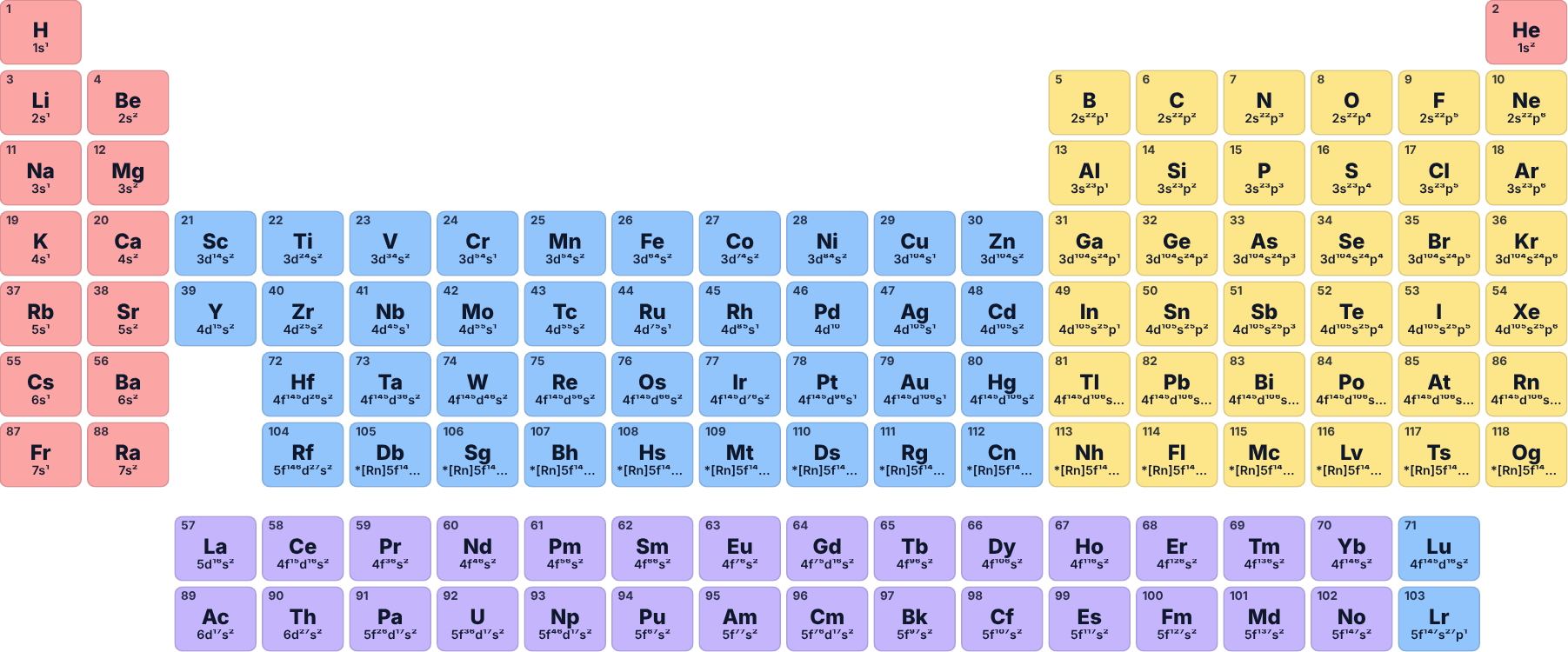
How to write an electron configuration from the table
- Start from the previous noble gas and write it in brackets, for example [Ne] for period 3.
- Move across the period: the s-block fills ns, the d-block fills (n−1)d, the p-block fills np and the f-block fills (n−2)f.
- Count tiles up to your element. Sulfur is the 4th p-block element of period 3: [Ne] 3s² 3p⁴.
Or let the electron configuration calculator do it, with orbital diagrams.
Exceptions to the Aufbau order
These 20 elements (up to Z = 103) have a ground-state configuration that differs from simple Madelung filling, usually because a half-filled or filled d or f subshell is more stable:
| Element | Actual configuration |
|---|---|
| Chromium (Cr) | [Ar] 3d⁵ 4s¹ |
| Copper (Cu) | [Ar] 3d¹⁰ 4s¹ |
| Niobium (Nb) | [Kr] 4d⁴ 5s¹ |
| Molybdenum (Mo) | [Kr] 4d⁵ 5s¹ |
| Ruthenium (Ru) | [Kr] 4d⁷ 5s¹ |
| Rhodium (Rh) | [Kr] 4d⁸ 5s¹ |
| Palladium (Pd) | [Kr] 4d¹⁰ |
| Silver (Ag) | [Kr] 4d¹⁰ 5s¹ |
| Lanthanum (La) | [Xe] 5d¹⁶s² |
| Cerium (Ce) | [Xe] 4f¹ 5d¹ 6s² |
| Gadolinium (Gd) | [Xe] 4f⁷ 5d¹ 6s² |
| Platinum (Pt) | [Xe] 4f¹⁴ 5d⁹ 6s¹ |
| Gold (Au) | [Xe] 4f¹⁴ 5d¹⁰ 6s¹ |
| Actinium (Ac) | [Rn] 6d¹ 7s² |
| Thorium (Th) | [Rn] 6d² 7s² |
| Protactinium (Pa) | [Rn] 5f² 6d¹ 7s² |
| Uranium (U) | [Rn] 5f³ 6d¹ 7s² |
| Neptunium (Np) | [Rn] 5f⁴ 6d¹ 7s² |
| Curium (Cm) | [Rn] 5f⁷ 6d¹ 7s² |
| Lawrencium (Lr) | [Rn] 5f¹⁴ 7s² 7p¹ |
Source: Ground-state electron configurations from Periodic-Table-JSON (CC BY-SA 3.0, derived from Wikipedia).
Electron configuration of every element
| Z | Element | Block | Electron configuration |
|---|---|---|---|
| 1 | Hydrogen (H) | s | 1s¹ |
| 2 | Helium (He) | s | 1s² |
| 3 | Lithium (Li) | s | [He] 2s¹ |
| 4 | Beryllium (Be) | s | [He] 2s² |
| 5 | Boron (B) | p | [He] 2s² 2p¹ |
| 6 | Carbon (C) | p | [He] 2s² 2p² |
| 7 | Nitrogen (N) | p | [He] 2s² 2p³ |
| 8 | Oxygen (O) | p | [He] 2s² 2p⁴ |
| 9 | Fluorine (F) | p | [He] 2s² 2p⁵ |
| 10 | Neon (Ne) | p | [He] 2s² 2p⁶ |
| 11 | Sodium (Na) | s | [Ne] 3s¹ |
| 12 | Magnesium (Mg) | s | [Ne] 3s² |
| 13 | Aluminium (Al) | p | [Ne] 3s² 3p¹ |
| 14 | Silicon (Si) | p | [Ne] 3s² 3p² |
| 15 | Phosphorus (P) | p | [Ne] 3s² 3p³ |
| 16 | Sulfur (S) | p | [Ne] 3s² 3p⁴ |
| 17 | Chlorine (Cl) | p | [Ne] 3s² 3p⁵ |
| 18 | Argon (Ar) | p | [Ne] 3s² 3p⁶ |
| 19 | Potassium (K) | s | [Ar] 4s¹ |
| 20 | Calcium (Ca) | s | [Ar] 4s² |
| 21 | Scandium (Sc) | d | [Ar] 3d¹ 4s² |
| 22 | Titanium (Ti) | d | [Ar] 3d² 4s² |
| 23 | Vanadium (V) | d | [Ar] 3d³ 4s² |
| 24 | Chromium (Cr) | d | [Ar] 3d⁵ 4s¹ |
| 25 | Manganese (Mn) | d | [Ar] 3d⁵ 4s² |
| 26 | Iron (Fe) | d | [Ar] 3d⁶ 4s² |
| 27 | Cobalt (Co) | d | [Ar] 3d⁷ 4s² |
| 28 | Nickel (Ni) | d | [Ar] 3d⁸ 4s² |
| 29 | Copper (Cu) | d | [Ar] 3d¹⁰ 4s¹ |
| 30 | Zinc (Zn) | d | [Ar] 3d¹⁰ 4s² |
| 31 | Gallium (Ga) | p | [Ar] 3d¹⁰ 4s² 4p¹ |
| 32 | Germanium (Ge) | p | [Ar] 3d¹⁰ 4s² 4p² |
| 33 | Arsenic (As) | p | [Ar] 3d¹⁰ 4s² 4p³ |
| 34 | Selenium (Se) | p | [Ar] 3d¹⁰ 4s² 4p⁴ |
| 35 | Bromine (Br) | p | [Ar] 3d¹⁰ 4s² 4p⁵ |
| 36 | Krypton (Kr) | p | [Ar] 3d¹⁰ 4s² 4p⁶ |
| 37 | Rubidium (Rb) | s | [Kr] 5s¹ |
| 38 | Strontium (Sr) | s | [Kr] 5s² |
| 39 | Yttrium (Y) | d | [Kr] 4d¹ 5s² |
| 40 | Zirconium (Zr) | d | [Kr] 4d² 5s² |
| 41 | Niobium (Nb) | d | [Kr] 4d⁴ 5s¹ |
| 42 | Molybdenum (Mo) | d | [Kr] 4d⁵ 5s¹ |
| 43 | Technetium (Tc) | d | [Kr] 4d⁵ 5s² |
| 44 | Ruthenium (Ru) | d | [Kr] 4d⁷ 5s¹ |
| 45 | Rhodium (Rh) | d | [Kr] 4d⁸ 5s¹ |
| 46 | Palladium (Pd) | d | [Kr] 4d¹⁰ |
| 47 | Silver (Ag) | d | [Kr] 4d¹⁰ 5s¹ |
| 48 | Cadmium (Cd) | d | [Kr] 4d¹⁰ 5s² |
| 49 | Indium (In) | p | [Kr] 4d¹⁰ 5s² 5p¹ |
| 50 | Tin (Sn) | p | [Kr] 4d¹⁰ 5s² 5p² |
| 51 | Antimony (Sb) | p | [Kr] 4d¹⁰ 5s² 5p³ |
| 52 | Tellurium (Te) | p | [Kr] 4d¹⁰ 5s² 5p⁴ |
| 53 | Iodine (I) | p | [Kr] 4d¹⁰ 5s² 5p⁵ |
| 54 | Xenon (Xe) | p | [Kr] 4d¹⁰ 5s² 5p⁶ |
| 55 | Cesium (Cs) | s | [Xe] 6s¹ |
| 56 | Barium (Ba) | s | [Xe] 6s² |
| 57 | Lanthanum (La) | f | [Xe] 5d¹⁶s² |
| 58 | Cerium (Ce) | f | [Xe] 4f¹ 5d¹ 6s² |
| 59 | Praseodymium (Pr) | f | [Xe] 4f³ 6s² |
| 60 | Neodymium (Nd) | f | [Xe] 4f⁴ 6s² |
| 61 | Promethium (Pm) | f | [Xe] 4f⁵ 6s² |
| 62 | Samarium (Sm) | f | [Xe] 4f⁶ 6s² |
| 63 | Europium (Eu) | f | [Xe] 4f⁷ 6s² |
| 64 | Gadolinium (Gd) | f | [Xe] 4f⁷ 5d¹ 6s² |
| 65 | Terbium (Tb) | f | [Xe] 4f⁹ 6s² |
| 66 | Dysprosium (Dy) | f | [Xe] 4f¹⁰ 6s² |
| 67 | Holmium (Ho) | f | [Xe] 4f¹¹ 6s² |
| 68 | Erbium (Er) | f | [Xe] 4f¹² 6s² |
| 69 | Thulium (Tm) | f | [Xe] 4f¹³ 6s² |
| 70 | Ytterbium (Yb) | f | [Xe] 4f¹⁴ 6s² |
| 71 | Lutetium (Lu) | d | [Xe] 4f¹⁴ 5d¹ 6s² |
| 72 | Hafnium (Hf) | d | [Xe] 4f¹⁴ 5d² 6s² |
| 73 | Tantalum (Ta) | d | [Xe] 4f¹⁴ 5d³ 6s² |
| 74 | Tungsten (W) | d | [Xe] 4f¹⁴ 5d⁴ 6s² |
| 75 | Rhenium (Re) | d | [Xe] 4f¹⁴ 5d⁵ 6s² |
| 76 | Osmium (Os) | d | [Xe] 4f¹⁴ 5d⁶ 6s² |
| 77 | Iridium (Ir) | d | [Xe] 4f¹⁴ 5d⁷ 6s² |
| 78 | Platinum (Pt) | d | [Xe] 4f¹⁴ 5d⁹ 6s¹ |
| 79 | Gold (Au) | d | [Xe] 4f¹⁴ 5d¹⁰ 6s¹ |
| 80 | Mercury (Hg) | d | [Xe] 4f¹⁴ 5d¹⁰ 6s² |
| 81 | Thallium (Tl) | p | [Xe] 4f¹⁴ 5d¹⁰ 6s² 6p¹ |
| 82 | Lead (Pb) | p | [Xe] 4f¹⁴ 5d¹⁰ 6s² 6p² |
| 83 | Bismuth (Bi) | p | [Xe] 4f¹⁴ 5d¹⁰ 6s² 6p³ |
| 84 | Polonium (Po) | p | [Xe] 4f¹⁴ 5d¹⁰ 6s² 6p⁴ |
| 85 | Astatine (At) | p | [Xe] 4f¹⁴ 5d¹⁰ 6s² 6p⁵ |
| 86 | Radon (Rn) | p | [Xe] 4f¹⁴ 5d¹⁰ 6s² 6p⁶ |
| 87 | Francium (Fr) | s | [Rn] 7s¹ |
| 88 | Radium (Ra) | s | [Rn] 7s² |
| 89 | Actinium (Ac) | f | [Rn] 6d¹ 7s² |
| 90 | Thorium (Th) | f | [Rn] 6d² 7s² |
| 91 | Protactinium (Pa) | f | [Rn] 5f² 6d¹ 7s² |
| 92 | Uranium (U) | f | [Rn] 5f³ 6d¹ 7s² |
| 93 | Neptunium (Np) | f | [Rn] 5f⁴ 6d¹ 7s² |
| 94 | Plutonium (Pu) | f | [Rn] 5f⁶ 7s² |
| 95 | Americium (Am) | f | [Rn] 5f⁷ 7s² |
| 96 | Curium (Cm) | f | [Rn] 5f⁷ 6d¹ 7s² |
| 97 | Berkelium (Bk) | f | [Rn] 5f⁹ 7s² |
| 98 | Californium (Cf) | f | [Rn] 5f¹⁰ 7s² |
| 99 | Einsteinium (Es) | f | [Rn] 5f¹¹ 7s² |
| 100 | Fermium (Fm) | f | [Rn] 5f¹² 7s² |
| 101 | Mendelevium (Md) | f | [Rn] 5f¹³ 7s² |
| 102 | Nobelium (No) | f | [Rn] 5f¹⁴ 7s² |
| 103 | Lawrencium (Lr) | d | [Rn] 5f¹⁴ 7s² 7p¹ |
| 104 | Rutherfordium (Rf) | d | [Rn] 5f¹⁴ 6d² 7s² |
| 105 | Dubnium (Db) | d | *[Rn] 5f¹⁴ 6d³ 7s² |
| 106 | Seaborgium (Sg) | d | *[Rn] 5f¹⁴ 6d⁴ 7s² |
| 107 | Bohrium (Bh) | d | *[Rn] 5f¹⁴ 6d⁵ 7s² |
| 108 | Hassium (Hs) | d | *[Rn] 5f¹⁴ 6d⁶ 7s² |
| 109 | Meitnerium (Mt) | d | *[Rn] 5f¹⁴ 6d⁷ 7s² |
| 110 | Darmstadtium (Ds) | d | *[Rn] 5f¹⁴ 6d⁹ 7s¹ |
| 111 | Roentgenium (Rg) | d | *[Rn] 5f¹⁴ 6d¹⁰ 7s¹ |
| 112 | Copernicium (Cn) | d | *[Rn] 5f¹⁴ 6d¹⁰ 7s² |
| 113 | Nihonium (Nh) | p | *[Rn] 5f¹⁴ 6d¹⁰ 7s² 7p¹ |
| 114 | Flerovium (Fl) | p | *[Rn] 5f¹⁴ 6d¹⁰ 7s² 7p² |
| 115 | Moscovium (Mc) | p | *[Rn] 5f¹⁴ 6d¹⁰ 7s² 7p³ |
| 116 | Livermorium (Lv) | p | *[Rn] 5f¹⁴ 6d¹⁰ 7s² 7p⁴ |
| 117 | Tennessine (Ts) | p | *[Rn] 5f¹⁴ 6d¹⁰ 7s² 7p⁵ |
| 118 | Oganesson (Og) | p | *[Rn] 5f¹⁴ 6d¹⁰ 7s² 7p⁶ |
Source: Ground-state electron configurations (values for elements above 103 are predicted) from Periodic-Table-JSON (CC BY-SA 3.0, derived from Wikipedia).
Frequently asked questions
What is the electron configuration of iron?
[Ar] 3d⁶ 4s². Iron is in the d-block, period 4.
Why is copper [Ar] 3d¹⁰ 4s¹ and not 3d⁹ 4s²?
A completely filled 3d subshell is lower in energy, so one 4s electron moves into 3d. Chromium does the same to reach a half-filled 3d⁵.
What are the blocks of the periodic table?
The s-block (groups 1–2), p-block (groups 13–18), d-block (groups 3–12) and f-block (lanthanides and actinides), named after the subshell being filled.
More periodic table charts
From elements to molecules: draw any compound in MolDraw and get its formula and molar mass instantly.
Open MolDraw editorLast updated: