Periodic Table with Valence Electrons
In short: For main-group elements the number of valence electrons comes from the group: group 1 has 1, group 2 has 2, and groups 13 to 18 have 3 to 8 (the group number minus 10). Helium is the exception with 2. Transition metals and the f-block do not follow a simple rule.
- 1 valence electron
- 2 valence electrons
- 3 valence electrons
- 4 valence electrons
- 5 valence electrons
- 6 valence electrons
- 7 valence electrons
- 8 valence electrons
- d- and f-block: varies
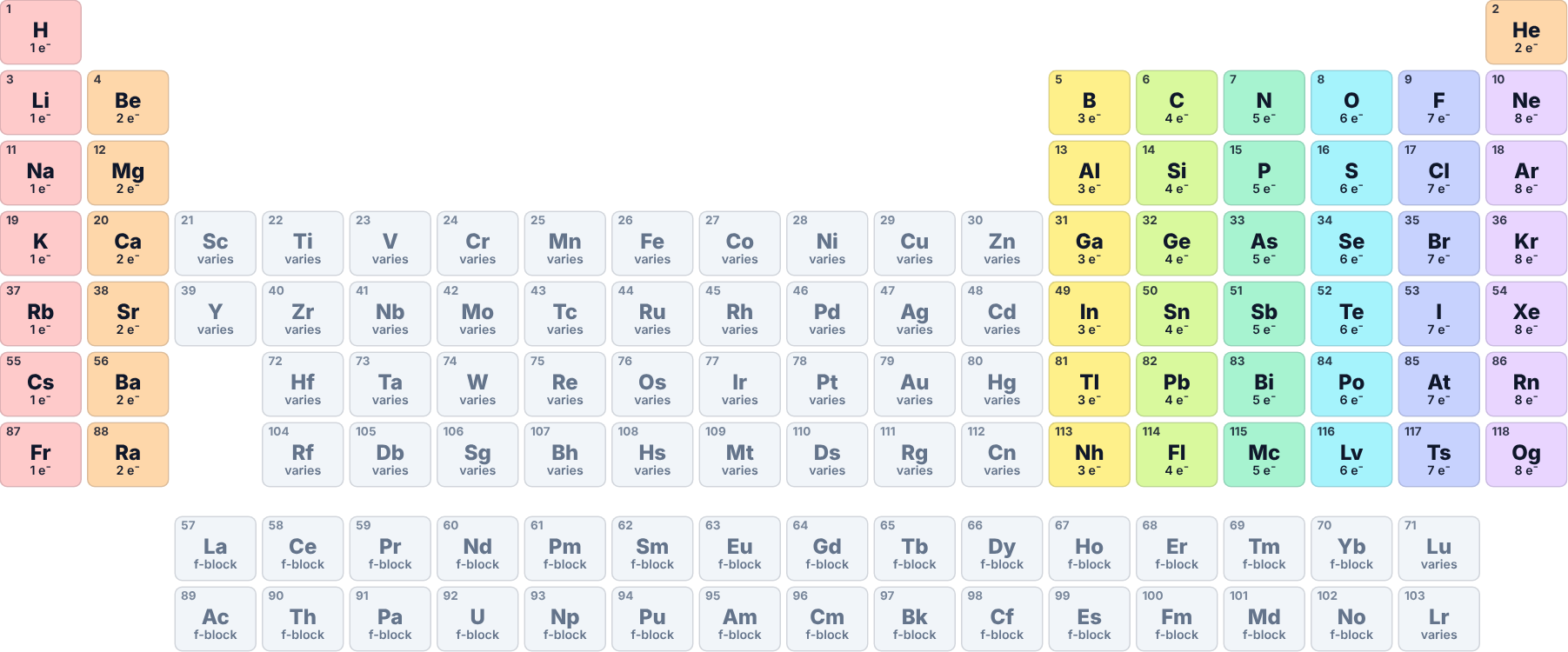
How to find valence electrons
- Find the element's group (column) on the table.
- Group 1 or 2: the number of valence electrons equals the group number.
- Groups 13 to 18: subtract 10 from the group number (group 16 → 6). Helium has 2.
- Check against the electron configuration: valence electrons are those in the outermost shell (highest n), for example oxygen 2s² 2p⁴ → 6.
| Group | 1 | 2 | 13 | 14 | 15 | 16 | 17 | 18 |
|---|---|---|---|---|---|---|---|---|
| Valence electrons | 1 | 2 | 3 | 4 | 5 | 6 | 7 | 8 (He: 2) |
| Outer configuration | ns¹ | ns² | ns² np¹ | ns² np² | ns² np³ | ns² np⁴ | ns² np⁵ | ns² np⁶ |
| Typical ion | +1 | +2 | +3 | – | −3 | −2 | −1 | none |
The typical ion is the charge an element reaches by gaining or losing electrons to get a full outer shell; carbon and silicon usually share electrons instead of forming ions. Heavier elements in groups 13 to 15 also form ions with lower charges (Tl⁺, Sn²⁺, Pb²⁺).
Valence electrons of the first 54 main-group elements
| Element | Group | Valence electrons | Lewis dots |
|---|---|---|---|
| Hydrogen (H) | 1 | 1 | |
| Helium (He) | 18 | 2 | |
| Lithium (Li) | 1 | 1 | |
| Beryllium (Be) | 2 | 2 | |
| Boron (B) | 13 | 3 | |
| Carbon (C) | 14 | 4 | |
| Nitrogen (N) | 15 | 5 | |
| Oxygen (O) | 16 | 6 | |
| Fluorine (F) | 17 | 7 | |
| Neon (Ne) | 18 | 8 | |
| Sodium (Na) | 1 | 1 | |
| Magnesium (Mg) | 2 | 2 | |
| Aluminium (Al) | 13 | 3 | |
| Silicon (Si) | 14 | 4 | |
| Phosphorus (P) | 15 | 5 | |
| Sulfur (S) | 16 | 6 | |
| Chlorine (Cl) | 17 | 7 | |
| Argon (Ar) | 18 | 8 | |
| Potassium (K) | 1 | 1 | |
| Calcium (Ca) | 2 | 2 | |
| Gallium (Ga) | 13 | 3 | |
| Germanium (Ge) | 14 | 4 | |
| Arsenic (As) | 15 | 5 | |
| Selenium (Se) | 16 | 6 | |
| Bromine (Br) | 17 | 7 | |
| Krypton (Kr) | 18 | 8 | |
| Rubidium (Rb) | 1 | 1 | |
| Strontium (Sr) | 2 | 2 | |
| Indium (In) | 13 | 3 | |
| Tin (Sn) | 14 | 4 | |
| Antimony (Sb) | 15 | 5 | |
| Tellurium (Te) | 16 | 6 | |
| Iodine (I) | 17 | 7 | |
| Xenon (Xe) | 18 | 8 |
Counts follow the group rule above. Draw the dot structure of a whole molecule with the Lewis structure generator.
Why transition metals are different
In the d-block the (n−1)d and ns electrons are close in energy, and both can take part in bonding. Iron (3d⁶ 4s²) can lose 2 or 3 electrons, so a single "valence electron" number is not meaningful. The chart shows "varies" for these elements; use their electron configuration instead.
Frequently asked questions
How many valence electrons does oxygen have?
Six. Oxygen is in group 16, and its configuration is 1s² 2s² 2p⁴: two electrons in 2s and four in 2p.
How many valence electrons does carbon have?
Four. Carbon is in group 14 (2s² 2p²), which is why it usually forms four bonds.
Why does helium have 2 valence electrons and not 8?
Helium has only the 1s shell, which is full with 2 electrons. It sits in group 18 because, like the other noble gases, its outer shell is full.
Do transition metals have valence electrons?
Yes, but the number is not fixed by the group. Both the outer s electrons and some d electrons can take part in bonding, so these elements show several oxidation states.
More periodic table charts
From elements to molecules: draw any compound in MolDraw and get its formula and molar mass instantly.
Open MolDraw editorLast updated: