Labeled Periodic Table
In short: This labeled periodic table shows group numbers across the top, period numbers down the side, and colours each element by family. Every tile links to that element's page with atomic mass and electron configuration.
- diatomic nonmetal
- noble gas
- alkali metal
- alkaline earth metal
- metalloid
- polyatomic nonmetal
- post-transition metal
- transition metal
- lanthanide
- actinide
- unknown, probably transition metal
- unknown, probably post-transition metal
- unknown, probably metalloid
- unknown, predicted to be noble gas
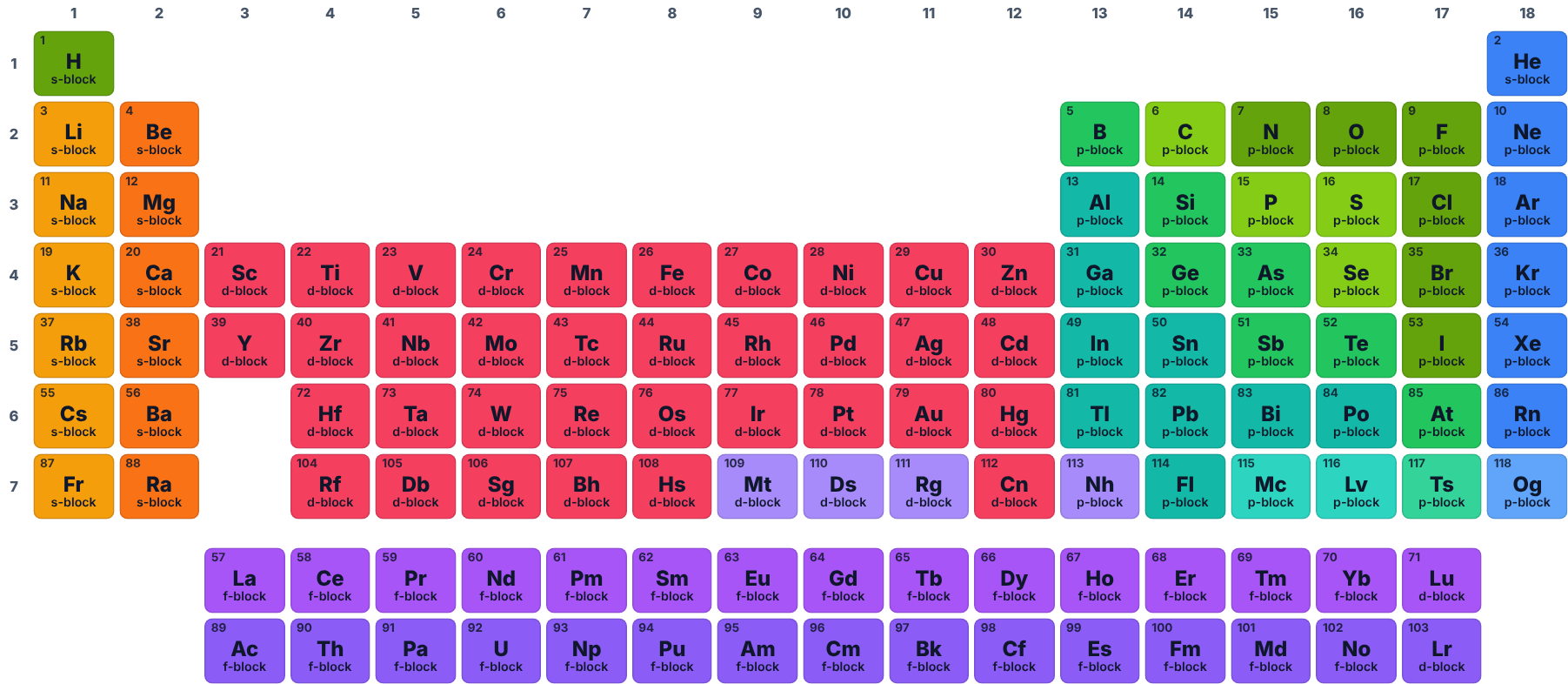
How to read the labels
- Numbers on top (1–18): groups. Elements in a column share their outer electron configuration.
- Numbers on the left (1–7): periods. The period is the outermost electron shell.
- Small text on each tile: the block (s, p, d or f), which is the subshell being filled. Groups 1–2 are the s-block, 13–18 the p-block, 3–12 the d-block, and the two rows below are the f-block.
- Colours: element families, from alkali metals to noble gases (see the legend).
Element families
Frequently asked questions
What are the labels on a periodic table?
Group numbers (1–18) across the top, period numbers (1–7) down the side, and on each tile the atomic number, symbol and usually the name and atomic mass.
What are the s, p, d and f blocks?
Regions of the table named after the subshell that is being filled: s (groups 1–2 and helium), p (groups 13–18), d (groups 3–12) and f (lanthanides and actinides).
Can I print this labeled periodic table?
Yes. Download the PNG above, or the colour and blank PDFs from the printable periodic table page.
More periodic table charts
From elements to molecules: draw any compound in MolDraw and get its formula and molar mass instantly.
Open MolDraw editorLast updated: