Metals, Nonmetals and Metalloids on the Periodic Table
In short: Metals are on the left and in the middle of the periodic table, nonmetals are on the right, and the metalloids sit on the staircase line between them. In this chart 86 elements are metals, 17 are nonmetals and 7 are metalloids; the 8 superheavy elements have predicted properties.
- Metal
- Metalloid
- Nonmetal
- Properties not known (predicted)
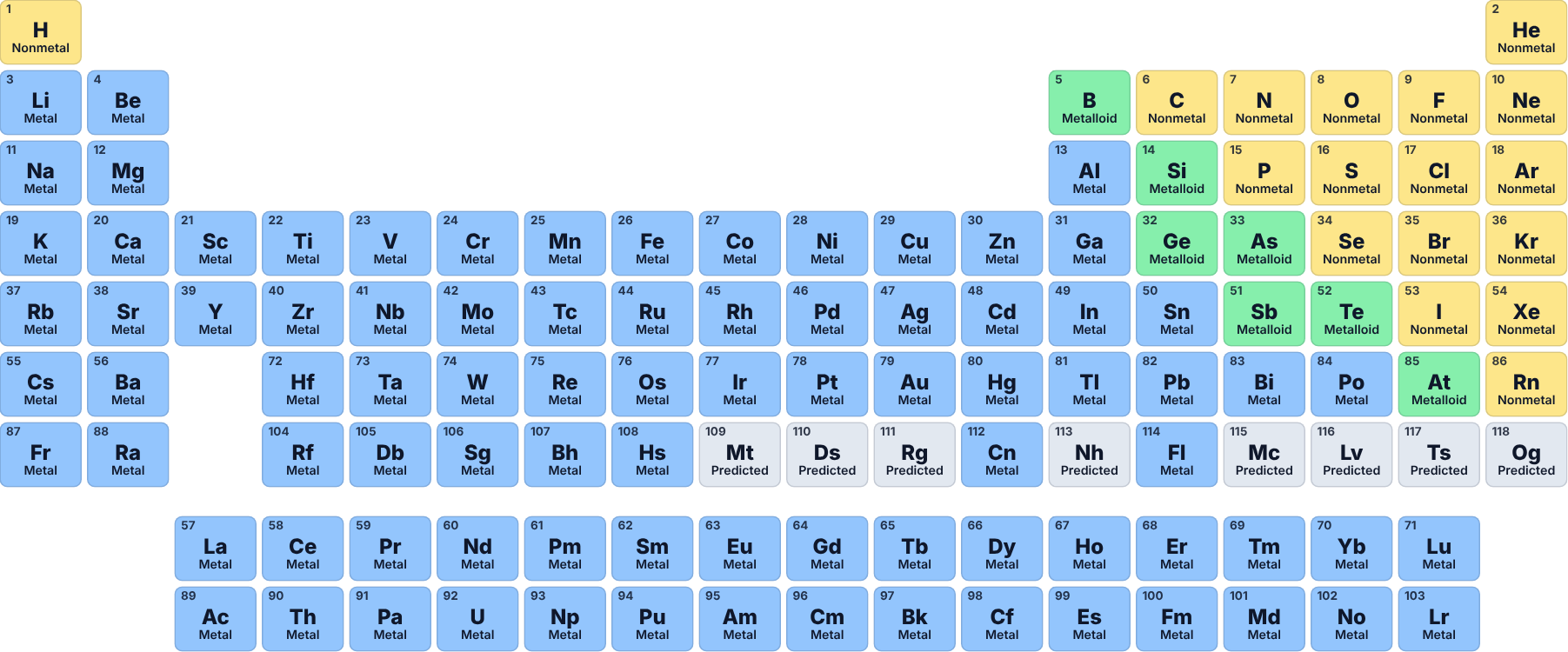
How to tell metals, nonmetals and metalloids apart
Follow the staircase line that runs from boron down to astatine. Elements to the left of it are metals (except hydrogen), elements to the right are nonmetals, and the elements touching the line are metalloids.
| Property | Metals | Metalloids | Nonmetals |
|---|---|---|---|
| Appearance | Shiny (lustrous) | Often shiny | Dull; many are gases |
| Conducts electricity | Good conductors | Semiconductors | Poor conductors (graphite is an exception) |
| Solids | Malleable and ductile | Brittle | Brittle |
| Ions | Lose electrons → cations | Mixed behaviour | Gain electrons → anions |
| Oxides | Basic | Amphoteric or weakly acidic | Acidic |
List of metalloids
Boron, Silicon, Germanium, Arsenic, Antimony, Tellurium, Astatine. Sources do not all agree on the borderline: polonium and astatine are sometimes counted as metals, and selenium or carbon are sometimes added to the metalloids. This chart follows the classification in its data source.
List of nonmetals
Hydrogen, Helium, Carbon, Nitrogen, Oxygen, Fluorine, Neon, Phosphorus, Sulfur, Chlorine, Argon, Selenium, Bromine, Krypton, Iodine, Xenon, Radon.
Metals
All other elements are metals: the alkali and alkaline earth metals, the transition metals, the post-transition metals (such as aluminium, tin and lead), and the lanthanides and actinides. The superheavy elements Meitnerium, Darmstadtium, Roentgenium, Nihonium, Moscovium, Livermorium, Tennessine, Oganesson have only been made a few atoms at a time, so their properties are predicted.
Frequently asked questions
How many metals are on the periodic table?
In this chart 86 of the 118 elements are metals, 17 are nonmetals and 7 are metalloids. The remaining 8 superheavy elements have predicted properties. The exact counts depend on how a source classifies the borderline elements.
Is hydrogen a metal?
No. Hydrogen is in group 1 above the alkali metals, but under normal conditions it is a nonmetal gas (H₂).
Where are the metalloids?
On the staircase line between metals and nonmetals: boron, silicon, germanium, arsenic, antimony, tellurium, astatine.
Is aluminium a metalloid?
No. Aluminium touches the staircase line but is a metal (a post-transition metal): it is shiny, conducts electricity well and forms Al³⁺ ions.
More periodic table charts
From elements to molecules: draw any compound in MolDraw and get its formula and molar mass instantly.
Open MolDraw editorLast updated: