Halogens on the Periodic Table
In short: The halogens are the group 17 elements: fluorine, chlorine, bromine, iodine, astatine and tennessine. With seven valence electrons they need one more to fill their outer shell, so they readily gain an electron to form −1 halide ions (F⁻, Cl⁻, Br⁻, I⁻). They exist as diatomic molecules (F₂, Cl₂, Br₂, I₂) and are among the most reactive nonmetals.
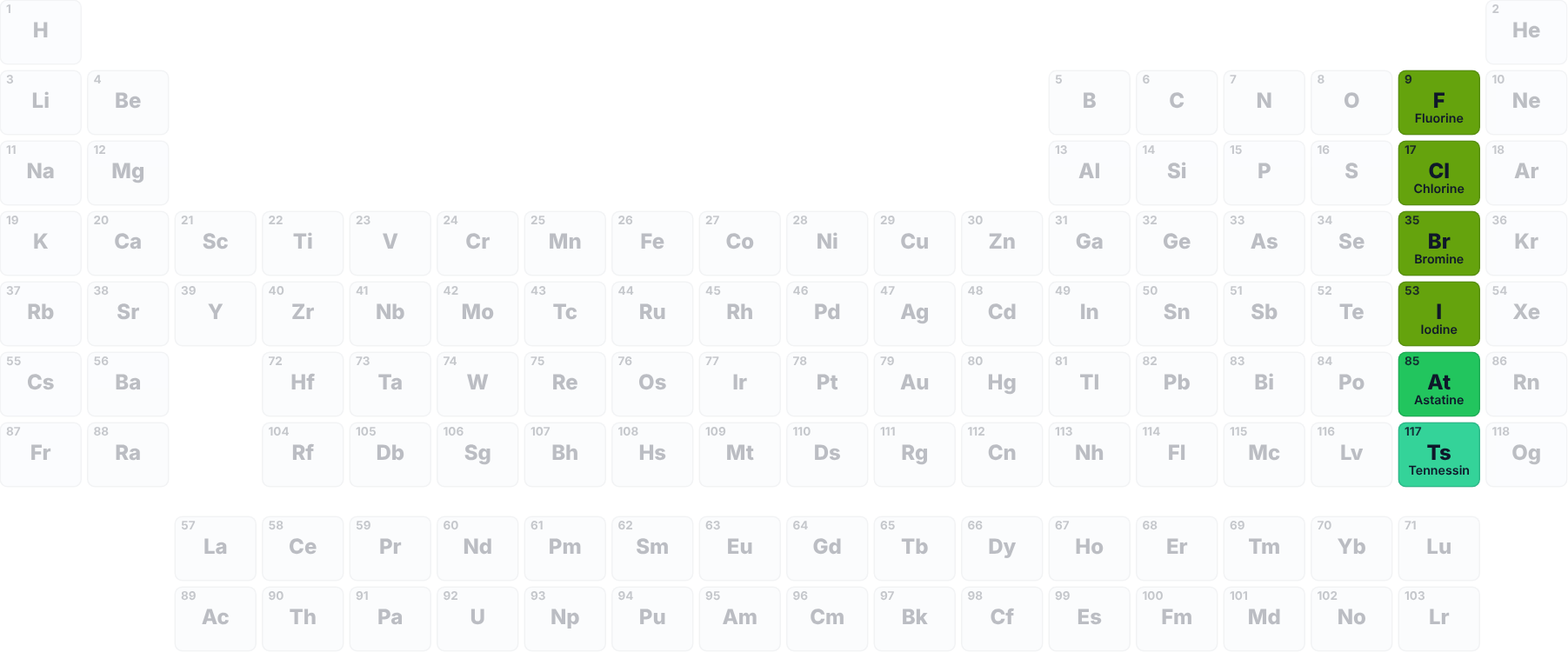
Highlighted: the 6 halogens. Click any tile for the element page.
Key facts about halogens
- Seven valence electrons (ns² np⁵); halide ions carry a −1 charge.
- Reactivity decreases down the group: fluorine is the most electronegative element.
- At room temperature fluorine and chlorine are gases, bromine is a liquid and iodine is a solid.
Properties of the halogens
| Z | Symbol | Element | Atomic mass (u) | Melting point (K) | Boiling point (K) | Density (g/cm³; gases g/L) | Electronegativity (Pauling) |
|---|---|---|---|---|---|---|---|
| 9 | F | Fluorine | 18.998 | 53.48 | 85.03 | 1.696 | 3.98 |
| 17 | Cl | Chlorine | 35.45 | 171.6 | 239.11 | 3.2 | 3.16 |
| 35 | Br | Bromine | 79.904 | 265.8 | 332 | 3.1028 | 2.96 |
| 53 | I | Iodine | 126.9 | 386.85 | 457.4 | 4.933 | 2.66 |
| 85 | At | Astatine | [210] | 575 | 610 | 6.35 | 2.2 |
| 117 | Ts | Tennessine | [294] | 723 | 883 | 7.17 | – |
Sources: IUPAC CIAAW, Abridged standard atomic weights; Periodic-Table-JSON (CC BY-SA 3.0, derived from Wikipedia).
Other families
Frequently asked questions
Which elements are halogens?
Fluorine (F), Chlorine (Cl), Bromine (Br), Iodine (I), Astatine (At), Tennessine (Ts).
Where are the halogens on the periodic table?
Group 17. They are highlighted in the chart above.
More periodic table charts
From elements to molecules: draw any compound in MolDraw and get its formula and molar mass instantly.
Open MolDraw editorLast updated: