Electronegativity Periodic Table
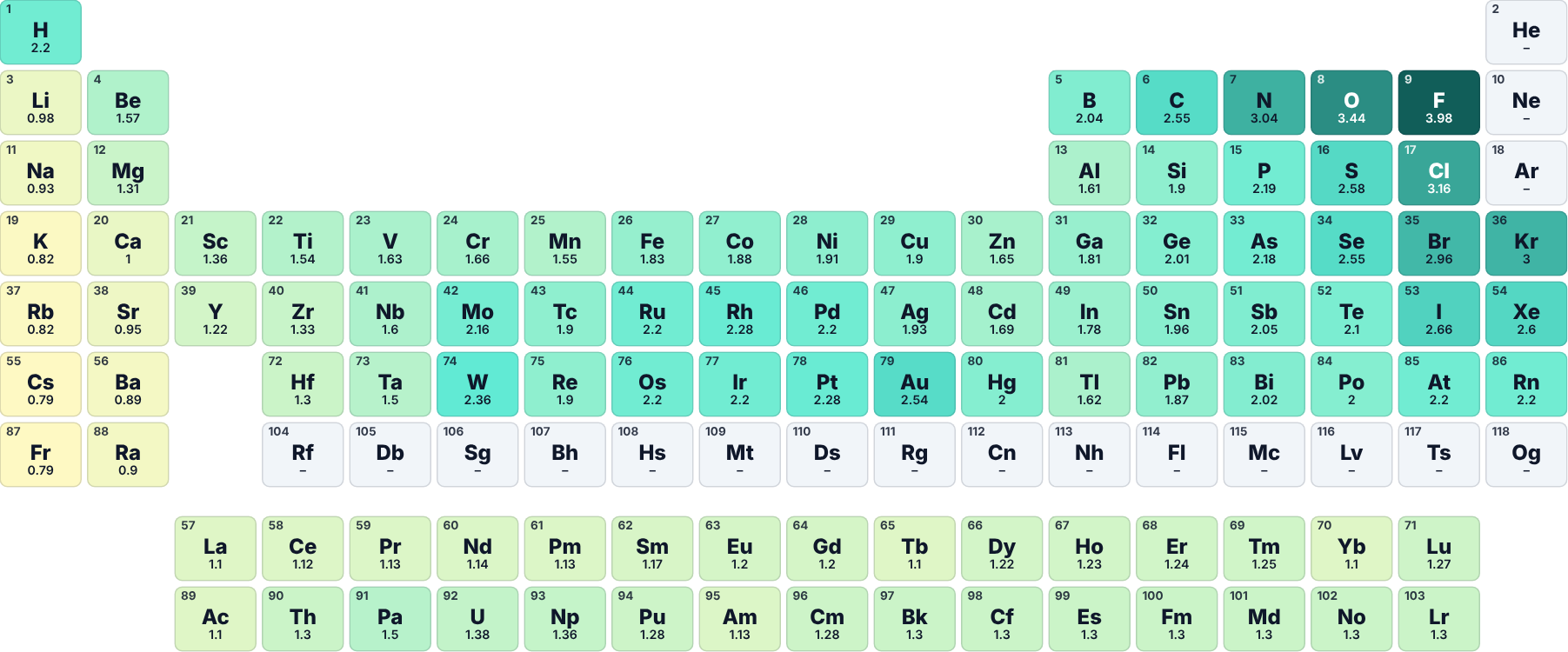
In short: Electronegativity is how strongly an atom pulls shared electrons towards itself in a bond. On the Pauling scale it rises across a period and up a group: fluorine is the highest at 3.98, and the alkali metals at the bottom left are the lowest (caesium 0.79).
Grey tiles: no Pauling value (most noble gases and superheavy elements).
Electronegativity trend
- Across a period (left to right): electronegativity increases. Nuclear charge rises while the electrons stay in the same shell, so they are held more tightly. Period 3 goes from sodium (0.93) to chlorine (3.16).
- Down a group: electronegativity decreases because the outer electrons are farther from the nucleus: fluorine 3.98, chlorine 3.16, bromine 2.96, iodine 2.66.
- Noble gases mostly have no Pauling value because they rarely form bonds.
Source: Pauling electronegativity values from Periodic-Table-JSON (CC BY-SA 3.0, derived from Wikipedia).
Using electronegativity to predict bonds
The difference in electronegativity (ΔEN) between two bonded atoms gives a rough guide to the bond type. These cut-offs are a common teaching rule of thumb, not sharp boundaries.
| ΔEN | Bond type (rule of thumb) | Example |
|---|---|---|
| below about 0.4 | Nonpolar covalent | C–H: |2.55 − 2.2| = 0.35 |
| about 0.4 to 1.7 | Polar covalent | O–H: |3.44 − 2.2| = 1.24 |
| above about 1.7 | Mostly ionic | Na–Cl: |3.16 − 0.93| = 2.23 |
Check any bond with the bond polarity and dipole checker.
Electronegativity values of all elements
Source: Pauling electronegativity values from Periodic-Table-JSON (CC BY-SA 3.0, derived from Wikipedia).
Frequently asked questions
Which element has the highest electronegativity?
Fluorine, at 3.98 on the Pauling scale. Oxygen (3.44) is second.
Which element has the lowest electronegativity?
Among elements with a value in this table, caesium (0.79) and francium (0.79) are the lowest.
Why does electronegativity increase across a period?
The number of protons increases while the outer electrons stay in the same shell, so the nucleus pulls bonding electrons more strongly.
Does electronegativity have units?
No. The Pauling scale is a relative, unitless scale.
More periodic table charts
From elements to molecules: draw any compound in MolDraw and get its formula and molar mass instantly.
Open MolDraw editorLast updated: