
Electrostatic Potential (MEP) plugin
Short answer: Install MEP from Settings, Plugins, draw a molecule, open the MEP tab and press Show in 3D.
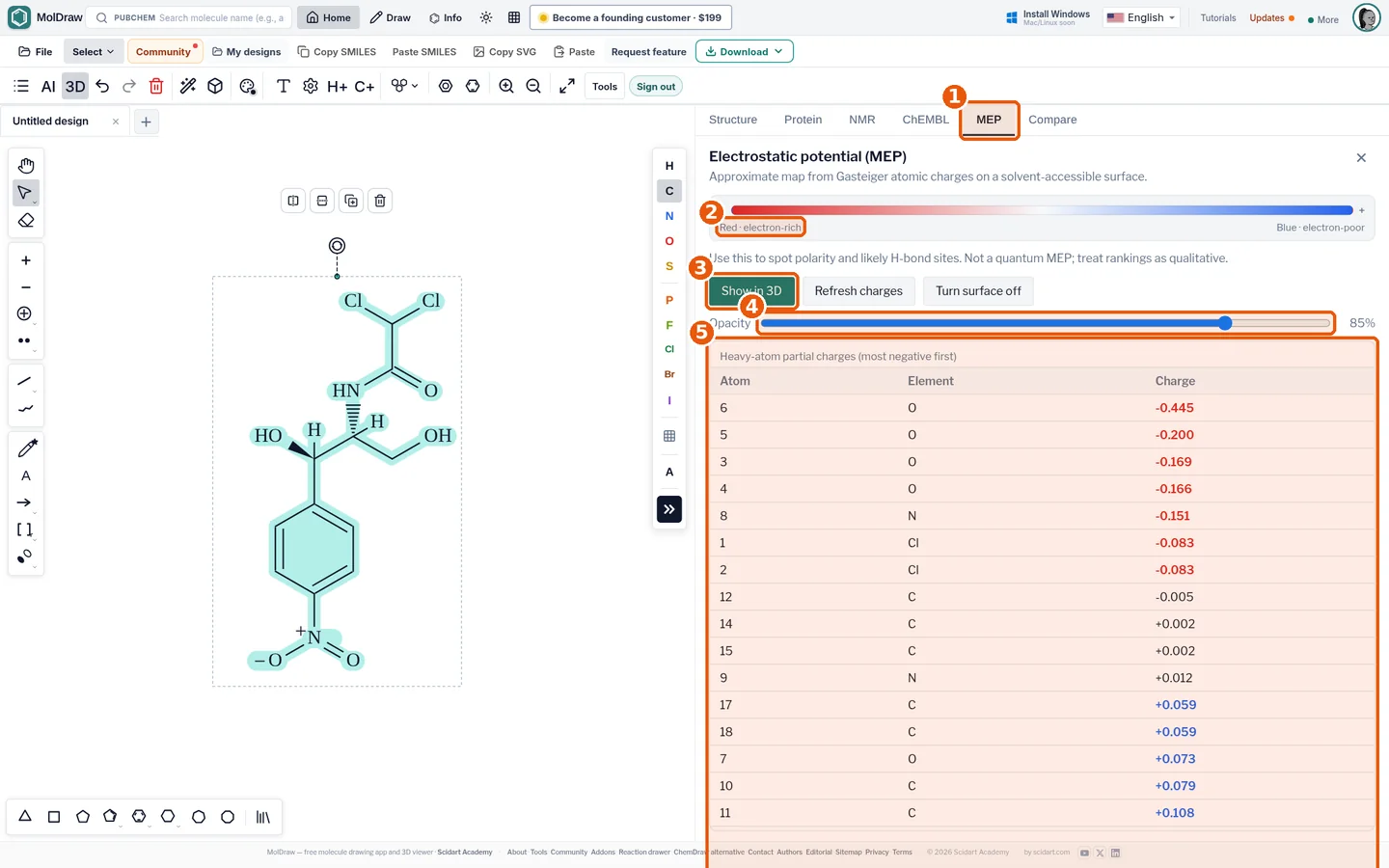
- MEP tab in the analysis panel.
- Colour scale from most electron-rich (red) to electron-poor (blue).
- Show in 3D draws the coloured surface on the 3D model; Refresh charges recalculates after edits.
- Opacity slider for the surface.
- Charge table: Gasteiger partial charge for every heavy atom, sorted most negative first.
What it does#
The plugin works out Gasteiger partial charges for each atom. Then it colors a surface around the 3D model. Red is negative. Blue is positive.
It is fast, but it is not a quantum calculation. Use it to compare, not for exact energies. For example, see which end is more negative or where a nucleophile will attack.
Who it is for#
Students who learn polarity. Teachers who make slides about charge. Anyone who wants a quick picture of charge in a molecule.
How to use it#
- Open the MolDraw editor and sign in. Click Settings, then Plugins, then Install next to Electrostatic Potential (MEP).
- Draw a molecule (or load one by name using the PubChem search box).
- Open the MEP tab (callout 1); charges are calculated immediately.
- Read the colour scale (callout 2) and the charge table (callout 5).
- Press Show in 3D (callout 3) to paint the surface on the 3D model.
- Adjust Opacity (callout 4) to see the ball-and-stick model through the surface.
- Use Turn surface off to return to the plain 3D view.
Tips#
- Compare related molecules, e.g. phenol vs. aniline, to see how substituents change charge.
- After editing the 2D drawing, press Refresh charges.
- For bond polarity, see the Lewis structure generator and VSEPR calculator.
Questions and answers
What does an electrostatic potential map show?
How positive or negative the electric potential is at the surface of a molecule. Red regions attract positive charges (lone pairs, electronegative atoms); blue regions are electron-poor.
How is the MEP calculated in MolDraw?
From Gasteiger partial atomic charges mapped onto a solvent-accessible surface. It is an approximation, not a quantum-chemical ESP.
Is it free?
Yes, with a free MolDraw account.