MolDraw › Templates › Reaction maps › Reducing agents guide
Reaction mapsPremium
Reducing agents guide template
Premium template. Preview and edit it free in MolDraw; downloading and exporting it is part of MolDraw Pro.
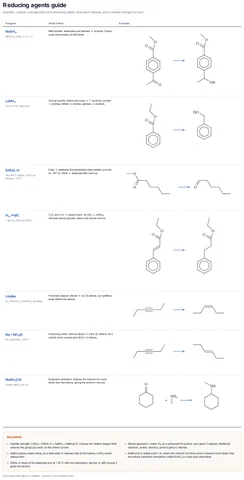
Reducing agents guide: NaBH₄, LiAlH₄, DIBAL-H, H₂/Pd-C, Lindlar catalyst, Na/NH₃ and NaBH₃CN, each with its conditions, chemoselectivity and a substrate → product example.
What the template shows
- Hydrides, catalytic hydrogenation and dissolving metals: what each reduces, and a worked example for each
- What it does
- MeOH or EtOH, 0 °C → rt
- Mild hydride: aldehydes and ketones → alcohols. Esters, acids and amides are left alone.
- Et₂O or THF; then H₃O⁺
- Strong hydride: esters and acids → 1° alcohols, amides → amines, nitriles → amines, ketones → alcohols.
- i-Bu₂AlH (1 equiv), CH₂Cl₂ or toluene, −78 °C
- Ester → aldehyde (the tetrahedral intermediate survives at −78 °C); nitrile → aldehyde after work-up.
- C=C and C≡C → alkane (syn), Ar–NO₂ → ArNH₂, removes benzyl groups; esters and arenes survive.
- H₂, Pd/CaCO₃, Pb(OAc)₂, quinoline
- Poisoned catalyst: alkyne → cis (Z) alkene, syn addition; stops before the alkane.
- Dissolving metal: internal alkyne → trans (E) alkene via a radical anion; arenes give Birch 1,4-dienes.
- amine, MeOH, pH ≈ 6
- Reductive amination: reduces the iminium ion much faster than the ketone, giving the amine in one pot.
- Hydride strength: LiAlH₄ > DIBAL-H > NaBH₄ > NaBH₃CN. Choose the mildest reagent that reduces the group you want, so the others survive.
- NaBH₄ leaves esters alone, so a keto-ester is reduced only at the ketone; LiAlH₄ would reduce both.
- DIBAL-H stops at the aldehyde only at −78 °C with one equivalent; warmer or with excess it gives the alcohol.
- Alkyne geometry: Lindlar (H₂ on a poisoned Pd surface, syn) gives Z alkenes; Na/NH₃(l) (electron, proton, electron, proton) gives E alkenes.
- NaBH₃CN is stable at pH ≈ 6, where the iminium ion forms and is reduced much faster than the ketone (reductive amination); NaBH(OAc)₃ is a less toxic alternative.
- Every part of this figure is editable · sources on the template card
Drawn with 128 atoms, 31 shapes – every one editable in MolDraw.
Sources
How to use this template
- Press Edit in MolDraw. The template opens on the canvas of the free MolDraw editor.
- Change anything: move structures, edit atoms and labels, recolour highlights or delete what you do not need.
- Add your own structures, arrows and text next to it, or combine several templates on one page.
- Export the drawing as PNG, SVG or PDF for slides, worksheets, theses and papers.
Frequently asked questions
Is the Reducing agents guide template free?
You can preview the Reducing agents guide template here and open and edit it in MolDraw for free. Downloading or exporting it is part of MolDraw Pro, together with the other premium templates.
Can I edit the Reducing agents guide template?
Yes. It opens as an ordinary MolDraw drawing, so every structure, arrow, label and colour can be changed, and you can add your own content around it.
Is the chemistry checked?
Every structure is checked with RDKit and every curly arrow passes MolDraw’s electron-flow audit. The sources used are listed on this page.
What is a reaction map?
A one-page diagram linking functional groups by the reactions that convert one into another, with the reagents on each arrow. It is one of the fastest ways to revise synthesis.