MolDraw › Templates › Reaction maps › Oxidising agents guide
Reaction mapsPremium
Oxidising agents guide template
Premium template. Preview and edit it free in MolDraw; downloading and exporting it is part of MolDraw Pro.
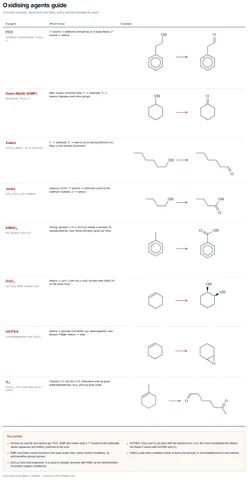
Oxidising agents guide: PCC, Dess–Martin periodinane, Swern, Jones reagent, KMnO₄, OsO₄, mCPBA and ozone, each with its conditions, selectivity and a substrate → product example.
What the template shows
- Common oxidants, what each one does, and a worked example for each
- What it does
- pyridinium chlorochromate, CH₂Cl₂, rt
- 1° alcohol → aldehyde (anhydrous, so it stops there); 2° alcohol → ketone.
- Dess–Martin (DMP)
- Mild, neutral, chromium-free: 1° → aldehyde, 2° → ketone; tolerates most other groups.
- (COCl)₂, DMSO, −78 °C; then Et₃N
- 1° → aldehyde, 2° → ketone via an alkoxysulfonium ion; Me₂S is the (smelly) by-product.
- CrO₃, H₂SO₄, H₂O / acetone
- Aqueous Cr(VI): 1° alcohol → carboxylic acid (via the aldehyde hydrate); 2° → ketone.
- hot, aqueous; then H₃O⁺
- Strong: benzylic C–H → ArCO₂H (needs a benzylic H); cleaves alkenes; cold, dilute and basic gives syn diols.
- cat. OsO₄, NMO, acetone / H₂O
- Alkene → syn-1,2-diol via a cyclic osmate ester (both OH on the same face).
- m-chloroperbenzoic acid, CH₂Cl₂
- Alkene → epoxide (concerted, syn, stereospecific); also Baeyer–Villiger: ketone → ester.
- CH₂Cl₂, −78 °C; then Me₂S (or Zn, AcOH)
- Cleaves C=C into two C=O. Reductive work-up gives aldehydes/ketones; H₂O₂ work-up gives acids.
- Choose by how far you want to go: PCC, DMP and Swern stop a 1° alcohol at the aldehyde; Jones (aqueous) and KMnO₄ continue to the acid.
- DMP and Swern avoid chromium and work under mild, nearly neutral conditions, so acid-sensitive groups survive.
- OsO₄ is toxic and expensive: it is used in catalytic amounts with NMO as the stoichiometric re-oxidant (Upjohn conditions).
- mCPBA, OsO₄ and O₃ all react with the electron-rich C=C; the more substituted the alkene, the faster it reacts with mCPBA and O₃.
- KMnO₄ side-chain oxidation needs at least one benzylic H: tert-butylbenzene is not oxidised.
- Every part of this figure is editable · sources on the template card
Drawn with 116 atoms, 35 shapes – every one editable in MolDraw.
Sources
How to use this template
- Press Edit in MolDraw. The template opens on the canvas of the free MolDraw editor.
- Change anything: move structures, edit atoms and labels, recolour highlights or delete what you do not need.
- Add your own structures, arrows and text next to it, or combine several templates on one page.
- Export the drawing as PNG, SVG or PDF for slides, worksheets, theses and papers.
Frequently asked questions
Is the Oxidising agents guide template free?
You can preview the Oxidising agents guide template here and open and edit it in MolDraw for free. Downloading or exporting it is part of MolDraw Pro, together with the other premium templates.
Can I edit the Oxidising agents guide template?
Yes. It opens as an ordinary MolDraw drawing, so every structure, arrow, label and colour can be changed, and you can add your own content around it.
Is the chemistry checked?
Every structure is checked with RDKit and every curly arrow passes MolDraw’s electron-flow audit. The sources used are listed on this page.
What is a reaction map?
A one-page diagram linking functional groups by the reactions that convert one into another, with the reagents on each arrow. It is one of the fastest ways to revise synthesis.