MolDraw › Templates › Reaction maps › Alkyne reactions map
Reaction mapsFree
Alkyne reactions map template
Free template. Download it, or open it in MolDraw to change it first.
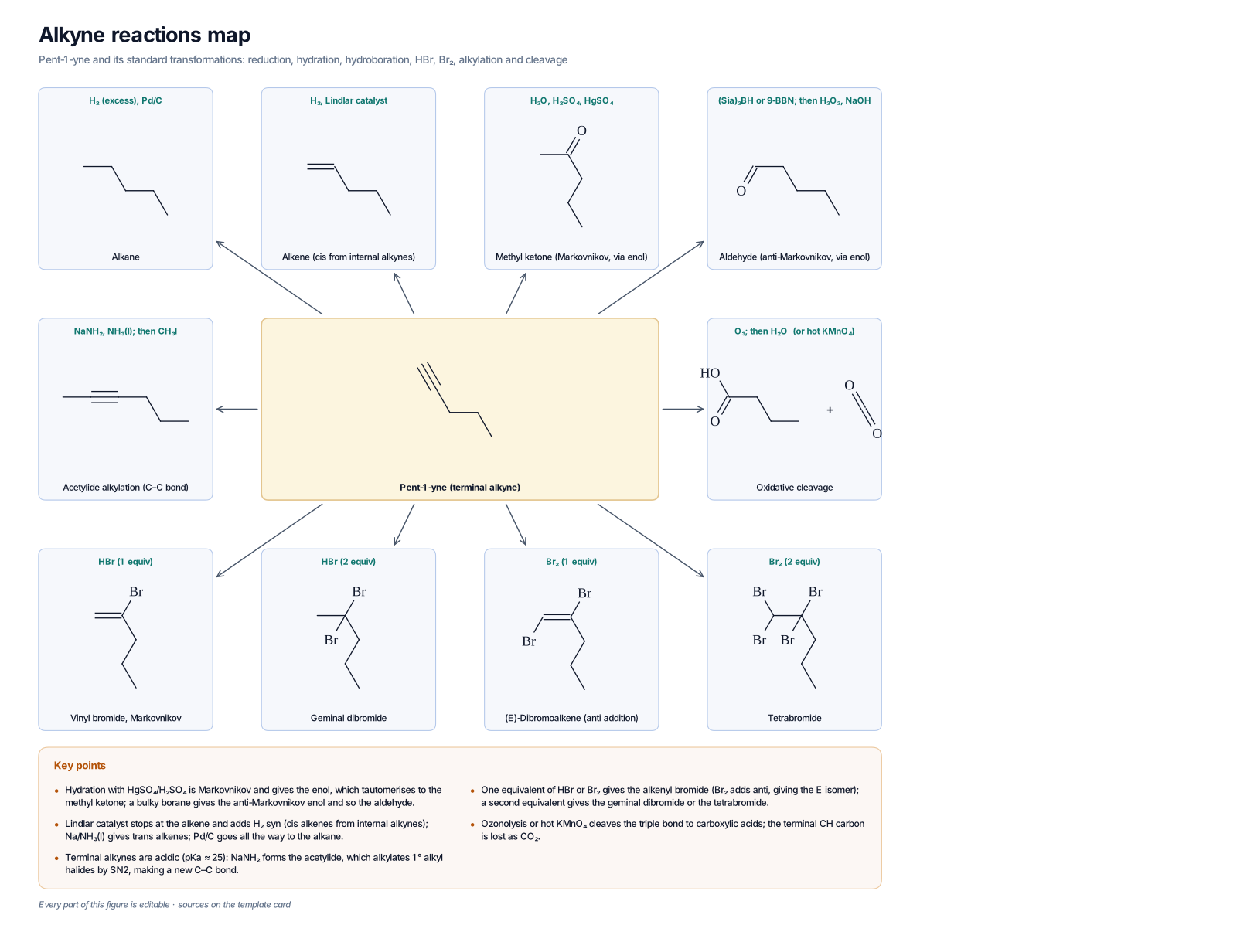
Alkyne reaction map: pent-1-yne in the centre with hydrogenation (Pd/C, Lindlar), Hg²⁺ hydration to the methyl ketone, hydroboration to the aldehyde, HBr and Br₂ (1 and 2 equiv), acetylide alkylation and ozonolysis, reagents on every arrow.
What the template shows
- Pent-1-yne and its standard transformations: reduction, hydration, hydroboration, HBr, Br₂, alkylation and cleavage
- Pent-1-yne (terminal alkyne)
- H₂, Lindlar catalyst
- Alkene (cis from internal alkynes)
- Methyl ketone (Markovnikov, via enol)
- (Sia)₂BH or 9-BBN; then H₂O₂, NaOH
- Aldehyde (anti-Markovnikov, via enol)
- NaNH₂, NH₃(l); then CH₃I
- Acetylide alkylation (C–C bond)
- O₃; then H₂O (or hot KMnO₄)
- Oxidative cleavage
- HBr (1 equiv)
- Vinyl bromide, Markovnikov
- HBr (2 equiv)
- Geminal dibromide
- (E)-Dibromoalkene (anti addition)
- Hydration with HgSO₄/H₂SO₄ is Markovnikov and gives the enol, which tautomerises to the methyl ketone; a bulky borane gives the anti-Markovnikov enol and so the aldehyde.
- Lindlar catalyst stops at the alkene and adds H₂ syn (cis alkenes from internal alkynes); Na/NH₃(l) gives trans alkenes; Pd/C goes all the way to the alkane.
- Terminal alkynes are acidic (pKa ≈ 25): NaNH₂ forms the acetylide, which alkylates 1° alkyl halides by SN2, making a new C–C bond.
- One equivalent of HBr or Br₂ gives the alkenyl bromide (Br₂ adds anti, giving the E isomer); a second equivalent gives the geminal dibromide or the tetrabromide.
- Ozonolysis or hot KMnO₄ cleaves the triple bond to carboxylic acids; the terminal CH carbon is lost as CO₂.
- Every part of this figure is editable · sources on the template card
Drawn with 71 atoms, 42 shapes – every one editable in MolDraw.
Sources
How to use this template
- Press Edit in MolDraw. The template opens on the canvas of the free MolDraw editor.
- Change anything: move structures, edit atoms and labels, recolour highlights or delete what you do not need.
- Add your own structures, arrows and text next to it, or combine several templates on one page.
- Export the drawing as PNG, SVG or PDF for slides, worksheets, theses and papers.
Frequently asked questions
Is the Alkyne reactions map template free?
Yes. The Alkyne reactions map template is one of the free MolDraw templates: open it in the editor or download it from this page as SVG or PNG and use it in your slides, worksheets and notes.
Can I edit the Alkyne reactions map template?
Yes. It opens as an ordinary MolDraw drawing, so every structure, arrow, label and colour can be changed, and you can add your own content around it.
Is the chemistry checked?
Every structure is checked with RDKit and every curly arrow passes MolDraw’s electron-flow audit. The sources used are listed on this page.
What is a reaction map?
A one-page diagram linking functional groups by the reactions that convert one into another, with the reagents on each arrow. It is one of the fastest ways to revise synthesis.