MolDraw › Templates › Reaction maps › Aromatic substitution map
Reaction mapsPremium
Aromatic substitution map template
Premium template. Preview and edit it free in MolDraw; downloading and exporting it is part of MolDraw Pro.
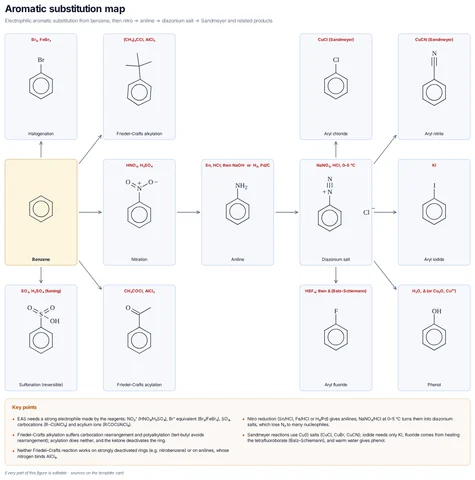
Aromatic substitution map: benzene to nitrobenzene, bromobenzene, benzenesulfonic acid, tert-butylbenzene and acetophenone (Friedel–Crafts), nitro reduction to aniline, diazotisation and the Sandmeyer (CuCl, CuCN), KI, Balz–Schiemann and phenol products.
What the template shows
- Electrophilic aromatic substitution from benzene, then nitro → aniline → diazonium salt → Sandmeyer and related products
- Sulfonation (reversible)
- (CH₃)₃CCl, AlCl₃
- Friedel–Crafts alkylation
- CH₃COCl, AlCl₃
- Friedel–Crafts acylation
- Sn, HCl; then NaOH or H₂, Pd/C
- NaNO₂, HCl, 0–5 °C
- Diazonium salt
- CuCl (Sandmeyer)
- Aryl chloride
- CuCN (Sandmeyer)
- Aryl nitrile
- Aryl iodide
- HBF₄; then Δ (Balz–Schiemann)
- Aryl fluoride
- EAS needs a strong electrophile made by the reagents: NO₂⁺ (HNO₃/H₂SO₄), Br⁺ equivalent (Br₂/FeBr₃), SO₃, carbocations (R–Cl/AlCl₃) and acylium ions (RCOCl/AlCl₃).
- Friedel–Crafts alkylation suffers carbocation rearrangement and polyalkylation (tert-butyl avoids rearrangement); acylation does neither, and the ketone deactivates the ring.
- Neither Friedel–Crafts reaction works on strongly deactivated rings (e.g. nitrobenzene) or on anilines, whose nitrogen binds AlCl₃.
- Nitro reduction (Sn/HCl, Fe/HCl or H₂/Pd) gives anilines; NaNO₂/HCl at 0–5 °C turns them into diazonium salts, which lose N₂ to many nucleophiles.
- Sandmeyer reactions use Cu(I) salts (CuCl, CuBr, CuCN); iodide needs only KI, fluoride comes from heating the tetrafluoroborate (Balz–Schiemann), and warm water gives phenol.
- Every part of this figure is editable · sources on the template card
Drawn with 103 atoms, 50 shapes – every one editable in MolDraw.
Sources
How to use this template
- Press Edit in MolDraw. The template opens on the canvas of the free MolDraw editor.
- Change anything: move structures, edit atoms and labels, recolour highlights or delete what you do not need.
- Add your own structures, arrows and text next to it, or combine several templates on one page.
- Export the drawing as PNG, SVG or PDF for slides, worksheets, theses and papers.
Frequently asked questions
Is the Aromatic substitution map template free?
You can preview the Aromatic substitution map template here and open and edit it in MolDraw for free. Downloading or exporting it is part of MolDraw Pro, together with the other premium templates.
Can I edit the Aromatic substitution map template?
Yes. It opens as an ordinary MolDraw drawing, so every structure, arrow, label and colour can be changed, and you can add your own content around it.
Is the chemistry checked?
Every structure is checked with RDKit and every curly arrow passes MolDraw’s electron-flow audit. The sources used are listed on this page.
What is a reaction map?
A one-page diagram linking functional groups by the reactions that convert one into another, with the reagents on each arrow. It is one of the fastest ways to revise synthesis.