MolDraw › Templates › Teaching lab › Salt analysis record sheet
Teaching labFree
Salt analysis record sheet template
Free template. Download it, or open it in MolDraw to change it first.
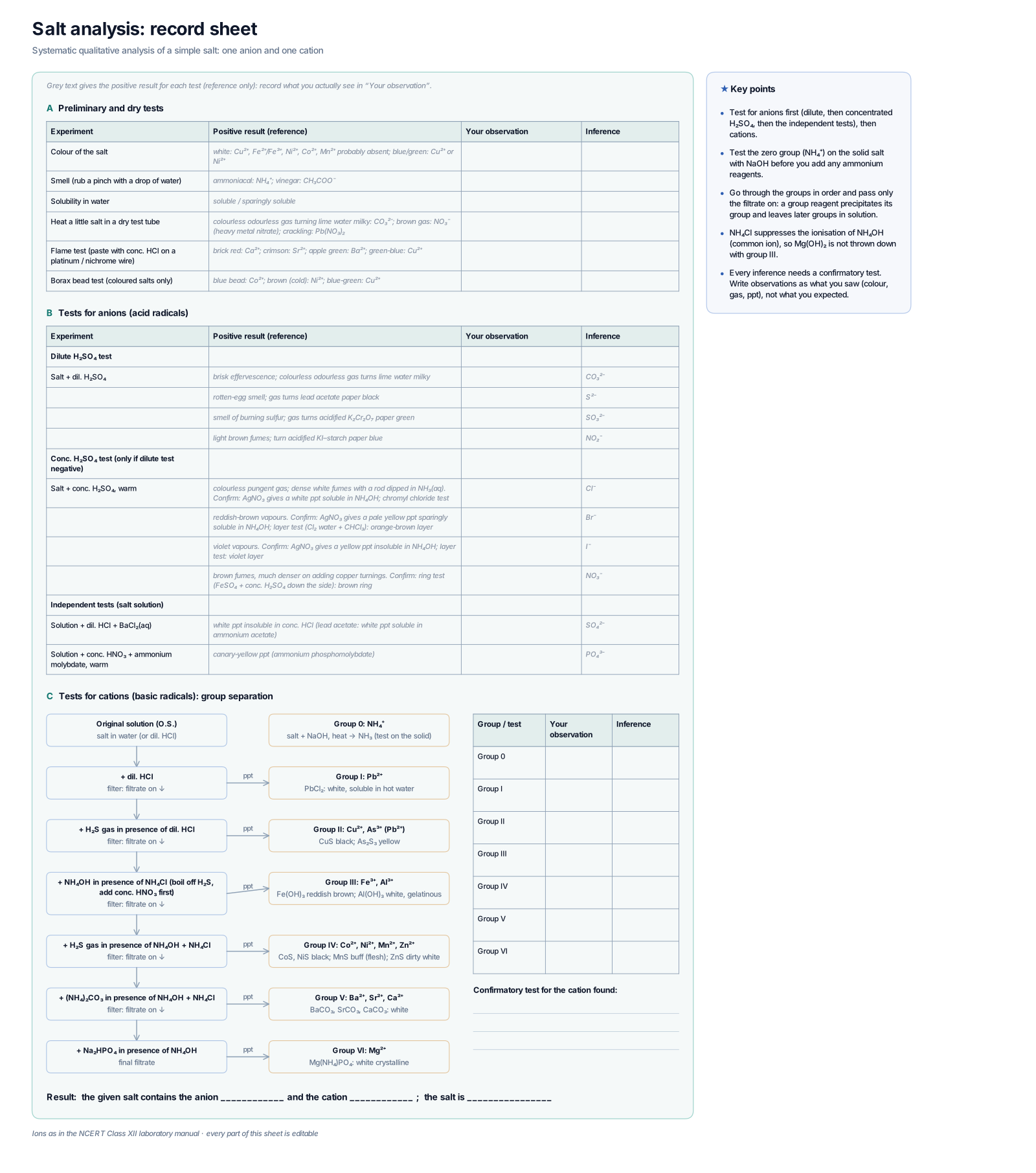
Qualitative inorganic analysis of a simple salt, practical-book style: preliminary and dry tests, anion tests (CO₃²⁻, S²⁻, SO₃²⁻, NO₂⁻, Cl⁻, Br⁻, I⁻, NO₃⁻, SO₄²⁻, PO₄³⁻) and the cation group separation flowchart (groups 0–VI) with observation and inference columns.
What the template shows
- Salt analysis: record sheet
- Systematic qualitative analysis of a simple salt: one anion and one cation
- Grey text gives the positive result for each test (reference only): record what you actually see in “Your observation”.
- Preliminary and dry tests
- Positive result (reference)
- Your observation
- Colour of the salt
- white: Cu²⁺, Fe²⁺/Fe³⁺, Ni²⁺, Co²⁺, Mn²⁺ probably absent; blue/green: Cu²⁺ or Ni²⁺
- Smell (rub a pinch with a drop of water)
- ammoniacal: NH₄⁺; vinegar: CH₃COO⁻
- Solubility in water
- soluble / sparingly soluble
- Heat a little salt in a dry test tube
- colourless odourless gas turning lime water milky: CO₃²⁻; brown gas: NO₃⁻ (heavy metal nitrate); crackling: Pb(NO₃)₂
- Flame test (paste with conc. HCl on a platinum / nichrome wire)
- brick red: Ca²⁺; crimson: Sr²⁺; apple green: Ba²⁺; green-blue: Cu²⁺
- Borax bead test (coloured salts only)
- blue bead: Co²⁺; brown (cold): Ni²⁺; blue-green: Cu²⁺
- Tests for anions (acid radicals)
- Dilute H₂SO₄ test
- Salt + dil. H₂SO₄
- brisk effervescence; colourless odourless gas turns lime water milky
- rotten-egg smell; gas turns lead acetate paper black
- smell of burning sulfur; gas turns acidified K₂Cr₂O₇ paper green
Drawn with 104 shapes – every one editable in MolDraw.
Sources
How to use this template
- Press Edit in MolDraw. The template opens on the canvas of the free MolDraw editor.
- Change anything: move structures, edit atoms and labels, recolour highlights or delete what you do not need.
- Add your own structures, arrows and text next to it, or combine several templates on one page.
- Export the drawing as PNG, SVG or PDF for slides, worksheets, theses and papers.
Frequently asked questions
Is the Salt analysis record sheet template free?
Yes. The Salt analysis record sheet template is one of the free MolDraw templates: open it in the editor or download it from this page as SVG or PNG and use it in your slides, worksheets and notes.
Can I edit the Salt analysis record sheet template?
Yes. It opens as an ordinary MolDraw drawing, so every structure, arrow, label and colour can be changed, and you can add your own content around it.
Is the chemistry checked?
Every structure is checked with RDKit and every curly arrow passes MolDraw’s electron-flow audit. The sources used are listed on this page.
Are the teaching lab sheets printable?
Yes. Open one in MolDraw, add your school or course name and export it as PDF to print.