MolDraw › Templates › Teaching lab › Lab report template
Teaching labFree
Lab report template template
Free template. Download it, or open it in MolDraw to change it first.
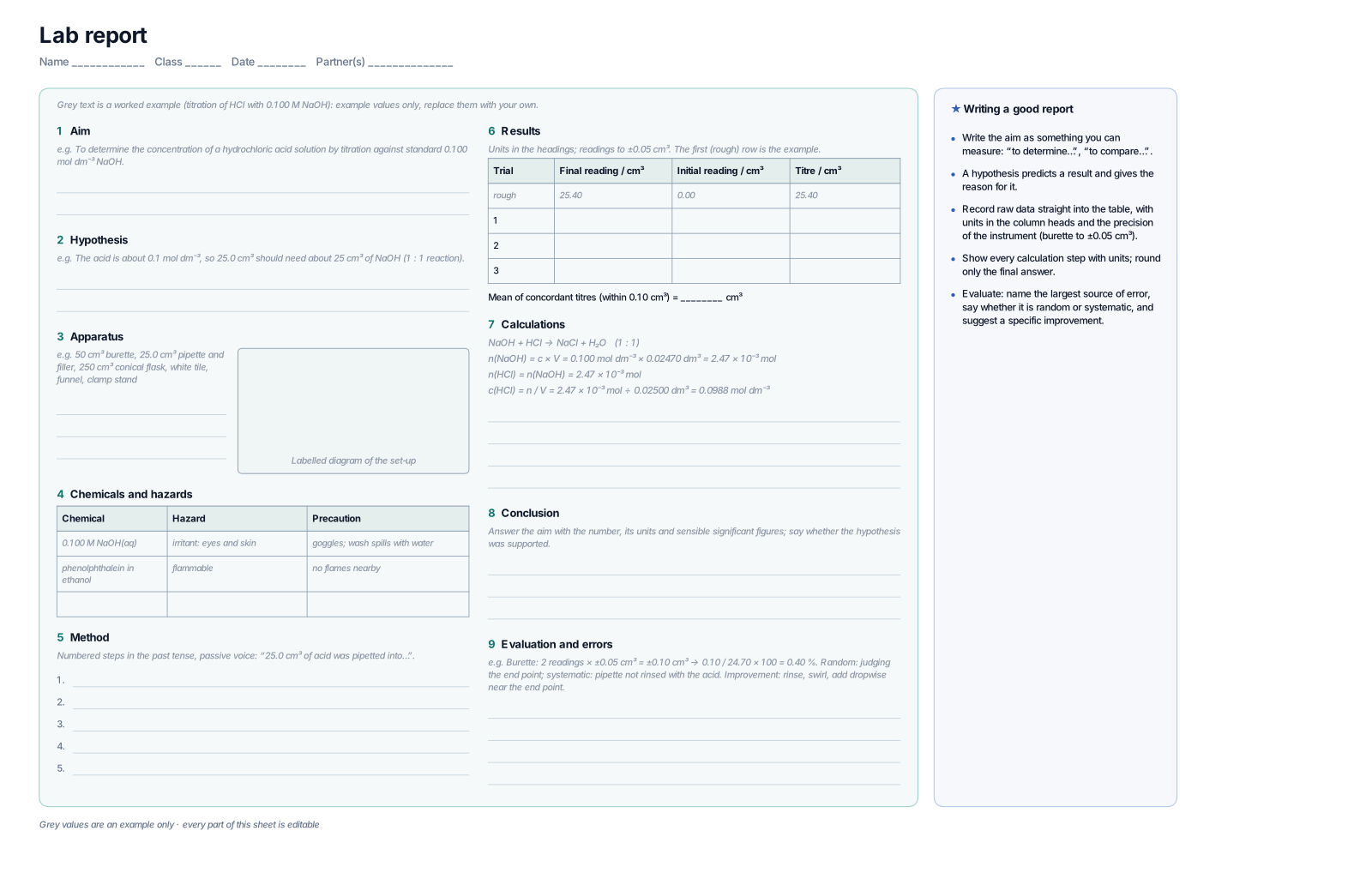
A practical write-up frame: aim, hypothesis, apparatus list and diagram box, chemicals and hazards, method, results table, calculations, conclusion and evaluation, with a titration worked in grey as the example.
What the template shows
- Lab report
- Name ____________ Class ______ Date ________ Partner(s) ______________
- Grey text is a worked example (titration of HCl with 0.100 M NaOH): example values only, replace them with your own.
- e.g. To determine the concentration of a hydrochloric acid solution by titration against standard 0.100 mol dm⁻³ NaOH.
- e.g. The acid is about 0.1 mol dm⁻³, so 25.0 cm³ should need about 25 cm³ of NaOH (1 : 1 reaction).
- e.g. 50 cm³ burette, 25.0 cm³ pipette and filler, 250 cm³ conical flask, white tile, funnel, clamp stand
- Labelled diagram of the set-up
- Chemicals and hazards
- irritant: eyes and skin
- goggles; wash spills with water
- phenolphthalein in ethanol
- no flames nearby
- Numbered steps in the past tense, passive voice: “25.0 cm³ of acid was pipetted into…”.
- Units in the headings; readings to ±0.05 cm³. The first (rough) row is the example.
- Final reading / cm³
- Initial reading / cm³
- Mean of concordant titres (within 0.10 cm³) = ________ cm³
- NaOH + HCl → NaCl + H₂O (1 : 1)
- n(NaOH) = c × V = 0.100 mol dm⁻³ × 0.02470 dm³ = 2.47 × 10⁻³ mol
- n(HCl) = n(NaOH) = 2.47 × 10⁻³ mol
- c(HCl) = n / V = 2.47 × 10⁻³ mol ÷ 0.02500 dm³ = 0.0988 mol dm⁻³
- Answer the aim with the number, its units and sensible significant figures; say whether the hypothesis was supported.
- Evaluation and errors
- e.g. Burette: 2 readings × ±0.05 cm³ = ±0.10 cm³ → 0.10 / 24.70 × 100 = 0.40 %. Random: judging the end point; systematic: pipette not rinsed with the acid. Improvement: rinse, swirl, add dropwise near the end point.
Drawn with 48 shapes – every one editable in MolDraw.
Sources
How to use this template
- Press Edit in MolDraw. The template opens on the canvas of the free MolDraw editor.
- Change anything: move structures, edit atoms and labels, recolour highlights or delete what you do not need.
- Add your own structures, arrows and text next to it, or combine several templates on one page.
- Export the drawing as PNG, SVG or PDF for slides, worksheets, theses and papers.
Frequently asked questions
Is the Lab report template template free?
Yes. The Lab report template template is one of the free MolDraw templates: open it in the editor or download it from this page as SVG or PNG and use it in your slides, worksheets and notes.
Can I edit the Lab report template template?
Yes. It opens as an ordinary MolDraw drawing, so every structure, arrow, label and colour can be changed, and you can add your own content around it.
Is the chemistry checked?
Every structure is checked with RDKit and every curly arrow passes MolDraw’s electron-flow audit. The sources used are listed on this page.
Are the teaching lab sheets printable?
Yes. Open one in MolDraw, add your school or course name and export it as PDF to print.