MolDraw › Educational materials › Chemistry Lab Report Template

Chemistry Lab Report Template

Lab activitiesGrades 9–12 · GCSE / A-level · IB · AP · CBSE15 items · answer key included

This free printable chemistry lab report template walks students through every section of a formal practical write-up: title, aim, hypothesis, apparatus with a labelled diagram, a chemicals and hazards (risk assessment) table, method, a blank observations/results table, calculations, conclusion and an evaluation of errors and improvements. The answer key is a fully worked example lab report for the acid–base titration of sodium hydroxide with hydrochloric acid, so students can see exactly what a strong chemistry lab report looks like before writing their own for any GCSE, A-level, IB, AP or CBSE practical.

Live A4 preview. “Download PDF” opens the print dialog: choose Save as PDF. Click a structure to open it in MolDraw.

Chemistry Lab Report Template

Name Class Date

Part A — Title, aim and hypothesis

State clearly what you are investigating and what you expect to happen, with a scientific reason.

1.
Title
Determining the concentration of a sodium hydroxide solution by titration with standard hydrochloric acid.
2.
Aim — what will you find out or measure?
To find the concentration (in mol dm−3) of a sodium hydroxide solution by titrating 25.00 cm3 portions against 0.100 mol dm−3 HCl using phenolphthalein indicator.
3.
Hypothesis / prediction (include the balanced equation if there is one)
NaOH(aq) + HCl(aq) → NaCl(aq) + H2O(l). The acid and alkali react in a 1 : 1 mole ratio, so at the end point moles of HCl added = moles of NaOH in the flask. The NaOH is expected to be close to 0.1 mol dm−3, so the titre should be about 25 cm3.

Part B — Apparatus and diagram

List all apparatus with sizes/precision, then draw a labelled diagram of the set-up (use a ruler and pencil; label every piece).

4.
Apparatus list
50.00 cm3 burette (±0.05 cm3) with clamp and stand; 25.00 cm3 volumetric pipette (±0.06 cm3) and pipette filler; 250 cm3 conical flasks ×3; small funnel; white tile; 100 cm3 beakers; wash bottle of distilled water; safety goggles.
5.
Labelled diagram of the apparatus

Model diagram: burette clamped vertically above a conical flask standing on a white tile; labels: burette (HCl, 0.100 mol dm−3), tap, clamp and stand, conical flask (25.00 cm3 NaOH + 3 drops phenolphthalein), white tile.
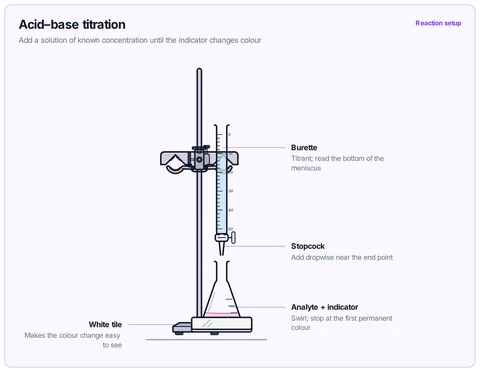
Acid–base titration apparatus: burette clamped above a conical flask on a white tile
Reference: typical titration set-up (burette, clamp stand, conical flask, white tile).

Part C — Chemicals and hazards (risk assessment)

Complete the risk assessment for every chemical used.

6.
Chemical (and concentration)HazardRiskPrecaution / control measure
Hydrochloric acid, 0.100 mol dm⁻³Low hazard at this concentration (may irritate eyes)Splashes into eyes when filling the buretteWear goggles; fill burette below eye level using a funnel; remove funnel before titrating
Sodium hydroxide, ≈0.1 mol dm⁻³IrritantSplashes to eyes/skin when pipettingWear goggles; use a pipette filler, never mouth-pipette; wash skin with water
Phenolphthalein in ethanolHighly flammable solventIgnition near a flameKeep away from Bunsen burners; use only 2–3 drops
GlasswareBroken glassCuts if burette or pipette breaksClamp burette securely; report and sweep up breakages

Part D — Method

Write numbered steps in the order you carried them out. Include volumes, concentrations and how you knew the end point was reached.

7.
Method (numbered steps)
1. Rinse the burette with a little 0.100 mol dm−3 HCl, then fill it using a funnel; remove the funnel and run some acid through so the jet is filled. Record the initial reading.
2. Rinse the pipette with NaOH solution, then use a pipette filler to transfer 25.00 cm3 into a conical flask.
3. Add 3 drops of phenolphthalein (pink in alkali).
4. Place the flask on a white tile and add acid while swirling, dropwise near the end point, until the pink colour just disappears (colourless).
5. Record the final burette reading. The first titration is a rough (trial) run.
6. Repeat accurately until at least two titres are concordant (within 0.10 cm3).

Part E — Results and observations

Record raw data in the table to the precision of the apparatus (burette readings to 2 d.p., ending in 0 or 5). Tick the concordant titres.

8.
RoughRun 1Run 2Run 3
Final reading / cm³24.6024.2524.1024.35
Initial reading / cm³0.000.100.000.20
Titre / cm³24.6024.1524.1024.15
Concordant (✓)✓✓✓
9.
Qualitative observations (colour changes, anything unexpected)
The solution in the flask was pink after adding phenolphthalein; a pink colour that faded on swirling appeared near the end point; at the end point one drop of acid turned the solution colourless. No other changes were seen.

Part F — Calculations and results

Show every step with units. Give the final answer to an appropriate number of significant figures.

10.
Calculations
Mean titre (concordant runs) = (24.15 + 24.10 + 24.15) ÷ 3 = 24.13 cm3
n(HCl) = 0.100 × 24.13/1000 = 2.413 × 10⁻³ mol
Mole ratio HCl : NaOH = 1 : 1, so n(NaOH) = 2.413 × 10⁻³ mol
[NaOH] = 2.413 × 10⁻³ ÷ (25.00/1000) = 0.0965 mol dm−3
11.
Final result (value, units, significant figures)
Concentration of NaOH = 0.0965 mol dm−3 (3 s.f.), equivalent to 0.0965 × 40.00 = 3.86 g dm−3.

Part G — Conclusion and evaluation

Answer the aim, compare with your hypothesis, then evaluate the reliability and accuracy of the experiment.

12.
Conclusion — answer the aim using your data.
The sodium hydroxide solution has a concentration of 0.0965 mol dm−3. This supports the prediction that it is close to 0.1 mol dm−3; the 1 : 1 ratio meant the titre (24.13 cm3) was just under 25 cm3.
13.
Sources of error — name random and systematic errors and their effect on the result.
Random: judging the exact end-point colour change and reading the meniscus (±0.05 cm3 per reading, so ±0.10 cm3 per titre ≈ ±0.4 %). Systematic: burette not rinsed with acid (dilutes HCl → titre too large → [NaOH] too high); air bubble in the burette jet; NaOH absorbs CO2 from air, slightly lowering its concentration. Pipette uncertainty ±0.06/25.00 ≈ ±0.24 %.
14.
Improvements — specific changes that would reduce each error.
Rinse burette and pipette with the solutions they will contain; remove air bubbles before the first reading; read the meniscus at eye level; add acid dropwise near the end point and use a white tile; repeat until three titres agree within 0.10 cm3; keep the NaOH stoppered.

moldraw.com/educational-materials/lab-report-template/

Answer key: Chemistry Lab Report Template

Part A — Title, aim and hypothesis

1.
Determining the concentration of a sodium hydroxide solution by titration with standard hydrochloric acid.
2.
To find the concentration (in mol dm−3) of a sodium hydroxide solution by titrating 25.00 cm3 portions against 0.100 mol dm−3 HCl using phenolphthalein indicator.
3.
NaOH(aq) + HCl(aq) → NaCl(aq) + H2O(l). The acid and alkali react in a 1 : 1 mole ratio, so at the end point moles of HCl added = moles of NaOH in the flask. The NaOH is expected to be close to 0.1 mol dm−3, so the titre should be about 25 cm3.

Part B — Apparatus and diagram

4.
50.00 cm3 burette (±0.05 cm3) with clamp and stand; 25.00 cm3 volumetric pipette (±0.06 cm3) and pipette filler; 250 cm3 conical flasks ×3; small funnel; white tile; 100 cm3 beakers; wash bottle of distilled water; safety goggles.
5.

Model diagram: burette clamped vertically above a conical flask standing on a white tile; labels: burette (HCl, 0.100 mol dm−3), tap, clamp and stand, conical flask (25.00 cm3 NaOH + 3 drops phenolphthalein), white tile.

Part C — Chemicals and hazards (risk assessment)

6.
Chemical (and concentration)HazardRiskPrecaution / control measure
Hydrochloric acid, 0.100 mol dm⁻³Low hazard at this concentration (may irritate eyes)Splashes into eyes when filling the buretteWear goggles; fill burette below eye level using a funnel; remove funnel before titrating
Sodium hydroxide, ≈0.1 mol dm⁻³IrritantSplashes to eyes/skin when pipettingWear goggles; use a pipette filler, never mouth-pipette; wash skin with water
Phenolphthalein in ethanolHighly flammable solventIgnition near a flameKeep away from Bunsen burners; use only 2–3 drops
GlasswareBroken glassCuts if burette or pipette breaksClamp burette securely; report and sweep up breakages

Part D — Method

7.
1. Rinse the burette with a little 0.100 mol dm−3 HCl, then fill it using a funnel; remove the funnel and run some acid through so the jet is filled. Record the initial reading.
2. Rinse the pipette with NaOH solution, then use a pipette filler to transfer 25.00 cm3 into a conical flask.
3. Add 3 drops of phenolphthalein (pink in alkali).
4. Place the flask on a white tile and add acid while swirling, dropwise near the end point, until the pink colour just disappears (colourless).
5. Record the final burette reading. The first titration is a rough (trial) run.
6. Repeat accurately until at least two titres are concordant (within 0.10 cm3).

Part E — Results and observations

8.
RoughRun 1Run 2Run 3
Final reading / cm³24.6024.2524.1024.35
Initial reading / cm³0.000.100.000.20
Titre / cm³24.6024.1524.1024.15
Concordant (✓)✓✓✓
9.
The solution in the flask was pink after adding phenolphthalein; a pink colour that faded on swirling appeared near the end point; at the end point one drop of acid turned the solution colourless. No other changes were seen.

Part F — Calculations and results

10.
Mean titre (concordant runs) = (24.15 + 24.10 + 24.15) ÷ 3 = 24.13 cm3
n(HCl) = 0.100 × 24.13/1000 = 2.413 × 10⁻³ mol
Mole ratio HCl : NaOH = 1 : 1, so n(NaOH) = 2.413 × 10⁻³ mol
[NaOH] = 2.413 × 10⁻³ ÷ (25.00/1000) = 0.0965 mol dm−3
11.
Concentration of NaOH = 0.0965 mol dm−3 (3 s.f.), equivalent to 0.0965 × 40.00 = 3.86 g dm−3.

Part G — Conclusion and evaluation

12.
The sodium hydroxide solution has a concentration of 0.0965 mol dm−3. This supports the prediction that it is close to 0.1 mol dm−3; the 1 : 1 ratio meant the titre (24.13 cm3) was just under 25 cm3.
13.
Random: judging the exact end-point colour change and reading the meniscus (±0.05 cm3 per reading, so ±0.10 cm3 per titre ≈ ±0.4 %). Systematic: burette not rinsed with acid (dilutes HCl → titre too large → [NaOH] too high); air bubble in the burette jet; NaOH absorbs CO2 from air, slightly lowering its concentration. Pipette uncertainty ±0.06/25.00 ≈ ±0.24 %.
14.
Rinse burette and pipette with the solutions they will contain; remove air bubbles before the first reading; read the meniscus at eye level; add acid dropwise near the end point and use a white tile; repeat until three titres agree within 0.10 cm3; keep the NaOH stoppered.

How to use this worksheet

  1. Hand out the blank template before any required practical so students plan the aim, hypothesis and risk assessment before touching apparatus.
  2. Print the answer key (worked NaOH/HCl titration report) as a model answer, or project it and annotate what makes each section strong.
  3. Edit the section headings in the live preview to match your exam board's practical endorsement or CPAC criteria.
  4. Use the evaluation section as a plenary: students must name one random and one systematic error with a specific improvement.
  5. Set the title, student lines and answer option on the left, then press Download PDF and choose “Save as PDF” (or print directly). Your choices are remembered on this device.

Draw and edit structures in MolDraw. Make your own questions: draw any molecule, then export it as PNG or SVG for your worksheets.

Draw and edit structures in MolDraw

Frequently asked questions

What sections should a chemistry lab report include?

A standard chemistry lab report has a title, aim, hypothesis, apparatus (with a labelled diagram), chemicals and hazards, method, results/observations, calculations, conclusion and evaluation (sources of error and improvements). This template includes all of them in that order.

Is there a completed lab report example?

Yes. The answer key is a fully filled-in example for the titration of 25.00 cm³ of sodium hydroxide with 0.100 mol dm⁻³ hydrochloric acid, including concordant titres, mean titre, a worked concentration calculation and an evaluation.

How do I write the evaluation section of a lab report?

Identify specific sources of error (random and systematic), say how each affected the result (too high or too low), estimate measurement uncertainties, and suggest a concrete improvement for each, such as using a white tile or reading the burette at eye level.

Can I use this template for practicals other than titration?

Yes. The blank template is generic and works for rates of reaction, enthalpy, chromatography, salt preparation or any other practical; only the worked example in the answer key is a titration.

Related worksheets