MolDraw › Templates › Spectroscopy › Spin–spin splitting: the n + 1 rule
SpectroscopyFree
Spin–spin splitting: the n + 1 rule template
Free template. Download it, or open it in MolDraw to change it first.
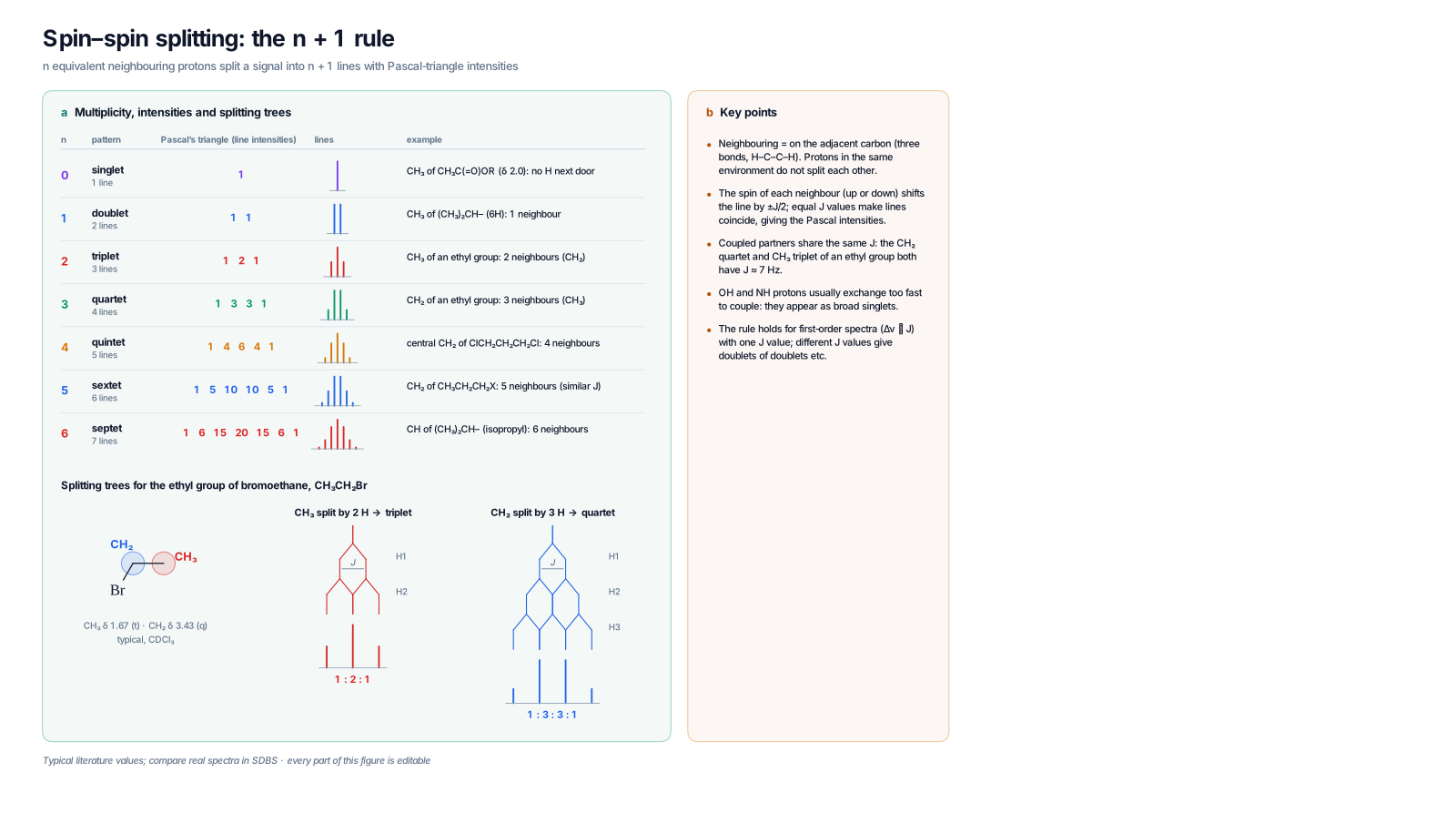
Singlet to septet with Pascal's triangle intensity ratios (1:1, 1:2:1, 1:3:3:1 … 1:6:15:20:15:6:1), stick multiplets, examples, and splitting trees for a triplet and a quartet, beside the ethyl group of bromoethane.
What the template shows
- n equivalent neighbouring protons split a signal into n + 1 lines with Pascal-triangle intensities
- Multiplicity, intensities and splitting trees
- Pascal's triangle (line intensities)
- CH₃ of CH₃C(=O)OR (δ 2.0): no H next door
- CH₃ of an ethyl group: 2 neighbours (CH₂)
- CH₂ of an ethyl group: 3 neighbours (CH₃)
- central CH₂ of ClCH₂CH₂CH₂Cl: 4 neighbours
- CH₂ of CH₃CH₂CH₂X: 5 neighbours (similar J)
- CH of (CH₃)₂CH– (isopropyl): 6 neighbours
- Splitting trees for the ethyl group of bromoethane, CH₃CH₂Br
- typical, CDCl₃
- CH₃ split by 2 H → triplet
- CH₂ split by 3 H → quartet
- Neighbouring = on the adjacent carbon (three bonds, H–C–C–H). Protons in the same environment do not split each other.
- The spin of each neighbour (up or down) shifts the line by ±J/2; equal J values make lines coincide, giving the Pascal intensities.
- Coupled partners share the same J: the CH₂ quartet and CH₃ triplet of an ethyl group both have J ≈ 7 Hz.
- OH and NH protons usually exchange too fast to couple: they appear as broad singlets.
- The rule holds for first-order spectra (Δν ≫ J) with one J value; different J values give doublets of doublets etc.
- Typical literature values; compare real spectra in SDBS · every part of this figure is editable
Drawn with 3 atoms, 95 shapes – every one editable in MolDraw.
Sources
How to use this template
- Press Edit in MolDraw. The template opens on the canvas of the free MolDraw editor.
- Change anything: move structures, edit atoms and labels, recolour highlights or delete what you do not need.
- Add your own structures, arrows and text next to it, or combine several templates on one page.
- Export the drawing as PNG, SVG or PDF for slides, worksheets, theses and papers.
Frequently asked questions
Is the Spin–spin splitting: the n + 1 rule template free?
Yes. The Spin–spin splitting: the n + 1 rule template is one of the free MolDraw templates: open it in the editor or download it from this page as SVG or PNG and use it in your slides, worksheets and notes.
Can I edit the Spin–spin splitting: the n + 1 rule template?
Yes. It opens as an ordinary MolDraw drawing, so every structure, arrow, label and colour can be changed, and you can add your own content around it.
Is the chemistry checked?
Every structure is checked with RDKit and every curly arrow passes MolDraw’s electron-flow audit. The sources used are listed on this page.
Are the spectra real data?
The spectra are schematic, drawn to the standard chemical shifts, splitting patterns and absorptions given in textbooks, so they are clear for teaching and exam practice.