MolDraw › 3D molecule models › Urea structure
Urea structure and 3D model (CH4N2O)
Urea is a carbonyl group joined to two NH₂ groups. It is the main way mammals get rid of excess nitrogen.
Drag to rotate · pinch or scroll to zoom. 3D coordinates: computed with RDKit (ETKDG conformer, force-field optimised).
Urea at a glance
| Formula | CH4N2O |
|---|---|
| Molar mass | 60.06 g/mol |
| IUPAC name | urea |
| Atoms / bonds | 8 / 7 |
| H-bond donors / acceptors | 2 / 1 |
| logP (estimated) | -1.0 |
| SMILES | C(=O)(N)N |
| InChIKey | XSQUKJJJFZCRTK-UHFFFAOYSA-N |
| PubChem | 1176 |
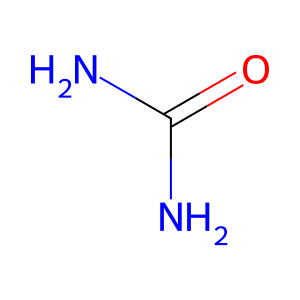
What the 3D model of Urea shows
The model contains 8 atoms (4 heavy atoms and 4 hydrogens) joined by 7 bonds; in ball-and-stick mode every stick is one bond, and double or aromatic bonds are drawn as multiple sticks. Switch to space-filling to see the molecule as its electron cloud, scaled to van der Waals radii: this is the shape other molecules actually "feel". It can donate 2 and accept 1 hydrogen bonds, and its estimated logP of -1.0 means it is very water-loving (hydrophilic). Its topological polar surface area is 69 Ų.
Shape and bond angles
| Atom(s) | Geometry / hybridisation | Angles & lengths |
|---|---|---|
| carbon | Trigonal planar, sp² | ≈ 120° (N–C–N about 117°) |
| nitrogens | Near-planar, conjugated with C=O | ≈ 120° |
Is Urea polar?
Yes, very. The C=O and four N–H bonds make strong hydrogen bonds, and more than 1 kg dissolves in 1 L of water.
Elemental composition of CH4N2O
| Element | Atoms | Mass (g/mol) | Mass % |
|---|---|---|---|
| Carbon (C) | 1 | 12.011 | 20.00% |
| Hydrogen (H) | 4 | 4.032 | 6.71% |
| Nitrogen (N) | 2 | 28.014 | 46.65% |
| Oxygen (O) | 1 | 15.999 | 26.64% |
Calculated from IUPAC standard atomic weights. Check any formula with the molar mass calculator.
Uses of urea
- The world's most widely used nitrogen fertiliser
- Raw material for urea-formaldehyde resins and glues
- Used in diesel exhaust fluid (AdBlue) to cut NOx emissions
Interesting facts
- Friedrich Wöhler made urea from ammonium cyanate in 1828, showing an organic compound could come from inorganic starting materials.
- The body makes urea in the liver through the urea cycle.
- Dissolving urea in water absorbs heat, which is why it is used in some instant cold packs.
Drawing structures for your notes? MolDraw is a free online chemical structure editor for molecules, reactions and lab diagrams.
Open MolDraw editorFrequently asked questions
What is the structure of Urea?
Urea is a carbonyl group joined to two NH₂ groups. It is the main way mammals get rid of excess nitrogen. Its SMILES is C(=O)(N)N.
Why is urea so soluble in water?
It is small and has one C=O and four N–H groups, so it fits easily into water's hydrogen-bond network.
Is urea organic or inorganic?
It is classed as organic. Wöhler's synthesis of it from an inorganic salt helped end the idea that organic compounds needed a living 'vital force'.
What is the chemical formula and molar mass of Urea?
Urea is CH4N2O with a molar mass of 60.06 g/mol. It contains 8 atoms: 1 carbon, 4 hydrogen, 2 nitrogen, 1 oxygen.
What is the IUPAC name of Urea?
The IUPAC name is urea.
How do I draw Urea?
Open the MolDraw editor, paste the SMILES C(=O)(N)N or type "Urea" in name search, and the structure is drawn for you. You can then export it as PNG, SVG, MOL or CDXML.