MolDraw › 3D molecule models › Ibuprofen structure
Ibuprofen structure and 3D model (C13H18O2)
Ibuprofen is a benzene ring with an isobutyl group at one end and a propanoic acid group at the other (para). The carbon next to the COOH is a stereocentre, and the drug is sold as a 50:50 mix of both mirror images.
Drag to rotate · pinch or scroll to zoom. 3D coordinates: computed with RDKit (ETKDG conformer, force-field optimised).
Ibuprofen at a glance
| Formula | C13H18O2 |
|---|---|
| Molar mass | 206.28 g/mol |
| IUPAC name | 2-[4-(2-methylpropyl)phenyl]propanoic acid |
| Atoms / bonds | 33 / 33 |
| H-bond donors / acceptors | 1 / 1 |
| logP (estimated) | 3.1 |
| SMILES | CC(C)CC1=CC=C(C=C1)C(C)C(=O)O |
| InChIKey | HEFNNWSXXWATRW-UHFFFAOYSA-N |
| PubChem | 3672 |
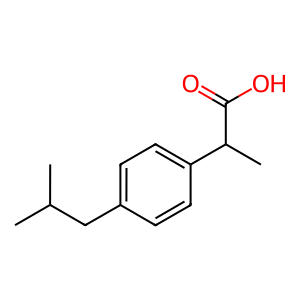
What the 3D model of Ibuprofen shows
The model contains 33 atoms (15 heavy atoms and 18 hydrogens) joined by 33 bonds; in ball-and-stick mode every stick is one bond, and double or aromatic bonds are drawn as multiple sticks. Switch to space-filling to see the molecule as its electron cloud, scaled to van der Waals radii: this is the shape other molecules actually "feel". It can donate 1 and accept 1 hydrogen bonds, and its estimated logP of 3.1 means it is fat-loving (lipophilic). Its topological polar surface area is 37 Ų.
Shape and bond angles
| Atom(s) | Geometry / hybridisation | Angles & lengths |
|---|---|---|
| ring carbons | Trigonal planar, sp²; planar ring | 120° |
| carboxylic acid carbon | Trigonal planar, sp² | ≈ 120° |
| CH, CH₂ and CH₃ carbons of the side chains | Tetrahedral, sp³ | ≈ 109.5° |
Is Ibuprofen polar?
Only slightly. The COOH group is polar, but the large hydrocarbon part makes ibuprofen dissolve much better in oils and ethanol than in water.
Elemental composition of C13H18O2
| Element | Atoms | Mass (g/mol) | Mass % |
|---|---|---|---|
| Carbon (C) | 13 | 156.143 | 75.69% |
| Hydrogen (H) | 18 | 18.144 | 8.80% |
| Oxygen (O) | 2 | 31.998 | 15.51% |
Calculated from IUPAC standard atomic weights. Check any formula with the molar mass calculator.
Uses of ibuprofen
- Pain relief, fever and inflammation (NSAID)
- Common over-the-counter medicine for headaches and muscle pain
- Model compound for teaching chirality in drugs
Interesting facts
- Ibuprofen was developed by Boots in the UK in the 1960s.
- Only the (S) enantiomer blocks the COX enzymes well, but the body converts much of the (R) form into (S).
- Its name comes from parts of iso-butyl-propanoic-phenolic acid.
Drawing structures for your notes? MolDraw is a free online chemical structure editor for molecules, reactions and lab diagrams.
Open MolDraw editorFrequently asked questions
What is the structure of Ibuprofen?
Ibuprofen is a benzene ring with an isobutyl group at one end and a propanoic acid group at the other (para). The carbon next to the COOH is a stereocentre, and the drug is sold as a 50:50 mix of both mirror images. Its SMILES is CC(C)CC1=CC=C(C=C1)C(C)C(=O)O.
Is ibuprofen an acid?
Yes. It is a weak carboxylic acid with a pKa of about 4.4, so it is mostly ionised in neutral water.
Is ibuprofen chiral?
Yes. It has one stereocentre, next to the COOH group. Ibuprofen is normally sold as the racemate, a 50:50 mix of (R) and (S).
What is the chemical formula and molar mass of Ibuprofen?
Ibuprofen is C13H18O2 with a molar mass of 206.28 g/mol. It contains 33 atoms: 13 carbon, 18 hydrogen, 2 oxygen.
What is the IUPAC name of Ibuprofen?
The IUPAC name is 2-[4-(2-methylpropyl)phenyl]propanoic acid.
How do I draw Ibuprofen?
Open the MolDraw editor, paste the SMILES CC(C)CC1=CC=C(C=C1)C(C)C(=O)O or type "Ibuprofen" in name search, and the structure is drawn for you. You can then export it as PNG, SVG, MOL or CDXML.