MolDraw › 3D molecule models › Morphine structure
Morphine structure and 3D model (C17H19NO3)
Morphine is an opium alkaloid with five fused rings that fold into a rigid T shape. It has a phenol OH, an alcohol OH, an ether bridge and a basic tertiary amine.
Drag to rotate · pinch or scroll to zoom. 3D coordinates: computed with RDKit (ETKDG conformer, force-field optimised).
Morphine at a glance
| Formula | C17H19NO3 |
|---|---|
| Molar mass | 285.34 g/mol |
| IUPAC name | (4R,4aR,7S,7aR,12bS)-3-methyl-2,4,4a,7,7a,13-hexahydro-1H-4,12-methanobenzofuro[3,2-e]isoquinoline-7,9-diol |
| Atoms / bonds | 40 / 44 |
| H-bond donors / acceptors | 2 / 4 |
| logP (estimated) | 1.2 |
| SMILES | CN1CC[C@]23[C@@H]4[C@H]1CC5=C2C(=C(C=C5)O)O[C@H]3[C@H](C=C4)O |
| InChIKey | BQJCRHHNABKAKU-KBQPJGBKSA-N |
| PubChem | 5288826 |
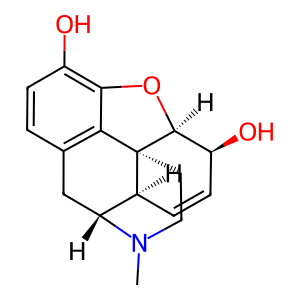
What the 3D model of Morphine shows
The model contains 40 atoms (21 heavy atoms and 19 hydrogens) joined by 44 bonds; in ball-and-stick mode every stick is one bond, and double or aromatic bonds are drawn as multiple sticks. Switch to space-filling to see the molecule as its electron cloud, scaled to van der Waals radii: this is the shape other molecules actually "feel". It can donate 2 and accept 4 hydrogen bonds, and its estimated logP of 1.2 means it is fairly balanced between water and fat. Its topological polar surface area is 53 Ų.
Shape and bond angles
| Atom(s) | Geometry / hybridisation | Angles & lengths |
|---|---|---|
| aromatic ring carbons | Trigonal planar, sp²; planar ring | 120° |
| ring-fusion and CH–OH carbons | Tetrahedral, sp³ | ≈ 109.5° |
| amine N | Trigonal pyramidal, sp³ | ≈ 109° |
| alkene C=C in the ring | Trigonal planar, sp² | ≈ 120° |
Is Morphine polar?
Yes. Two OH groups, an ether oxygen and an amine make it polar, although the free base is only slightly soluble in water. Medical forms are salts such as morphine sulfate.
Elemental composition of C17H19NO3
| Element | Atoms | Mass (g/mol) | Mass % |
|---|---|---|---|
| Carbon (C) | 17 | 204.187 | 71.56% |
| Hydrogen (H) | 19 | 19.152 | 6.71% |
| Nitrogen (N) | 1 | 14.007 | 4.91% |
| Oxygen (O) | 3 | 47.997 | 16.82% |
Calculated from IUPAC standard atomic weights. Check any formula with the molar mass calculator.
Uses of morphine
- Strong painkiller (opioid) used in hospitals
- Reference compound for comparing other opioids
- Starting material for making codeine and other opioids
Interesting facts
- Morphine was isolated from opium by Friedrich Sertürner in the early 1800s, one of the first alkaloids ever purified.
- It is named after Morpheus, the Greek god of dreams.
- Its structure was solved by Robert Robinson in 1925 and first synthesised by Marshall Gates in 1952.
Drawing structures for your notes? MolDraw is a free online chemical structure editor for molecules, reactions and lab diagrams.
Open MolDraw editorFrequently asked questions
What is the structure of Morphine?
Morphine is an opium alkaloid with five fused rings that fold into a rigid T shape. It has a phenol OH, an alcohol OH, an ether bridge and a basic tertiary amine. Its SMILES is CN1CC[C@]23[C@@H]4[C@H]1CC5=C2C(=C(C=C5)O)O[C@H]3[C@H](C=C4)O.
How many stereocentres does morphine have?
Five. Natural morphine is a single stereoisomer with the configuration 5R,6S,9R,13S,14R (morphinan numbering).
What is the difference between morphine and codeine?
Codeine is morphine with the phenol OH converted to a methyl ether (OCH₃). The body converts some codeine back into morphine.
What is the chemical formula and molar mass of Morphine?
Morphine is C17H19NO3 with a molar mass of 285.34 g/mol. It contains 40 atoms: 17 carbon, 19 hydrogen, 1 nitrogen, 3 oxygen.
What is the IUPAC name of Morphine?
The IUPAC name is (4R,4aR,7S,7aR,12bS)-3-methyl-2,4,4a,7,7a,13-hexahydro-1H-4,12-methanobenzofuro[3,2-e]isoquinoline-7,9-diol.
How do I draw Morphine?
Open the MolDraw editor, paste the SMILES CN1CC[C@]23[C@@H]4[C@H]1CC5=C2C(=C(C=C5)O)O[C@H]3[C@H](C=C4)O or type "Morphine" in name search, and the structure is drawn for you. You can then export it as PNG, SVG, MOL or CDXML.